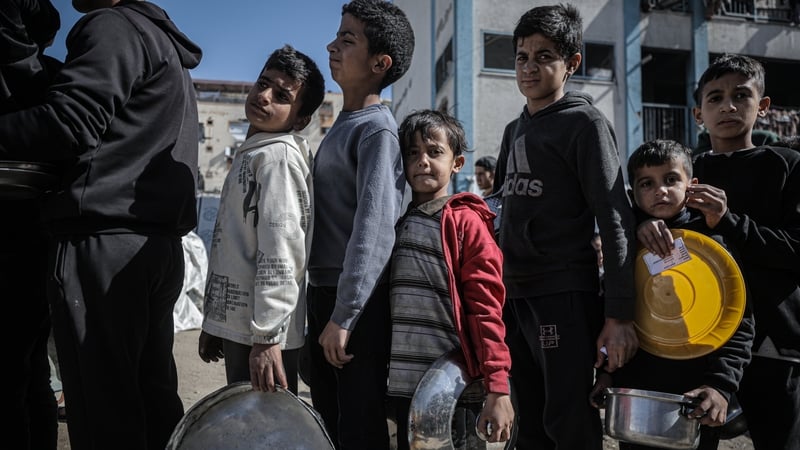

It's been four months since a ceasefire was declared in Gaza.
"Together we've achieved what everybody said was impossible," US President Donald Trump said on 13 October, "at long last we have peace in the Middle East".
"After years of suffering and bloodshed, the war in Gaza is over," he added.
But since then, hundreds of people have been killed and injured.
"People believe there is ceasefire," Ajith Sunghay, Head of the UN's Human Rights Office in the Occupied Palestinian Territory told RTÉ News "that things are normal, people are not dying".
"That's not the case," he said.
In the West Bank, meanwhile, settler violence has intensified as has the displacement of Palestinians.
We need your consent to load this rte-player contentWe use rte-player to manage extra content that can set cookies on your device and collect data about your activity. Please review their details and accept them to load the content.Manage Preferences
Last weekend, the Israeli government announced plans to expand control over Palestinian territory in what Palestinian officials called "de facto annexation".
"We need to watch West Bank because it's at boiling point," Mr Sunghay added, speaking to RTÉ News from Jordan, "and it's not getting enough attention".
According to UN estimates, more than 570 Gazans have been killed and 1,500 injured since the October ceasefire. At least 108 of the Palestinians killed were children and at least 67 were women.
Some of the killings took place in the vicinity of the "yellow line", the demarcation to where Israel agreed to withdraw troops, under the initial terms of the ceasefire. Others occurred much deeper into the enclave.
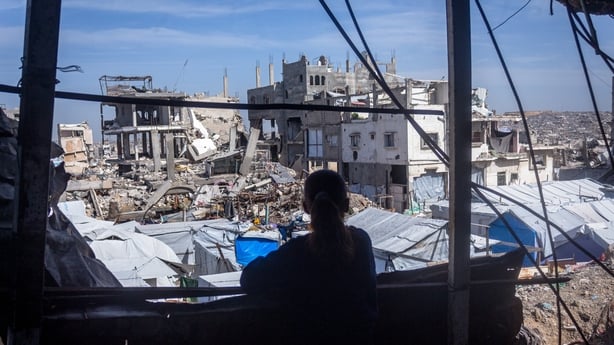
"In Gaza, the Office for the Coordination of Humanitarian Affairs has received more reports of airstrikes, bombing, shelling, navy fire, and shooting in the last 24 hours," a spokesman for the UN Secretary General told reporters on Tuesday.
"This includes strikes in residential areas, which put civilians in danger and adds to the immense hardship they have endured over the last 28 months," he said.
On Tuesday, two Palestinians on bicycles were killed in an Israeli drone strike. In addition to fresh attacks, some of the deaths and injuries were attributed to bombs previously dropped on Gaza during the two-year bombardment.
Some 33 explosive ordnance incidents have been reported since the ceasefire came into effect, resulting in nine deaths and 65 injuries, according to the UN.
In a statement to RTÉ News, the Israeli Defence Forces (IDF) said strikes carried out since the ceasefire were "solely against terrorist targets". The statement said the IDF employed "all possible operational measures to mitigate harm to civilians".
'Meaningless' ceasefire - Hamas
Citing Israeli attacks, Hamas called the ceasefire "meaningless".
The UN also recorded at least 80 reported killings of Palestinians by Hamas since the ceasefire declaration, mostly in clashes with rival families and in summary executions.
Last month UN Secretary General Antonio Guterres told a news conference in New York that the situation in Gaza was a "lesser fire", rather than a ceasefire.
Phase 1 of the deal also provided for a surge in humanitarian aid into the enclave. But UN agencies described the humanitarian situation for civilians as "hanging by a thread", with insufficient food, water and medicine reaching those in need, as winter worsened conditions.
The opening this month of the Rafah Crossing between Gaza and Egypt, as part of the ceasefire deal, saw a number of medical evacuations and family reunions. But it did little to improve the humanitarian picture inside the territory, according to UN agencies on the ground.
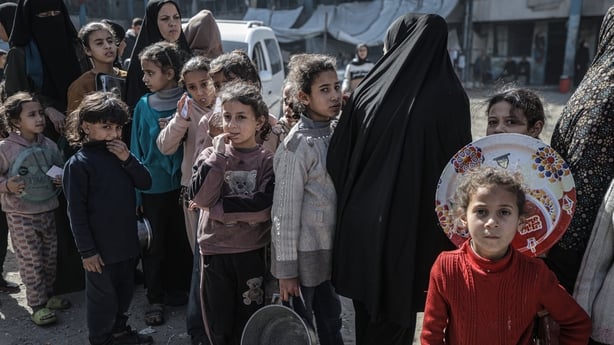
Despite the ongoing violence, Phase 2 of the US-brokered peace plan is officially underway.
This phase stipulated the disarmament of Hamas, the deployment of an international stabilisation force and reconstruction of Gaza.
But according to some Israeli press reports, the army was preparing a new military offensive on Gaza to disarm Hamas by force.
Hamas has so far refused to disarm and continues to carry out attacks on rival militants.
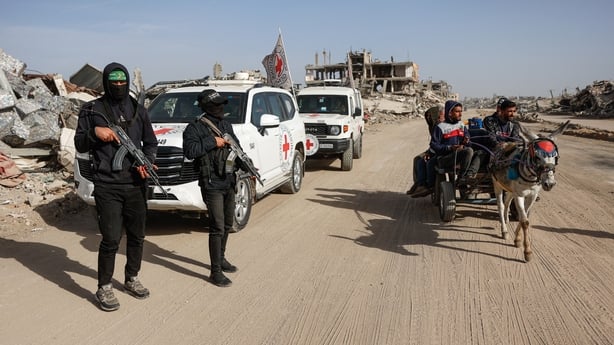
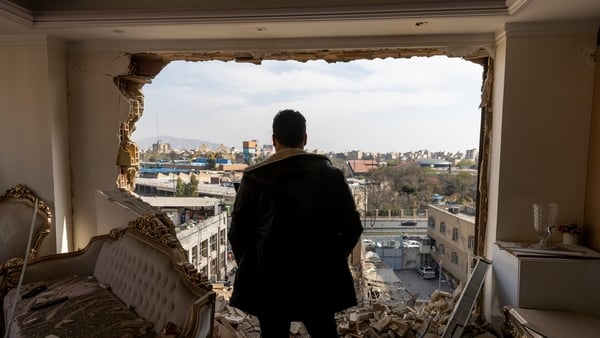
Most of Gaza was reduced to rubble over the past two years with an estimated 80% of buildings destroyed.
But last month, US President Donald Trump's son-in-law Jared Kushner took to the stage at Davos to unveil a master plan for "New Gaza" and make the case for investment in the enclave.
His appearance formed part of the US administration’s official launch of the "Board of Peace" - a body endorsed by the UN Security Council, originally designed to oversee the transitional phase of post-war Gaza, but which has since ballooned into an international peacebuilding organisation, with President Trump chairman, likely for life.
Displaying a map of Gaza on screen, Mr Kushner talked attendees through what he described as "amazing investment opportunities".
"I know it's a little risky to be investing in a place like this, but we need you to come," he said, "take faith, invest in the people, try to be a part of it".
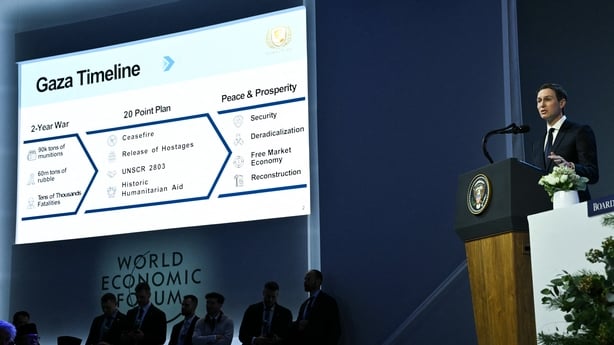
Analysts questioned whether the Board of Peace was "engineered for effective governance".
"Beneath the heads of state who make up the board sit an executive board dominated by people from the US, a more multinational Gaza executive board and a Palestinian technical committee for administering Gaza," wrote Max Rodenbeck and Michael Hanna in a report for the International Crisis Group, a New York-based think tank.
Responsibilities were not clearly delineated, they wrote.
As for the international stabilisation force, it remained "unclear who will send troops, who will pay them or what exactly their mandate will be", they wrote.
Indonesia was the first country to make a firm commitment of 8000 troops to the force, with UAE, Egypt, Turkey, Qatar, Azerbaijan, Pakistan said to be considering deployment.
"It remains to be seen whether this cumbersome mechanism will be capable of cutting through the bundle of interlocking interests and human passions in Gaza," the authors wrote.
Two-state solution
While most UN member states remain committed to a two-state solution for Israel and Palestine, Israeli officials have repeatedly vowed to prevent it.
Last weekend, the Israeli government announced a package of measures to expand administrative control over Palestinian land in the West Bank in apparent contravention of the 1995 Oslo II Accord.
New rules on property ownership paved the way for further settlement expansion, deemed illegal under international law.
The measures drew condemnation from Arab states, the EU, Canada and the United Nations.
But Israel's far right finance minister and settler Bezalel Smotrich said in a statement: "We will continue to bury the idea of a Palestinian state."
Ajith Sunghay of the UN Human Rights Office, said the international community was failing to pay attention to developments in the Occupied Palestinian Territory.
"We have repeatedly said this: Actions are not being taken by member states - there have been so many red flags that we have raised, so many alerts," he said.
"But violations continue to happen every day," he added.