
Given much of the commentary around Brazilian beef imports into Ireland and the wider EU in recent times, people could be easily forgiven for thinking that any company buying in meat from the South American country to sell here is breaking the law or has done something they shouldn't.
In addition, with the debate here in Ireland around the EU-Mercosur trade deal largely centering on the potential for cheap Brazilian beef to flood the EU market, there's a fair bit of confusion around how much, if any, South American meat is sold and consumed here.
While some groups - notably Irish farmers - are strongly opposed to Brazilian beef imports in particular, it's important to note a certain amount of the product is still consumed in the EU already.
Here, our Agriculture and Consumer Affairs Correspondent Aengus Cox looks at what consumers might want to know...
How much Brazilian beef is sold into the Irish market?
Not a lot of Brazilian beef is consumed here.
The main reason for this is that as a country we produce a lot more beef than we consume.
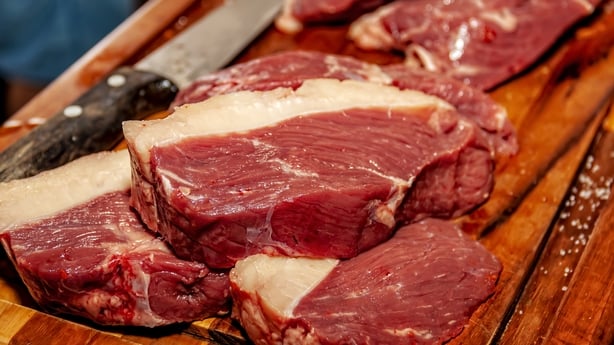
Ireland's self-sufficiency rate for beef was an eye-catching 701% in 2024 (that means we produce seven times the amount of beef we eat).
So, it's no surprise then that we export the vast majority of our beef. Of the circa 600,000 tonnes produced in 2024, around 90% of it was sold to other countries.
2024 is the most recent year for which we have official figures on this, although the 2025 numbers are not expected to be vastly different.
Whereas last year Ireland imported just over 400 tonnes of beef from South America - little more than 0.6% of what we produce ourselves.
Of those 400 tonnes just 145 tonnes came from Brazil, with the majority coming from Argentina (257 tonnes).
How do I know what country any beef I eat comes from?
If you buy beef in a supermarket or shop it should be fairly straightforward, as food-labelling requirements mean the country of origin of the animal and where it was slaughtered must be clearly displayed.
Cafés, restaurants, delis, etc. are also required to clearly indicate the country of origin at the point of sale.
For example, this can be done by placing details on a menu or placing a sign on a counter.
However, sometimes such information can be a little tricker to locate than a food label on a packet of meat.
Is there any potential food-safety risk from consuming Brazilian beef?
In theory there shouldn't be. Any food products imported into the EU are subject to the same regulations as food produced inside the single market.
But in practice it doesn't always work out that way, and sometimes food-safety issues are identified in imported products following surveillance and testing.
Only last December the European Commission recalled consignments of frozen Brazilian beef products imported into the EU, after it was found they contained hormones banned in the bloc.
Authorities in a number of countries - including Germany and Italy - removed affected products from sale and issued recalls.
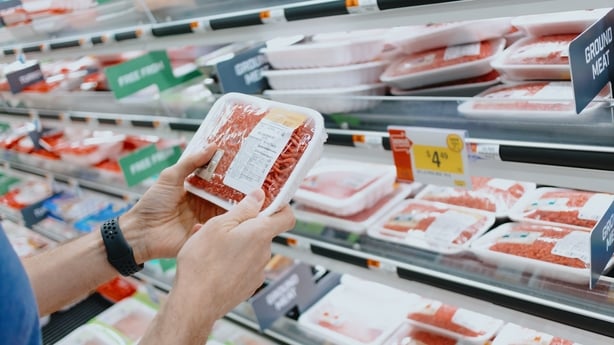
While last month it was confirmed that Brazilian beef containing banned hormones entered the Irish food chain.
The Department of Agriculture was notified by the Food Safety Authority of Ireland that 128kg of the implicated beef, which was the subject of a recall, was distributed to three food business operators here.
The beef - from animals treated with oestradiol, a growth-promoting hormone banned in the EU - was part of consignments sent to Northern Ireland where a food business operator distributed the beef to the three operators in the Republic in September.
Traceability in this area is strong though, and the affected beef was found and removed from the Irish market.
Would there be much more Brazilian beef in Ireland and the EU if the Mercosur trade agreement goes ahead?
There would most likely be an increase in the level of Brazilian beef being imported here, but how significant it would be is unclear.
At the moment, any South American country beef coming into the EU is subject to significant tariffs of up to 45%.
It is perfectly legal to sell these products here, but the tariff essentially prices Brazilian beef out of the market in terms of mass sales.
Though, with Irish beef prices jumping in the last couple of years, Brazilian beef has gradually become more competitive - even with the high tariffs.
However, if the Mercosur deal comes into effect, South American countries included would be allowed to sell 99,000 tonnes of beef into the EU at a much-reduced tariff rate of 7.5%.
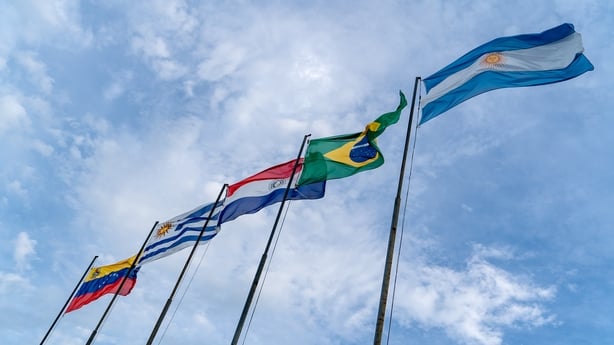
99,000 might sound like a lot, but it would comprise just 1.5% of the total amount consumed across the 27 EU countries.
The European Commission has also made clear that any Mercosur meat entering the EU would have to adhere to our regulations and safety standards and says extensive surveillance and testing of shipments would take place.
This would be a crucial element, because Brazil's reputation for beef production is further under the microscope after a recent investigation from the Irish Farmers Journal - which claimed to have been able to buy animal antibiotics in Brazil without prescriptions, and hormones banned in the EU.
Farmers here aren't reassured by Brussels yet and claim they could be undercut by beef that's produced much cheaper because it's not made by abiding by the same food-safety and environmental standards as producers in the EU.
But the Commission has also promised safeguards for farmers, including a review of the agreement being triggered in the event of Mercosur beef imports leading to a sharp drop in prices and the option to increase tariffs and even limit the levels of beef coming from South America.
What about other meat products coming from South America?
Mercosur would also likely see a jump in poultry imports into the EU, with an allowance for 180,000 tonnes from South America at a much-reduced tariff.
However, Ireland produces nowhere near as much poultry as it does beef, with our poultry self-sufficiency rate in 2024 standing at 72%.
This means we don't produce enough chicken, turkey, etc. to meet consumption and are reliant on imports to some degree.
Like with beef, poultry farmers in Ireland - despite EU reassurances - fear they'll have to compete with South American chicken that costs less to produce due to different standards in place.
Read more: The Mercosur trade deal: all you need to know
They'll also point to food-safety concerns in this regard and the detection last year of chlorine in a number of batches of chicken imported into the single market from Brazil.
From a consumer perspective, that's unsettling to read but it's also worth noting that it's a positive that testing and surveillance is picking up on such incidents.
And that's before Mercosur is in effect, and the fate of the deal is still far from certain with the agreement having recently been referred to the courts.
The European Parliament will also have to vote to approve it at some point.
In the meantime, food labelling is the best guide to be sure of what you're consuming and where it's coming from.