
A sweeping purge of China's senior generals is raising questions about the country’s internal volatility as well as fears of a military miscalculation.
It comes during a stream of visits by Western leaders - including Ireland - to deepen ties with Beijing as relations with Washington sour, in a pivot which one analyst described as "strategically myopic".
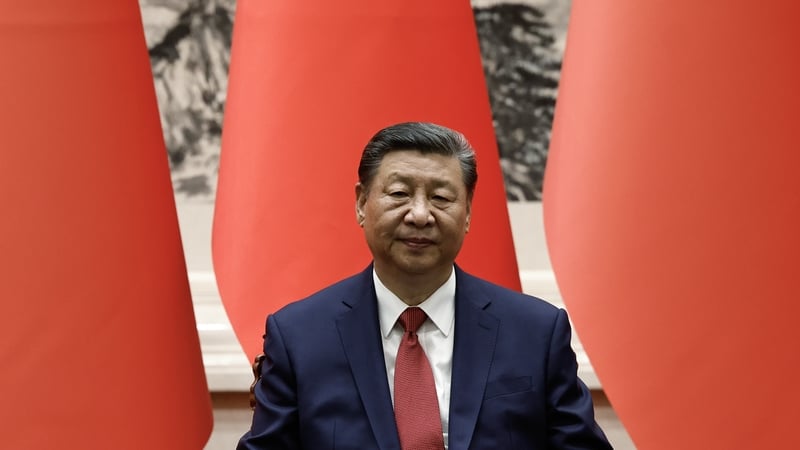
For Wen-Ti Sung, senior fellow at the think tank Atlantic Council, the dismissal of vice chairman of the Chinese Military Commission (CMC) Zhang Youxia and General Liu Zhenli for "violations of discipline and law" indicates further concentration of power in the hands of Chinese leader Xi Jinping.
"Xi has no rivals that can or dare challenge him either inside the party or in the military," he told RTÉ News.
But that also means the Chinese leader "trusts no one and has (almost) no one to trust", he said.
The CMC is China’s supreme military command, which oversees the army, navy, air force, nuclear arsenal, police and militia.
Xi Jinping sits atop as chairman.
This latest purge means the command’s original seven members have been whittled down to just two: Xi Jinping and the Disciplinary Chief Zhang Shengmin, who surely can’t be feeling too comfortable at the moment.
This isn’t new, of course.
President Xi has carried out extensive purges throughout his 13-year-rule.
Early on, he identified rampant corruption as a threat to the party’s legitimacy.
He launched the 'Tigers and Flies' campaign to target both high ranking officials and low-level cadres accused of enriching themselves during China’s boom years.
Mr Xi’s drive to root out graft also served the twin purpose of neutralising any opposition to his growing power.
Millions of Chinese officials were investigated and punished, with the People’s Liberation Army (PLA) seen as a stubborn hotbed of corruption.
"Ranks and promotions were routinely up for sale and bribery was rampant," a report from the Berlin-based China think tank MERICS found last year.
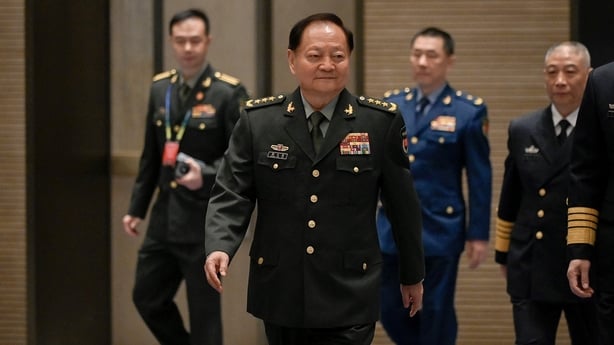
Ongoing purges suggested Mr Xi’s initial push to clean up the endemic corruption within the military failed, the study found, and that he remained "unsure of the PLA’s leadership and their commitment to the party and its goals".
But the defenestration of general Zhang Youxia surprised many because he was not only the most senior general in China’s army, but he was also a combat veteran from China’s wars with Vietnam - a rare commodity in China.
He is also what is known in China as "a princeling" - a descendant of the senior Communist Party revolutionary leaders, just like Mr Xi.
Their fathers Xi Zhongxun and Zhang Zongxun fought alongside each other in the same military unit during the communist revolution.
So, the younger Mr Xi and Mr Zhang have known each other all their lives and were thought to be close allies.
Members of this "red nobility" hold unrivalled power, influence and wealth within the Chinese regime.
Until, that is, they are disposed of.
An article in the People’s Liberation Army Daily last weekend accused Mr Zhang and Mr Liu of "grave betrayal" of the trust placed in them by the Communist Party’s Central Committee.
They "seriously trampled on and undermined the system of ultimate responsibility resting with the CMC chairman", the editorial said.
These carefully chosen words suggested to Shanshan Mei, political scientist with a US-based global policy think tank RAND Corporation, that it was a "political and personal" infraction or disloyalty.
"He has crossed the line in Xi's eyes," she told RTÉ News, adding "we just don't know what that line is".
Internal Chinese politics are often described as a "black box" with analysts left reading tealeaves for clues as to what’s really going on.
Reports of a coup attempt or accusations that Mr Zhang was caught giving nuclear secrets to the Americans, were therefore taken with a grain of salt.
The question on everyone’s mind, though, is how this latest sweep affects China’s plans to unify the self-ruling democracy of Taiwan with the People’s Republic of China.
Mr Xi has set a deadline of 2027 for the army to be capable of seizing the island militarily, according to US intelligence assessments.
One theory on Mr Zhang’s demise is that he did not think the PLA would be ready to invade Taiwan by the deadline and that displeased the chairman.
General Zhang’s removal means China’s military has a broken chain of command and relative absence of warfighting know how at the top level, Mr Sung said.
"This should mean China is in no rush to start a major war with anybody anytime soon," he said.
But there is also no one left with the stature to advise Mr Xi to think again in the event he decides to throw caution to the wind and take a gamble on Taiwan, he added.
"Without Zhang, Beijing’s military policy has a lot less capacity for course correction," he added.
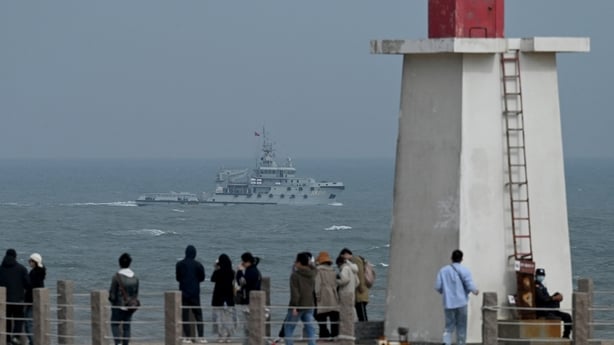
And although Taiwan remains in sharp focus - China has intensified its war games around the island in recent weeks - it is not the only flashpoint in the region.
"What if something tricky happens [during a routine training exercise in] South China Sea, the China/India border, or even Burma, Vietnam, Philippines, Japan, North Korea," said Shanshan Mei.
She added: "Who is going to advise Xi at this point?
"I am concerned."
Velina Tchakarova of FACE geopolitical risk consultancy, which is based in Vienna is Austria, agreed.
"When purges reach the level of senior commanders responsible for nuclear forces, missile units and joint command structures, the implications extend far beyond domestic power consolidation," she told RTÉ News.
"They directly affect crisis management, signaling reliability and escalation control," she added.
Throughout history, Ms Tchakarova said, internal purges like this have tended to correlate "not with restraint, but with higher external risk tolerance, reduced transparency and abrupt policy shifts".
In that context, she viewed the optics of smaller countries courting Beijing amid growing tensions with the United States as problematic.
"The implicit assumption that engagement with China offers a calmer, more predictable counterweight no longer holds under current conditions," she told RTÉ News.
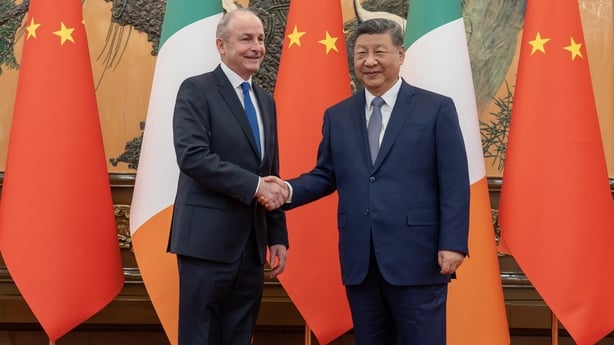
Despite growing concerns around China’s support for Russia’s war on the European continent, several Western leaders have been beating a path to China, most recently British Prime Minister Keir Starmer just this week.
French President Emmanuel Macron paid a visit late last year and Taoiseach Micheál Martin led an Irish delegation to Beijing and Shanghai in early January.
Then came Canada’s Prime Minister Mark Carney.
He made headlines with his talk of a "new strategic partnership" between Ottawa and Beijing.
This, he said, sets them up well for the "new world order".
It was a sudden and remarkable thaw in relations, largely frozen since two Canadian citizens Michael Kovrig and Michael Spavor were detained in China in 2018, in apparent retaliation for the arrest of the Huawei executive Meng Wanzhou on a US extradition request.
China also banned imports of Canadian meat and canola oil.
Like US President Donald Trump, China has deployed economic coercion against countries that upset Beijing.
It deployed such a tactic against Norway over the award of the 2010 Nobel peace prize to Chinese dissident Liu Xiaobo and against Australia for calling for an independent investigation into the origins of Covid-19.
Mr Kovrig spent six months of his three-year detention in solitary confinement and described his treatment during his incarceration as "psychological torture".
Watching Mr Carney smiling and shaking hands with Mr Xi was "morally, if not repugnant, then at least uncomfortable", he told Semafor.
The pivot of "middle powers" toward China should sound alarm bells, Mr Kovrig, a senior advisor with International Crisis Group, wrote on social media.
"Seeking refuge with another authoritarian power because Trump is unreliable isn’t strategy," he wrote, adding "it’s just a more subtle form of supplication".