
"Maybe climate change is not so bad in such a cold country as ours? 2-3 degrees wouldn't hurt – we'll spend less on fur coats, and the grain harvest would go up"
- Vladimir Putin, President of the Russian Federation, 2003.
Is there really a connection between the price of fur coats in Russia and the rupture between the US and the rest of NATO (and the EU) that Canadian Prime Minister Mark Carney described so starkly in his Davos speech last week?
Hold my (arctic-chilled) beer!
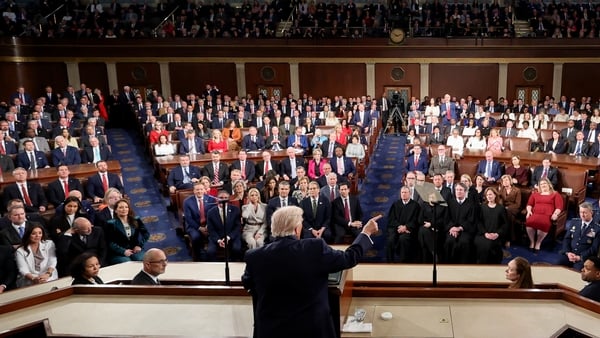
All of a sudden, just after getting re-elected, US President Donald J Trump started insisting that the United States must own Greenland. He said it is vital for US national security.
He is right - it is.
But does that mean he has to own it?
In the climbdown/row back/NATO fudge or whatever it was that happened on Wednesday in Davos, the president said he will work out a deal with Denmark and Greenland that all three countries will like, and which will improve security for Europe, Canada and the US.
Hopefully it will.
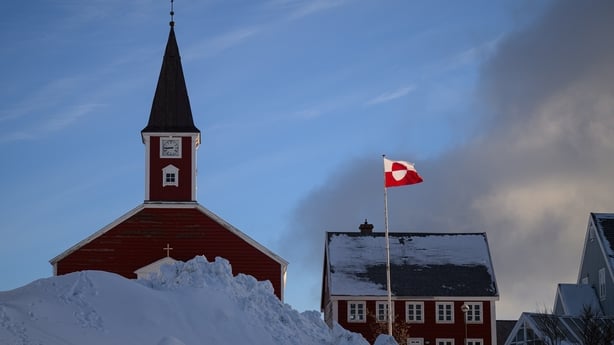
A deal has been on offer from the Danes for almost a year now. The US can have anything it wants as long as it respects two red lines: Danish sovereignty (i.e., ownership) of Greenland and Greenlandic self-determination about its future.
The 'Cyprus solution' of sovereign base areas in Greenland, put forward by NATO Secretary General Mark Rutte, provided an immediate off-ramp from the highway to hell that was Mr Trump's drive for Greenland - a drive that threatened to run the proverbial coach-and-four through transatlantic relations.
It may do so yet.
Where that off-ramp leads is unclear.
The Danes do not like anything that cedes sovereignty. The Cypriots have a scratchy relationship with the Sovereign Base Areas of Akrotiri and Dhekalia - even before Brexit; the Irish did not like the Treaty Ports in the 1920s and 30s.
And yet there is method to the madness.
In an ever-changing world, one of the less remarked changes has been the rapid rise of the Arctic region to strategic relevance.
That is to say, a place adjoining countries used to pretty much ignore, but are now becoming obsessed with.
What changed? The climate.
If any of us paid attention to the annual reports of the melting polar ice cap, it was to think of the poor starving polar bears (before heading off to munch a burger of sustainably farmed beef).
But the kind of folks who are paid to think strategically, thought a whole other set of thoughts.
They mostly thought about the opportunities that arise from the melting of the polar ice, as well as the threats.
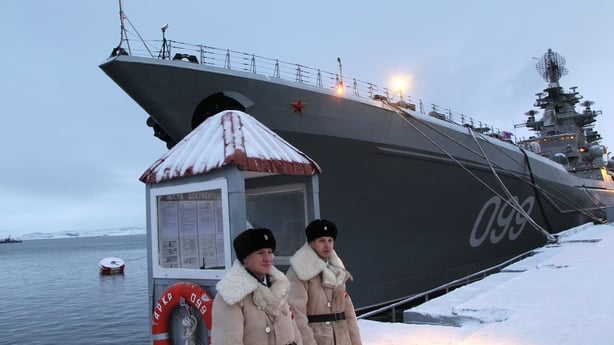
Some of those strategic thinkers were in Russia, the massively disrupted inheritor state of the key parts of the Soviet Union, looking around for new ways to prosper.
Throughout Russian history access to the world's main shipping routes has been a constant driver of strategic ambition - from Peter the Great's northern war against the Swedes and the foundation of St Petersburg to access the Baltic; to the Ukraine war and the concentration on the Black Sea coast that is west of Crimea, alongside the loss of a long standing Russian naval base in Syria, its only Mediterranean base, gone due to the fall of the Assad regime.
From a Russian perspective, the melting of the polar ice is a game changer.
This vast but largely landlocked country is suddenly gaining a lot more navigable coastline to its Arctic north. Hence, Russian President Vladimir Putin's 2003 comments about climate change not being so bad for Russia.
I've no idea about its effect on the real-terms price of fur coats there, but it has certainly changed the world's shipping patterns.
Chinese container ships - steaming behind Russian ice-breakers - have been able to lop two to three weeks off their sailing time from places like Shenzhen to Hamburg and Rotterdam, a huge improvement in a business where time is money.
When they first started this route the cargo ships had to follow Russian ice-breakers.
But in September 2023, the Russians transited an oil tanker without an ice-breaker support for the first time through this new shipping lane.
The more the planet warms, the more strategic the Arctic region becomes.
Mining in the Arctic region has become slightly easier too - as has fishing and even tourism (the word slightly is doing a lot of heavy lifting here: it's still a savagely harsh climate).
As usual, the rare earth metals used in high tech industries and defence manufacturing are mentioned - less often the extremely dirty nature of the refining of these metals, best done where nobody lives.
With mining and shipping naturally comes security interest. The urge to protect and stop others muscling in what you regard as yours.
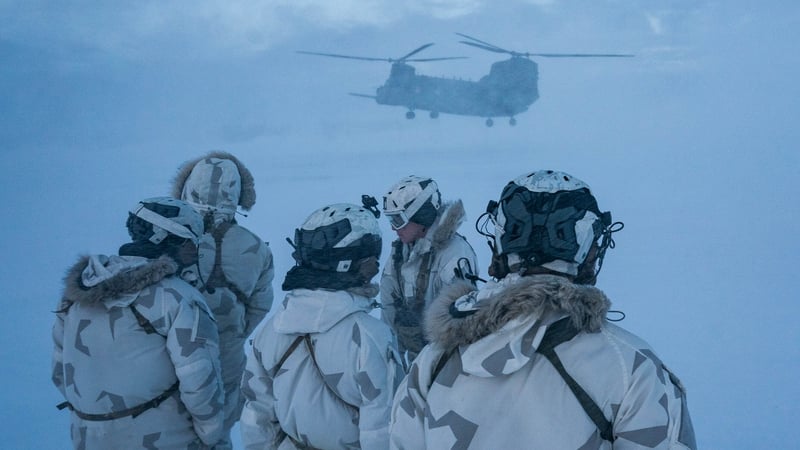
So there has been a buildup in military activity in what the Scandinavians call the "high north".
It has pulled in interest from China, which mostly sends research ships but has conducted joint military exercises with the Russians in the Pacific Arctic.
But most of the military activity in the Arctic region is from Russia.
That's no surprise when you look at a map that puts the North Pole at the centre.
There are eight countries adjoining the Arctic - seven of them are in NATO.
Russia is by far the biggest in terms of coastline.
From the mid-2000s on, the Russians have been building up military capacity in the Arctic and asserting legal claims over the new trade routes.
The melting of the polar ice has done away with Russia's "natural barrier" against invasion of the motherland.
But Russia's own invasion of Ukraine has ended the reasonably co-operative and "low tension" approach to Arctic security.
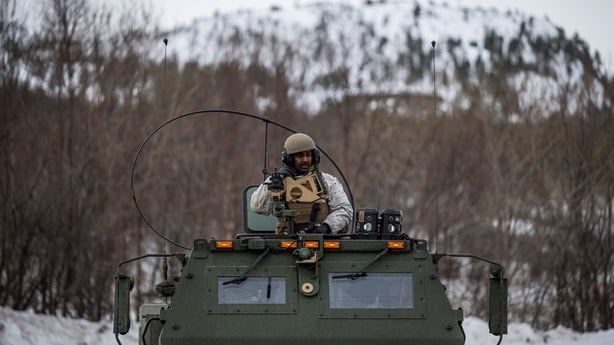
Now the region is increasingly characterised by unannounced military exercises, "buzzing" and incursions by aircraft, and jamming of GPS and communications equipment.
A recent paper by Washington-based think tank the Centre for European Policy Analysis called for an Arctic Military Code of Conduct, which is a sort of "rules of the road" for peacetime military operatons in the region to help take down the temperature, and avoid the risks of miscalculation and accidents causing a shooting war.
It suggests getting Russia into the code of conduct, as well as "any country that can sustain military assets in the arctic" - notably China.
The Americans have started to get a lot more interested in the region over the past few years.
A National Strategy for the Arctic Region in 2022 was followed the next year by an implementation strategy and the then Department of Defence - now Department of War - Arctic Strategy document in 2024.
Those documents exposed gaps in US capabilities, pointing to a need for ice-breaker ships and other vessels, equipment that is "ice-strengthened" along with more air defence, threat detection, radar and underseas sensing equipment - a lot of it remotely operated in a "drone style".
A NATO command centre in Norfolk, Virginia, exists to co-ordinate with Canda and European NATO allies, including Iceland, Denmark, Norway Sweden and Finland.
The UK also leads a ten-country Joint Expeditionary Force that practices warfighting in the harsh Arctic climate.
Last year, the US agreed to a multi-billion dollar deal to buy a fleet of ice-breaker ships from new NATO ally Finland - the US lacks the know-how and working shipyards to produce its own rapidly.
It also agreed terms to base US troops and equipment in Sweden and Finland, and expanded its base operations in Norway, giving it more than 40 bases in the Arctic regions of these three countries.
The US has a long standing agreement with Denmark for bases in Greenland.
President Trump had expressed an interest in buying Greenland in 2019, during his first administration.
Nothing came of it, but the issue did come roaring back just after he started his second presidential term, along with his claim that Canada should become the 51st state and his dismissal of then prime minister Justin Trudeau as "Governor Trudeau".
So, a policy area that has been working its way slowly up the political agendas through the quiet channels of NATO committees, and foreign and defence ministry planning groups has suddenly exploded into a diplomatic crisis.
Denmark and the other European Arctic countries agree more needs to be done on Arctic security.
Denmark is home to the world's second biggest container shipping company, Maersk, while Swiss and French lines make up the top three, so new shipping lanes are very much a European interest.
But perhaps not like this.
By deploying full on so-called "Madman Theory" in the lead up to Davos, Mr Trump seems to have pushed European countries and Canada to put this issue way up the urgent to do list.
It may even be another manifestation of the "Donroe" Doctrine, Mr Trump’s adaptation of the Monroe Doctrine, which was designed to keep European powers out of Latin America.
The Trump corollary is that no power anywhere will be allowed to get strategic advantage through bases or control of resources of trade routes in the Western Hemisphere, be they Russia or China or the EU.
It's very much in keeping with November's US National Security Strategy - even though that document doesn't mention Greenland at all.
It could achieve a lot in terms of Arctic defence and strategic positioning, but it has come with a very big cost in terms of alliance cohesion and trust.
That will be particularly tested in the other, more overtly stated reason for US interest in Greenland: an anti-missile shield.
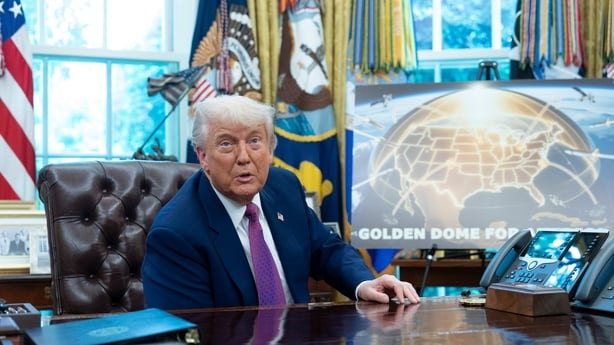
Missile defence is the US president's own pet project.
Impressed by Israel’s Iron Dome missile defence system, he wants a Golden Dome for the US.
But Israel is very small and it takes a lot less to defend it from missile attack than the vastness of the continental United States.
Providing the US with an Israeli level of cover will be phenomenally expensive, even if technical hurdles can be overcome.
The EU is working on its own version of missile defence, dubbed the European Sky Shield.
It's been beset with the usual politicking about where to get the systems from.
The Germans arguing in favour of buying existing US technology to get the system in place quickly, the French in favour of developing a European only system - that would take longer to develop, but would not be dependent on US suppliers and politicians.
The US papers have carried their fair share of maps this past week with the North Pole at their centre, showing Russian missile bases and drawing lines for missile launches that all converge on Washington DC.
But it would only take a few degrees of rightward tun for the same lines to converge on Brussels.
Clearly Greenland is of significance to a missile defence system for both Europe and the US.
But again, does the US need to own Greenland to secure itself? Does Denmark need to keep all sovereignty or could it allow Sovereign Base Areas? Would European security be compromised or enhanced by sovereign maximalism or allied co-operation? How will the political competition in European defence industrial policy play out?
Whatever the outcome, whatever the arguments - the process is in train right now.
The President of the United States will expect answers and Europe will have to come up with them, sooner rather than later.
Although some European countries have been pressing for more Arctic security measures and a plan for dealing with the changing physical nature of the high north due to global warming and its implications for economic and military security, it's been treated as a third order issue at best.
It something the securocrats drone on about, worthy but dull, more pressing issues etc – the usual Brussels formulae for not doing something.
Now Mr Trump has put it up to them to actually do something.
The matter has moved much higher up the political agenda as a result of his intervention: prime ministers and presidents are dealing with something that until a few weeks ago was the preserve of a few mid-level defence officials and military officers.
Which is why President Trump's supporters are saying he is winning on this policy, even if he has apparently backed down from forcing a crisis at Davos in the face of unusual European resolve and financial market disapproval.
Sooner or later, they will call it an American response to global warming as well.
You can hand me that beer back now.