
Over the past two weeks, US President Donald Trump managed to do what his Russian counterpart Vladimir Putin failed to do for the past two decades: create serious discord between the United States and its European allies in NATO.
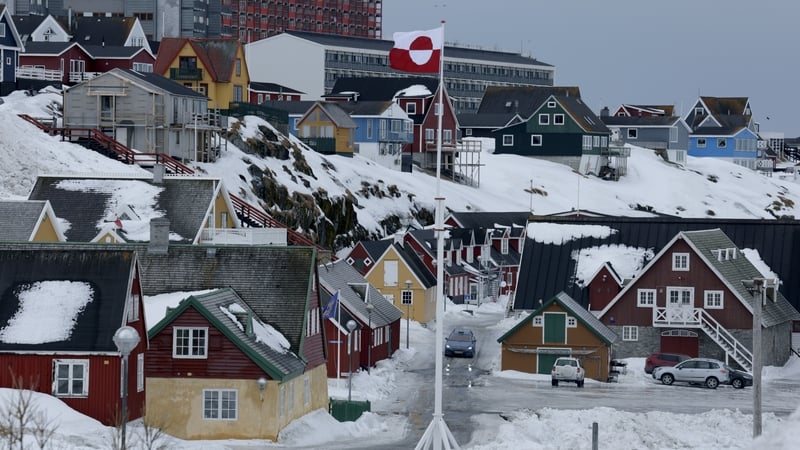
The US president's demands to annex Greenland drove a wedge between decades-old allies like never before.
And Russia savoured it.
Russian state media backed Mr Trump's wrecking ball diplomacy and hailed, in its view, the oncoming end of the transatlantic alliance.
The Kremlin held back from directly criticising Mr Trump over his claim that Russia poses a threat to Greenland.
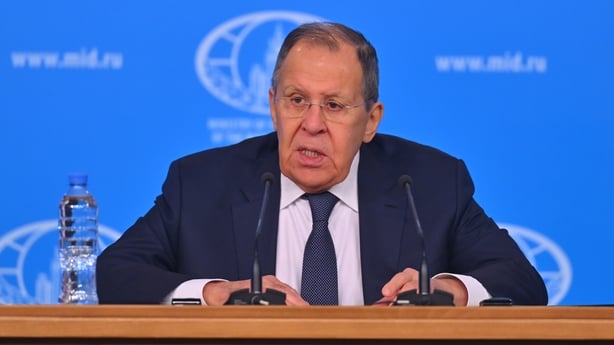
Russian Foreign Minister Sergei Lavrov simply stated on Tuesday, during his annual foreign policy address, that Russia has no plans to seize Greenland, while vaguely questioning Danish sovereignty over the island.
"Greenland is not a natural part of Denmark," he said.
He described the island as "a colonial acquisition", before listing overseas territories still governed by France and Britain.
He presented Russia and its so-called 'Group of Friends in Defence of the UN Charter', a club of autocratic countries, as defenders of colonised people around the world.
Yet, Mr Lavrov did not categorise Mr Trump's demands to annex Greenland against its inhabitants' wishes as a new brand of colonialism.
Instead, he tried to compare Greenland to Crimea - a strange and unfitting comparison if ever there was one.
"Crimea is no less important for the national security of Russia than Greenland for the national security of the US," he said.
This leads to the real and obvious reason for Russia’s acquiescence over Mr Trump’s recent demands to annex Greenland: Ukraine.
Moscow will support any US policy that weakens US-Europe relations because a sidelined Europe would serve to strengthen Russia's position in negotiations to end the war in Ukraine.
And just as Russia dimmed its criticism of US action in Venezuela and the capture of President Nicolas Maduro at the start of this month lest it steer the US more towards Ukraine's negotiating position, so too has the Kremlin held off on criticising Mr Trump's plans for Greenland.
"Russia will try to exploit this, to persuade the Americans to agree to their version of a peace deal that would be catastrophic for Ukraine," Witold Rodkiewicz, a Russia foreign policy analyst, told RTÉ News.
Russian negotiators, he believes, will now try to pressure US Special Envoy Steve Witkoff to give up Ukraine's redrafted 20-point peace plan, hashed out in Florida between US and Ukrainian officials last month.
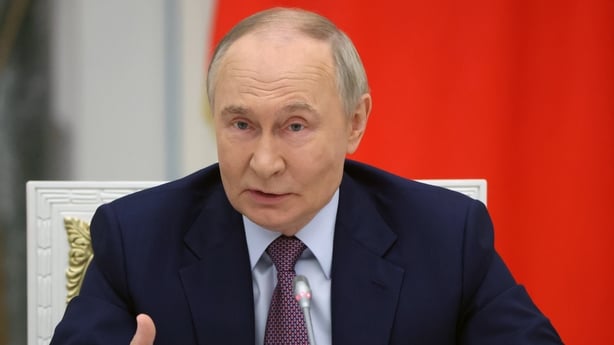
Mr Putin, who finally issued a statement on the Greenland debate to Russia’s Security Council on Wednesday, said the future of Greenland was of no concern to Russia.
That is about as far as he went to address Mr Trump’s claim that Russia could threaten Greenland if the US did not control it.
Instead, Russia’s president tried to make a historic comparison to justify Mr Trump’s moves, citing Russia’s sale of Alaska to the US in 1867 and Denmark’s sale of the Virgin Islands, also to the US, in 1917.
Territories can be bought and sold was the message.
However, it is difficult to believe that enhanced US influence over Greenland - whatever form that now takes - and the Arctic is of no concern to the Kremlin.
Russia sees the Arctic as "one of the major theatres of the future", said Mr Rodkiewicz, a senior fellow at the Centre for Eastern Studies in Warsaw.
A larger US military presence in Greenland and patrolling its waters stands a good chance of one day rubbing up against Russian interests in the Arctic.
Greenland's rare earth minerals are valuable but so too are the shipping lines that traverse the north of the island and, as Arctic temperatures continue to rise, those routes could become more navigable for more months during the year, cutting shipping costs dramatically.
That could result in more competition between the US, Russia and China for those routes in the long-term.
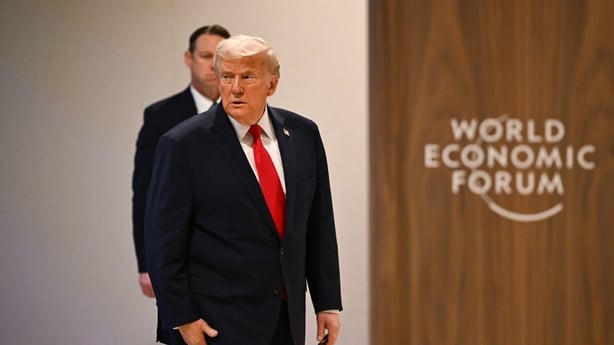
For now, the Kremlin is willing to cast aside any competition over that "big, beautiful piece of ice", as Mr Trump called Greenland during his speech in Davos this week, if it means getting the US to support its key demand for Ukraine to withdraw entirely from Donbas.
Russia's leader has long-wanted to establish a multipolar world order where the dominance of the US and the West is diminished.
In this respect, the Trump administration's renewed foreign policy focus on the Western Hemisphere, in line with what the US president now calls the 'Donroe Doctrine' - his riff on the original Monroe Doctrine from 1823, suits Moscow.
"Russia is preoccupied with Ukraine. That's an absolute and utmost priority and it's imperative for them to deal with Ukraine," Volodymyr Dubovyk, a US foreign policy expert at Odesa National University, told RTÉ News.
He added: "Everything else doesn't matter.
"The Russians are trying to curry favour with Trump on Greenland and basically praise him, and that's not going to go unnoticed in Washington."