
If you'd fallen asleep a hundred or so years ago and woken up last week, you’d probably think not much had changed.
Back then, buying and selling land was very much de rigueur. (As was conquering it militarily, enslaving or wiping out the indigenous population and grabbing all the natural resources).
Sovereignty and the inviolability of national borders is very much a 20th Century concept, enshrined in international law and the United Nations Charter - only after the unprecedented devastation and mass murder of World War II forced a rethink.
But senior White House advisor Stephen Miller has called such principles "niceties".
Much of the US posture in recent weeks, involving threats to take Greenland whether the locals liked it or not, presented fairly robust evidence that Washington now sees international borders as little more than a nicety.
On Wednesday, Republicans in Washington DC carved up a Greenland-shaped cake with Stars and Stripes icing on top. "The 51st state," someone off camera said as the knife went in - suggesting that despite the deal struck in Davos, the annexation of Greenland for some US politicians remains on the table.
In many ways this is the US reverting to type. Historically, it grew rich and powerful in no small part through expanding its territory.
And for a US president who unapologetically covets the trappings of greatness - such as a spot on Mount Rushmore or a Nobel Peace Prize - nostalgia for a perceived glory of yesteryear, when the US was a growing power, no doubt plays a role in his designs.
It could indeed be seen as an attempt to make America great again in its most literal sense.
A quick trot through its 250 years tells the tale of US expansion through transactions, treaties and war (with some credit to my American public school-educated children, who have to learn a lot of this in history class).
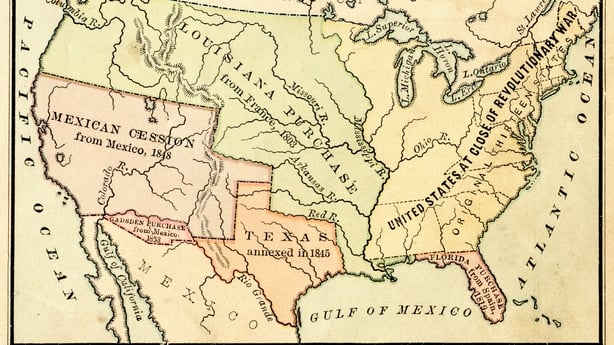
After the American War of Independence, Britain recognised US sovereignty over its 13 former colonies in the 1783 Treaty of Paris. That gave the US all the territory from the Mississippi River to the Atlantic Ocean, up to the borders of Canada in the north and Florida in the south.
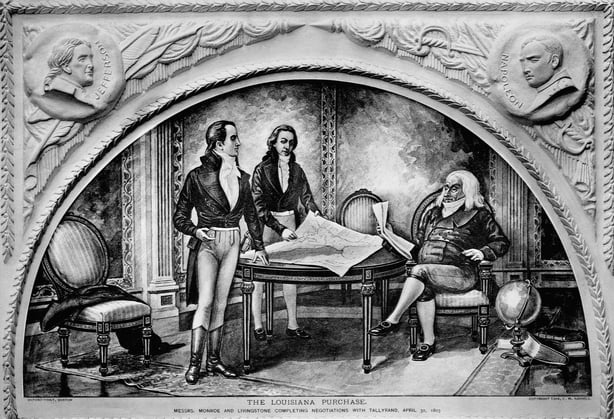
Then, in 1803, the US bought Louisiana from France for $15 million, thereby doubling the size of the young country.
Then president Thomas Jefferson, fearing the strategic port of New Orleans could fall into European hands, made an offer to Napolean of $10m for the city.
Surprising the Americans, the French - battle-weary and broke - offered them the whole lot.
The vast new territory stretched from the Mississippi River to the Rocky Mountains in the north, taking in much of the modern-day states of Louisiana, Arkansas, Missouri, Iowa, Oklahoma, Kansas, Nebraska, North Dakota, South Dakota, Minnesota, Montana, Wyoming, Colorado and New Mexico.
The land was very fertile and of great interest to Jefferson and his vision of an "Agrarian Republic" made up of small family farms and rural communities. It was also home to Native American tribes, who never recovered from their dispossession.
1819 saw the Adams-Onís Treaty where Spain, a declining colonial power, ceded Florida to the United States. In return, the United States recognised Spanish sovereignty over Texas.
But not for long.
In 1845, the US offered to purchase Texas from Mexico, which the latter turned down. So, the US annexed the territory and declared war on Mexico.
Around this time the notion of "Manifest Destiny" began to take hold. Americans, its proponents said, were divinely ordained to expand across the continent. (It was later invoked for the US's space exploration, including by Donald Trump in his inaugural address last year).
The Mexican-American war ended with Mexico losing more than half its territory in the 1848 Treaty of Guadalupe Hidalgo.
And through that treaty, the US gained California, Nevada, Utah, Arizona, New Mexico and parts of Colorado for the sum of $15m.
While the US was fighting Mexico, US and Britain struck a deal over Oregon, drawing a boundary under British territory in Canada.
And then it was back to the southern border with the $10m Gadsden Purchase from Mexico, securing land in Arizona and New Mexico for a transcontinental railroad.
But the US didn't stop there.
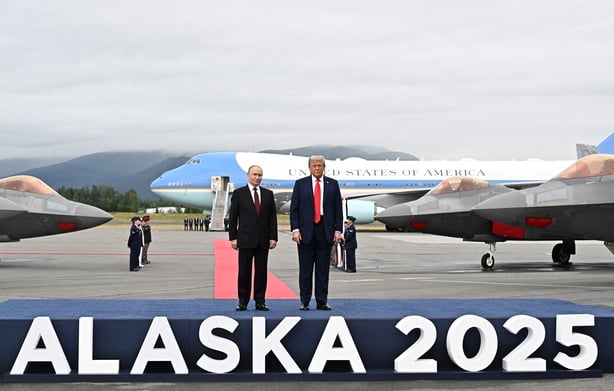
In 1867, US Secretary of State William Seward orchestrated the purchase of Alaska from Imperial Russia for $7.2 million.
Some called it "Seward's Folly" until vast amounts of gold were discovered. When I reported on the summit between Russian President Vladimir Putin and President Trump in Alaska last summer, I got talking to some Russian journalists who told me the climate and landscape reminded them a lot of Russia.
It was, incidentally, William Seward who first floated the idea of buying Greenland, seeing it as a strategic bulwark against Britain, although the proposal didn't materialise.
Now at its most westward point, the US pressed on into the Pacific Ocean.
The Spanish-American war saw the acquisition of Puerto Rico, Guam, and the Philippines in 1898.
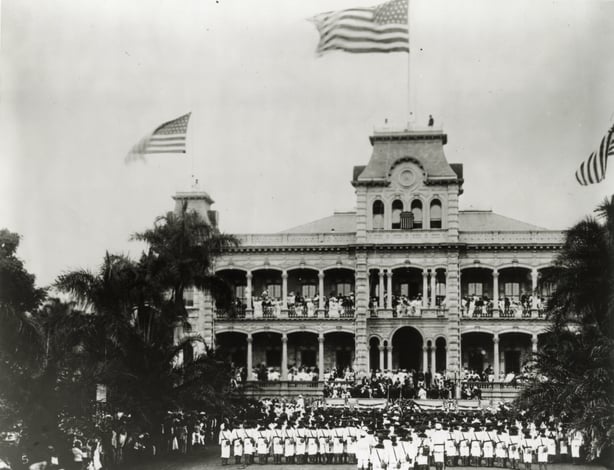
Also that year, the US annexed Hawaii, having staged a coup to overthrow the Hawaiian monarchy - something the United States later apologised for.
The early 20th Century ushered in US presidents with a taste for further expansion. Officials under President William Howard Taft drew up plans for a complicated land swap deal that would transfer Greenland to the United States.
The idea was parked as World War I descended.
And then in 1917, the purchase of the Virgin Islands from Denmark for $25m in gold - for their strategic location near the Panama Canal - appeared to draw a line under the matter, with the US recognising Danish sovereignty over Greenland as part of the deal.
Notably, among the US's new acquisitions was Little Saint James - better known today as Epstein Island.
But in 1946, the administration of President Harry Truman secretly offered Denmark $100m in gold in exchange for Greenland.
Denmark again refused.
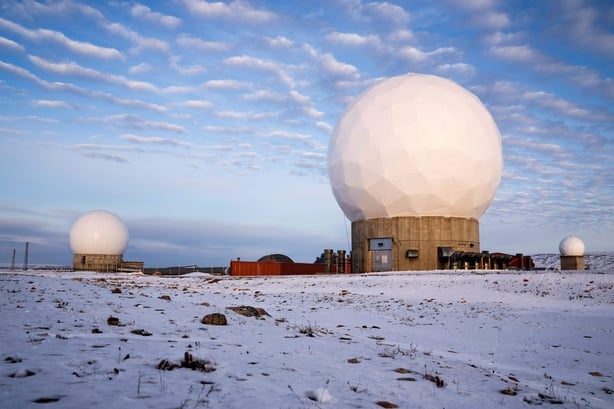
Around the same time, the Mariana and Marshall Islands were captured from Japan, the latter becoming a US nuclear testing site. Between 1946 and 1958, the US carried out 67 detonations on Bikini Atoll and Enewetak Atoll, sickening and displacing the local population.
Which brings us back to Greenland, another site of US nuclear activity.
During the Cold War, a US B-52 aircraft carrying four thermonuclear bombs crashed near the site of the Pittufik Space Base in the north of Greenland, contaminating the ice sheet with radioactive material.
It caused major upset in Denmark whose government insisted the Americans clean up the mess or risk losing their airbase on what was then Danish territory. Greenland has since become an autonomous territory within the Kingdom of Denmark.
It was the most serious incident in the decades-long cooperation between Denmark and the United States. Until last week.
Now, the Europeans a breathing a sigh of relief hoping that the danger has passed.
Certainly, Washington’s strategic concerns over Russian and Chinese activity in the Arctic may have been allayed by a framework agreed with Denmark and NATO to beef up defences at the top of the earth.
But the US's belief in "manifest destiny" is having a revival under Mr Trump.
Here’s what he said in his inaugural speech last year: "The United States will once again consider itself a growing nation - one that increases our wealth, expands our territory, builds our cities, raises our expectations, and carries our flag into new and beautiful horizons.
"And we will pursue our manifest destiny into the stars, launching American astronauts to plant the stars and stripes on the planet Mars."
Throughout the history of US expansion, economic and strategic interests have been interwoven with a hunger for American greatness.
And it's unlikely that a Greenland-shaped cake will be enough to satisfy that.