
The meeting had not gone well.
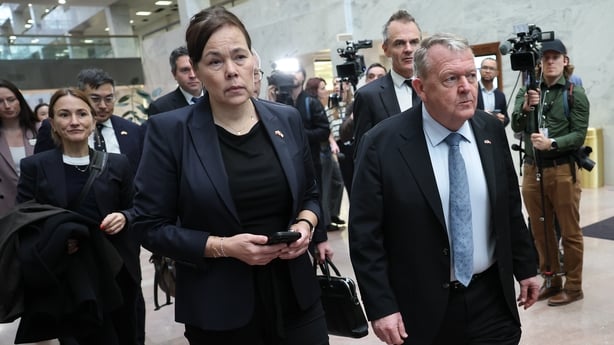
Denmark's foreign minister emerged from the White House and jogged to his car for cigarettes.
A video of the scene went viral instantly - Lars Løkke Rasmussen, cigarette dangling from his mouth, offering the pack and lighter to his Greenlandic counterpart, Vivian Motzfeldt.
Their meeting with US Vice President JD Vance and Secretary of State Marco Rubio had clearly taken its toll.
In a press conference outside the Danish embassy in Washington, Mr Rasmussen, a bruising political heavyweight and former prime minister, made clear why he needed that cigarette.
"We didn't manage to change the American position," he said.
"It's clear that the president has this wish of conquering over Greenland."
The one positive, Mr Rasmussen said, was an agreement to form a working group.
But even that flickering hope was soon extinguished. Both sides, it turned out, had fundamentally different understandings of what had been decided in that room.
On Thursday, the White House announced the working group would focus on how the US could acquire Greenland. The Danes, who thought they had agreed to discuss American security concerns, and not a transfer of sovereignty, were stunned.
The disagreement would be extraordinary in any other week. But this is a story that has moved faster than anyone anticipated.
When I was in Greenland this week, most people I spoke to were bowled over by mere words of support from European leaders.
They were grateful that anyone was standing up for them at all.
More than one person told me they knew not to expect European troops on the ground. That seemed like wishful thinking, far beyond what their island could reasonably ask for.
But, by Sunday, European capitals had actually begun floating the idea of a NATO mission to the Arctic - ostensibly to address the security concerns Donald Trump has raised.
Mr Trump has repeatedly claimed Russian and Chinese ships are prowling Greenland’s waters, despite no evidence of any such presence.
Watch: Trump says US will take Greenland 'one way or the other'
Observers quickly noted the convenient dual purpose: While it would show Mr Trump that Europe was taking Arctic security seriously, it would also ensure the US could not seize Greenland without first confronting European forces.
But for a continent not exactly renowned for speed, things moved even faster than that.
By Wednesday, they had seemingly abandoned the NATO idea, which would have required the support of all 32 of the military alliance's members.
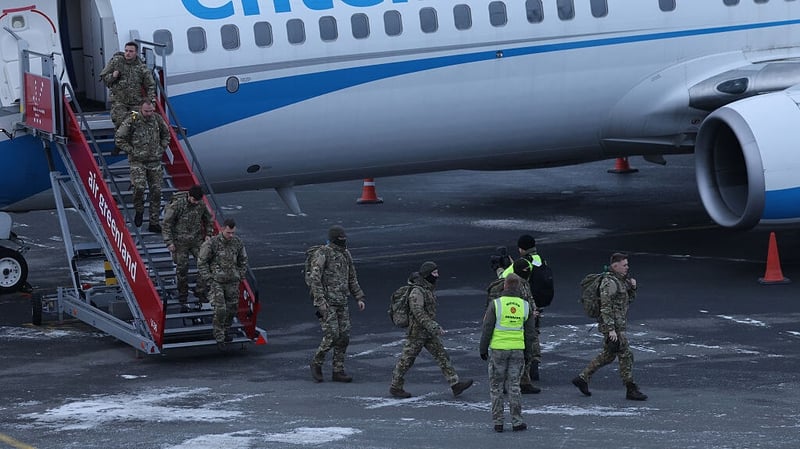
Instead, Denmark announced an immediate deployment of troops under what it dubbed Operation Arctic Endurance.
France and Germany each sent around a dozen troops. Sweden, Norway, and the Netherlands contributed a handful of officers. Britain sent exactly one, in what became an instant meme.
While the numbers seemed too small to matter, six allies putting boots on Greenlandic soil is a powerful statement of support - a veritable line in the snow.
And these are not symbolic or token forces - they are military planners laying the groundwork for a more substantial deployment.
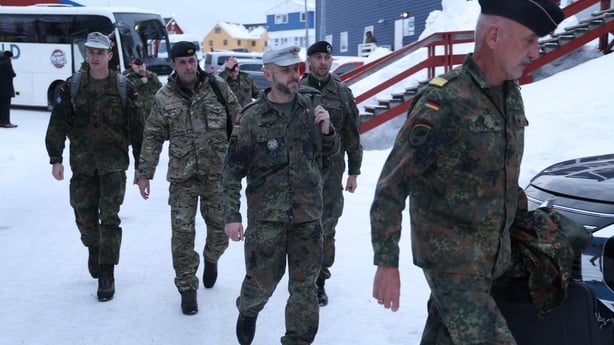
On the surface, European diplomats insisted that Operation Arctic Endurance was about addressing Mr Trump's security concerns.
Behind closed doors, French officials were reportedly far more candid, noting that the goal was to jolt American opinion, particularly in the Pentagon.
President Emmanuel Macron barely bothered with the fiction, and heavily implied that the operation was a response to American threats.
In his new year's address to France's armed forces, Mr Macron said his country’s "correct role" was standing "at the side of a sovereign state to protect its territory".
He noted that Europe was "being shaken in some of its certainties", including by having "rivals it did not expect to see".
But people remain none the wiser as to why Mr Trump seems so determined to shake those certainties.
The US President has insisted that anything less than US ownership is "unacceptable". The White House has repeatedly refused to rule out military action.
And he has now threatened tariffs on countries that don’t support his plans to annex the island.
A bipartisan delegation of US lawmakers visited Copenhagen yesterday hoping to "lower the temperature". They too seemed bewildered.
Senator Chris Coons told reporters there was "a lot of rhetoric, but not a lot of reality" to Mr Trump’s concerns.
If it is genuinely about national security, a 1951 agreement with Denmark already gives the US practically unfettered military access. If it’s about Greenland's minerals or oil reserves, they are largely inaccessible beneath ice - and Denmark is open to deals anyway.
The only explanation that makes sense is the one Mr Trump himself has offered.
As I wrote last week, his comments to The New York Times made clear that this is not about strategy or logic - but instead the psychology of possession applied to foreign policy.
He said that he needs to "own" Greenland because that is what he feels "is psychologically needed for success".
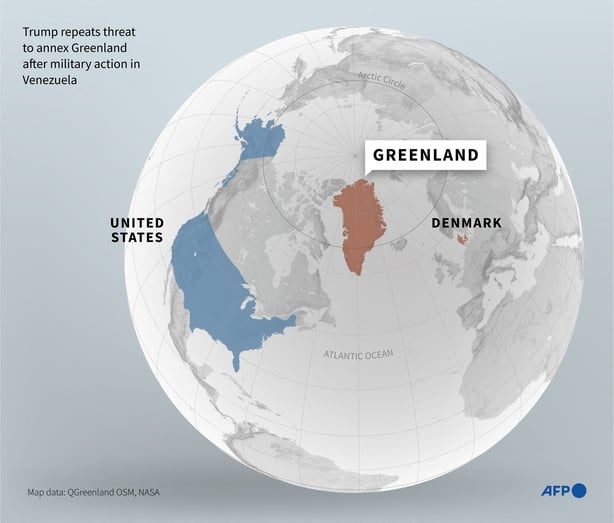
And Greenland's sheer size feeds that psychology - he famously told journalists in 2019 that he loved maps, and that Greenland looked enormous.
"And I always said, 'Look at the size of this, it’s massive, and that should be part of the United States’," Mr Trump said.
That presents an impossible problem for Europe.
How do you counter a desire rooted in cartography and ego?
No security arrangement will satisfy someone who simply wants to see more American territory on the map.
Watch: 'I'm afraid' - Greenlanders react to Trump threats
Yesterday, perhaps also in an attempt to lower the temperature, Denmark’s top military officer in Greenland insisted the deployment was focused on Russian threats, not American ones.
"My focus is not toward the US. Not at all. My focus is on Russia," Major General Soren Andersen said, as if reading from a script.
But his superior had already acknowledged the uncomfortable reality just two days earlier.
Peter Boysen, head of the Danish army, told The Atlantic that Denmark had a royal decree from 1952 compelling soldiers to fight back if their territory is invaded.
"You have to," he explained. "It’s an obligation."
When asked whether Danish forces would actually fight Americans, he paused.
"This is highly political," he said. "And I’m just a soldier."
It remains an extraordinary scenario. Europe, forced to contemplate deterring an American invasion.
No wonder Mr Rasmussen needed that cigarette.