
While Micheál Martin was in China this week for an official visit aimed at improving economic and diplomatic ties with Beijing, it ended up being events on the other side of the world that garnered much of the spotlight during the four-day trip.
As the Irish delegation was in the air, the United States launched an incursion into Venezuela, capturing President Nicolas Maduro in the process.
The US proved a further distraction during the visit, when the White House failed to rule out military intervention to acquire Greenland.
Then towards the end of the week, political wrangling in both Dublin and Brussels around the EU-Mercosur trade agreement meant the Taoiseach was forced to forego the opportunity to sell some of the successes as he saw them of his China trip, and instead face the Irish press pool in Shanghai in a rapid-fire question round on the deal.
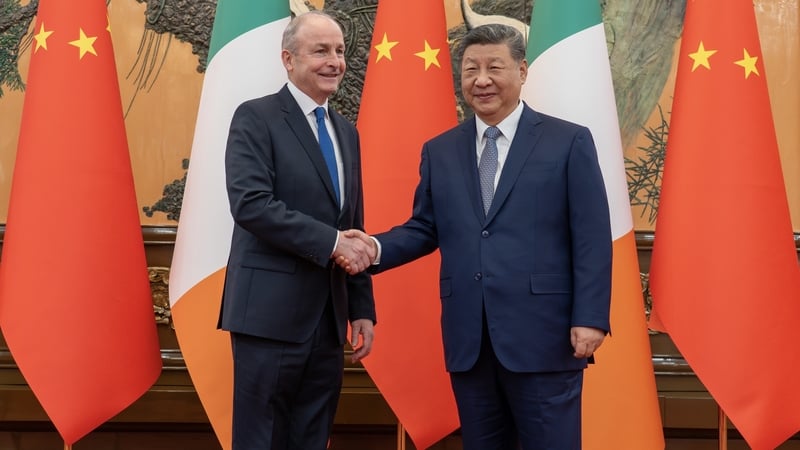
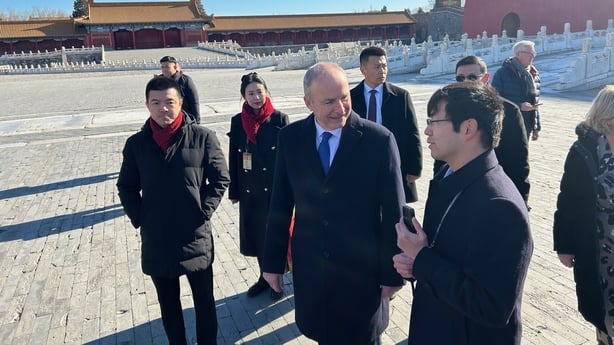
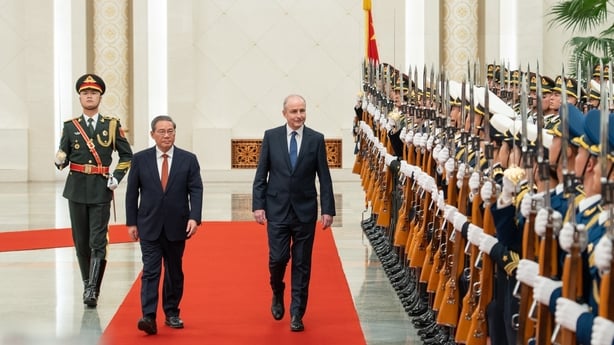
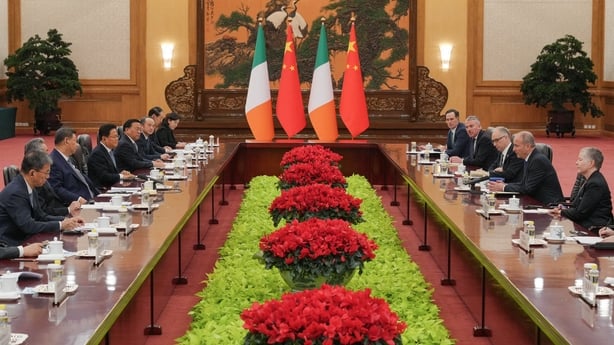
Though the visit started positively in Beijing on Monday, when Mr Martin had an audience with Chinese President Xi Jinping in the city's historic Great Hall (this would be the first of three visits to the giant ceremonial venue across two days to meet Chinese officials).
The Taoiseach described his engagement with President Xi as "warm" and "constructive", with the two leaders full of compliments for each other.
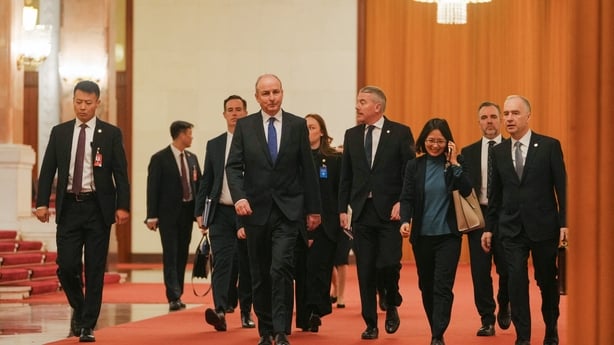
Micheál Martin acknowledged what he called China’s indispensable role in the world, highlighting the country’s work at the UN.
Meanwhile, President Xi spoke fondly of a previous visit to Ireland and said there should be increased co-operation between the countries in various areas including Artificial Intelligence and the digital economy.
Equally positive meetings with head of the National People’s Congress Zhao Leji and Chinese Prime Minister Li Qiang followed.
The significance of these meetings should not be ignored.
Following his audience with the prime minister, Mr Martin had met the three highest-ranking officials in the Chinese Communist Party.
To put that in context, the last time a sitting Taoiseach even had a face-to-face with the Chinese President was more than 20 years ago when Bertie Ahern was in the role.
China clearly rolled out the red carpet for this visit, with the Irish delegation getting unprecedented access.
Chinese state media were upfront in reporting the likely reason for such importance placed on the visit from their side, saying Beijing sees Ireland as a potential bridge to ease growing trade tensions between China and the EU.
While Chinese academic Cui Honqjian from the Beijing Foreign Studies University was quoted in the State-controlled Global Times noting that "Ireland will serve as a rotating EU presidency holder in the second half of 2026, giving it the opportunity to elevate some national concerns to the EU level.
"This could further enhance China-EU complementarities and contribute positively to China-EU relations," he says.
Ireland has "at times played up to this role", according to Alexander Dukalskis, Associate Professor in the School of Politics and International Relations in UCD.
Speaking to RTÉ News, Dr Dukalskis also thinks "China likes that Ireland is not in NATO, an organisation that along with Russia it dislikes".
However, he believes China’s attitude could easily shift.
"Ireland is in a tough spot right now when it comes to great-power politics.
"The current US administration is treating Europe like an enemy, Putin's Russia has actively invaded European territory and has allegedly carried out operations in Ireland, and China wants Russia to win the war and will exert its economic leverage ruthlessly should Beijing and Dublin ever have a diplomatic conflict."
The potentially tricky spot Ireland is in geo-politically was highlighted by the line of questioning from Irish journalists in China for the visit.
China firmly opposed the US intervention in Venezuela (which has been a steady source of oil supply for Beijing).
However, the Taoiseach would not condemn the US actions, instead choosing to focus on the negatives of the Maduro regime.
He was also asked if what the US has done in Venezuela might send a signal to China about Taiwan (i.e., what’s to stop China doing something similar with Taiwan, something it has threatened for some time).
Mr Martin refused to be drawn on the specifics of the question, saying he didn’t believe the two situations were comparable before underlining the importance of the international rules-based order as well as the role of the United Nations.
During the trip there were other moments when the Taoiseach needed to tread carefully.
On Tuesday, he attended an education event organised by Enterprise Ireland in Beijing, which was attended by representatives from colleges in Ireland as well as from China.
However, this emphasis on co-operation at third level comes after The Sunday Times last month reported the Irish military intelligence service briefed university leaders, warning about the risks associated with Chinese engagement in sensitive areas of research.
Mr Martin maintained there is no security risk, though Dr Dukalskis said the Taoiseach "of course can't be expected to know all the details of what goes on at universities but some of these cases have been reported publicly in major Irish media outlets over the years."
"Universities are terrified of offending China and so are not likely to raise these issues publicly or with Chinese partners, but they're there for sure, and there are ways the Government can help," Dr Dukalskis added.
Officials on both the Irish and Chinese sides this week were keen to highlight the many ways the countries are similar (economic progress fuelled by technology innovation, societies formed by strong cultural traditions), but the Irish delegation seemed equally happy to disregard the ways in which China is still quite different - some of which raise moral issues.
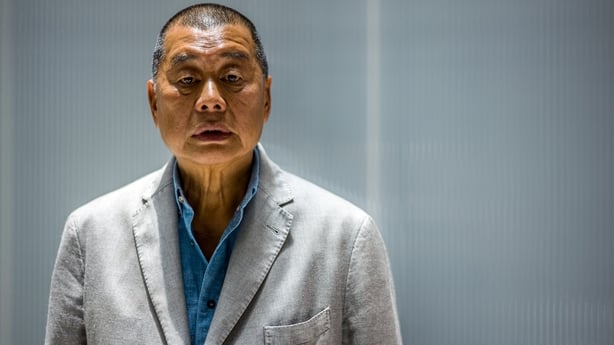
Take human rights. China has a chequered history in this regard - most notable in an Irish context around its treatment of jailed pro-democracy businessman Jimmy Lai in Hong Kong.
Mr Lai's case has received particular prominence here due to the fact he is represented by Irish human rights lawyer Caoilfhionn Gallagher.
In a recent interview, Ms Gallagher said she had been targeted by Chinese State media for her work on Mr Lai's case.
This, she claimed, included "hit pieces" calling her an "enemy of people", and having details of her workplace published.
Ms Gallagher also said she was threatened by Hong Kong authorities for representing Mr Lai, and has been subject to co-ordinated online attacks.
The Taoiseach was asked about this situation during the China visit and said he discussed the Jimmy Lai case with President Xi.
He also said Ireland repeatedly raises human rights issues with China.
In terms of the specific experience of Ms Gallagher, Micheál Martin said "it is not a satisfactory experience" but also that he had not seen those comments.
Mr Martin said he raised the issue of human rights more generally with the Chinese President, though the Irish press pool in Beijing did not get much more detail than that.
And although China has opened up to the world in recent decades in economic terms, it is still very much a closed shop internally when it comes to public discourse.
Police and security personnel had a remarkably strong presence pretty much everywhere we visited in Beijing and Shanghai, while thousands of CCTV cameras watched our every move.
A simple freedom journalists can expect across the Western world is being able to go to a town, a city, a country and speak with the people there to find out what is happening and to tell their stories.
In China though this is not the case.
We were strongly warned not to attempt to interview anyone out in public and that if we did so we risked detention.
Indeed, shortly after finishing a live TV report for the RTÉ News one evening in Beijing, an Irish person passing by warned us that if the police saw us doing that "we could be lifted".
On another occasion, my cameraman was filming shots of the Shanghai skyline in public and within 90 seconds Chinese police were on the scene, demanding we stop and we were indeed detained for a few minutes while our identities and intentions were verified.
Perhaps the realpolitik of the situation dictates that in a world where the US is turning increasingly hostile towards Europe, and with war raging on the continent, the Irish Government feels we are not in a position to be as picky with whom we do business with.
Viewed through such a lens, Mr Martin’s China visit was a successful one … with more trade likely to develop and closer ties being achieved.
While in Shanghai, the delegation visited numerous successful Irish business exports - such as Kerry Group and Bord Bia - which have established themselves and grown significantly not just in the city but across the country.
There is no doubt Ireland's growing relationship with China brings many positives.
In recent times we've seen a shift among world powers, whereby longstanding trade and political relationships can now quickly erode.
Ireland may have to continue to play both sides to some extent to keep our diplomatic and economic stance on a sure footing.
Read more:
Taoiseach calls for more open trade during visit to China
Trump's Greenland confession exposes his real motives
Political necessity at home trumped wider view on Mercosur deal