In 1963, anthropologist Jean Briggs spent over a year studying the Inuit, the indigenous people of the Arctic.
She lived with them for 17 months - sharing their igloos in winter, pitching her tent beside theirs in summer.
What she discovered, documented in her landmark 1970 book 'Never in Anger', was a culture of profound emotional restraint.
The Inuit avoided conflict at almost any cost. Expressions of anger were vanishingly rare. Children were taught from infancy to control their emotions.
I thought about Briggs's work as I arrived in Nuuk, the capital of Greenland. On some level, I was expecting to find defiance.
Surely Greenlanders - a people facing threats from the world's most powerful military - would be standing up to US President Donald Trump with anger and determination.
Instead, what I found was fear.
People here are frightened. And their cultural instinct toward calm, toward avoiding direct confrontation, seems to be colliding with a moment that demands exactly the opposite.
It has been hard to get politicians to talk here. But what struck me the most was how difficult it was to get ordinary people to speak on camera.
Some told me they were worried about repercussions. Others simply didn't want to engage.
The very act of speaking out felt like an escalation they weren't comfortable making.
"They have no respect for us, for my country, for our country."
But their silence doesn't mean they don't care. If anything, the reluctance to speak is a measure of how profoundly unsettling this moment feels.
"I don't like to talk about [Donald Trump] because he spoils my sleep. I don't sleep very well because I'm afraid," one woman, a retired university lecturer, told RTÉ News.
"They have no respect for us, for my country, for our country."
Another retired woman said she had dreamt about Mr Trump last night.
"It was a nightmare - that he was coming with the ship," she said.
"It was awful, that dream. I'm scared for his plans. We are scared. We are all scared."
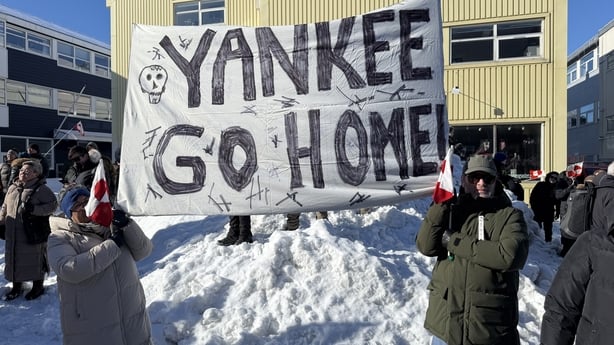
But not everyone shares that fear. Or, at least, not everyone draws the same conclusions from it.
Some politicians here believe the answer isn't to resist Mr Trump's pressure, but to engage with it directly.
The leader of Greenland's main opposition party said the country should bypass Denmark and negotiate directly with Washington.
Pele Broberg, the leader of Naleraq, is not a fringe figure: in last year's elections, his party won 25% of the vote running on a platform of rapid independence from Denmark.
Greenlanders react as US piles pressure on the territory
We need your consent to load this rte-player contentWe use rte-player to manage extra content that can set cookies on your device and collect data about your activity. Please review their details and accept them to load the content.Manage Preferences
Mr Broberg and his allies are open to what's called a "free association" agreement with the United States - similar to what America has with Pacific island nations like the Marshall Islands and Palau.
Under those arrangements, the countries are nominally independent, but the US provides defence, economic support, and has unrestricted military access to their territory.
But that scenario remains legally impossible - for now.
'We must respect the law'
Greenland's Foreign Minister Vivian Motzfeldt said in response to his remarks that Greenland cannot conduct direct negotiations with Washington without Denmark because "we must respect the law".
Ms Motzfeldt is hoping that next week's meeting with US Secretary of State Marco Rubio will lead to what she called a "normalisation" of relations.
At the same time, Denmark and its EU partners are convinced they cannot simply stand aside.
Behind the scenes in Brussels, European officials are discussing how to raise the stakes of any American intervention.
While they know they couldn't stop a full US military operation in Greenland, the theory is that they could make such a move costly enough that Mr Trump's own government would intervene to stop him, or at least cause him to have second thoughts.
The discussions have begun in earnest. Germany's Foreign Minister is reportedly working on plans that could include deploying European forces as a deterrent, potentially modelling efforts on NATO's Baltic operations.
Last year, France's Foreign Minister did not rule out sending French troops to the island.
EU foreign policy chief Kaja Kallas asked bluntly: "If this is a real threat, then what would be our response?"
The question remains unanswered - partly because European leaders are still trying to understand what Mr Trump actually wants.
His stated justifications - national security, Chinese and Russian threats, mineral wealth - don't stand up to scrutiny.
The US already has extensive military access under a decades-old agreement.
While China and Russia are expanding their operations in the Arctic, hostile ships are not anywhere near Greenland.
The resources are too expensive to extract.
So if none of those reasons hold up, what is this really about?
That's the question European capitals and Greenlanders are asking - and the uncertainty makes it harder to know how to respond.
Read more: Trump administration mulls payments to sway Greenlanders to join US