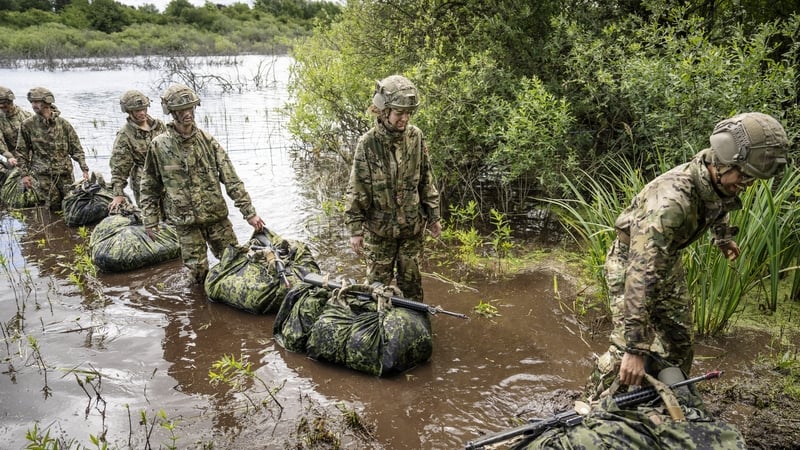

Russia's full-scale invasion of Ukraine made European governments reevaluate the strength of their own conventional forces and ask hard questions about whether their armies could muster a defence of their own sovereign territory in the event of conflict.
What has emerged in many countries in Europe since February 2022 is a return to some form of conscription or incentivised voluntary military service.
It largely reverses a trend of countries maintaining smaller professional armies, which became the norm in the 1990s and 2000s following the end of the Cold War and a temporary easing of relations between the West and Russia.
Since 2022, European governments have increased their spending on defence budgets, a process that accelerated this year with the return of US President Donald Trump to the White House.
Mr Trump's administration has been very clear that European governments need to shoulder more of the burden for their own national security, shattering a decades-old perception in European capitals that the continent can rely on an eternal American security guarantee.
Many defence ministries in Europe now favour providing military training to young adults as a way of bulking up their reserve forces in the long term.

In the past two weeks alone, Germany and France announced new schemes to enlist more young recruits into their armies.
Belgium also announced the reintroduction of a form of voluntary military service for all 18 year olds earlier this year, just as the Netherlands did in 2023.
Others, like Lithuania and Sweden, saw Russia's seizure and illegal annexation of Crimea in 2014 as an early warning sign to beef up their armies, and reintroduced conscription soon after.
Voluntary conscription
A vote by Germany's federal parliament on 5 December introduced a new system of voluntary conscription - a term that sounds like a misnomer.
In practice, the new law creates a voluntary system where recruits will serve between six to 11 months in the armed forces.
Starting from next year, all 18-year-old German males will be required to complete a digital questionnaire outlining their willingness to serve in the military and attend a medical examination.
Recruits will get paid about €2,600 per month, plus a bonus if they decide to extend their service period.
After completing this initial service, they will become reservists.
The scheme is designed to boost personnel numbers in the Bundeswehr, Germany’s armed forces, from the current level of 184,000 personnel and 60,000 reservists to 260,000 full-time personnel and 200,000 reservists by 2035.
But the law passed by the Bundestag last week also allows for the possibility of a wider compulsory draft if the security situation requires it, or if the target numbers set for the Bundeswehr are not reached.
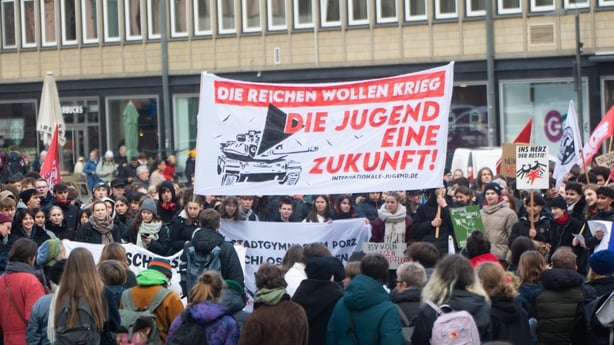
Protests by thousands of students in German cities last weekend indicated that any expansion of conscription measures could face stiff opposition.
Like Germany, France is introducing a form of voluntary military service for 18 and 19 year olds from next year, having previously ended conscription in 2001.
"At a time when all our European allies are moving forward in the face of a threat that weighs on us all, France cannot stand still," French President Emmanuel Macron said when announcing the introduction of the scheme on 27 November.
This new model will require recruits to serve 10 months in a military unit and Mr Marcon said he hoped that volunteer numbers would reach 10,000 annually by 2030.
Recruits signing up for this "new national service" scheme will be paid €800 per month, three times less than their German counterparts.

Northern exposure
Lithuania reintroduced conscription in 2015, one year after Russia's annexation of Crimea.
Sweden reintroduced a selective conscription model for both male and female 18 year olds in 2017.
A number of countries, including Germany, have replicated the Swedish model.
All 18 year olds in Sweden complete an online conscription questionnaire. After a series of stamina tests and interviews, the military decides on the most suitable candidates.
It means that fewer than 10% of 18-year-olds end up being conscripted in any given year.
Last year, 7,000 young Swedish men and women were conscripted to serve between nine and 15 months in the armed forces.

Finland, which joined NATO along with Sweden in 2023, never got rid of conscription following the end of the Cold War.
All Finnish men above the age of 18 can be conscripted to serve between six and 12 months in the military. Conscripts who object to military training can apply to complete non-military civil service, which can last twice as long.
Former conscripts then become reservists until the age of 50 and during times of emergency, Finland can mobilise up to 280,000 trained reservists.
Last year, Denmark extended its draft to 18 year-old women who serve up to 11 months alongside male conscripts.
Spare a thought for Norway's male and female conscripts as their period of service can run to 19 months.
Latvia reintroduced conscription for young men in 2023 after a pause of 16 years and its defence ministry has also proposed extending the draft to women in 2028.
All 18 to 26-year-old men must serve 11 months in the armed forces in Estonia.
The country has maintained conscription since gaining independence from the former Soviet Union in 1991.
Far from being a task that many young men deplore, many of the Estonian conscripts view their military service as a necessary undertaking.
And, like Finland, its conscripts go on to form the backbone of Estonia's reservist force of 40,000 personnel who can be called up in an emergency.
Citizen soldiers
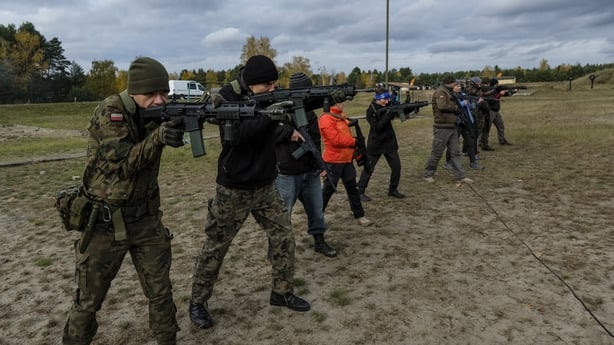
Poland ended conscription in 2008 and the current government in Warsaw has so far held off from reintroducing the draft.
Instead, earlier this year, Prime Minister Donald Tusk announced his government's plan to introduce military training for all adult men in the country and to build an army of 500,000 personnel, including reservists.
That plan has morphed into a military training course for all Polish citizens, which began last month.
Participants can decide to sign up for anything from one to 30 days of training.
A course covers basic military, survival skills and first aid training.
The government intends to train 100,000 people in 2027.
A survey conducted in late November by Polish media firm Wirtualna Polska found that 59% of those in Poland supported a return to compulsory military service, though other recent surveys have shown support at around 40%.
The United Kingdom, one of only two European nuclear powers, has no plans to introduce conscription 65 years after phasing out national service in the country.
A proposal by former conservative British prime minister Rishi Sunak to introduce a new form of voluntary national service ahead of last year's UK general election quickly faded away after the Labour Party returned to power.
Ireland and Malta, both militarily neutral, are unique in Europe for the fact that neither has a history of conscription and that is highly unlikely to change.
Italy and Spain, both NATO members, maintain large professional armies, but Italy's defence minister last month suggested introducing a voluntary service system similar to the new French and German models.
Looking at these conscription trends, an obvious picture emerges: the closer a country is located to Russia, the more likely it is to have reintroduced some form of conscription or bolstered its reserve forces since Moscow's invasion of Ukraine.
Travel farther west or south from NATO's eastern flank and societies are less likely to support drafting their young men and women into national armies.