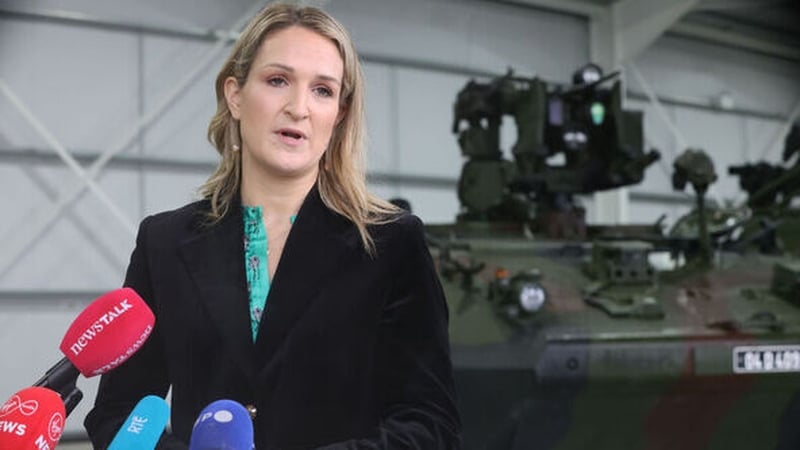
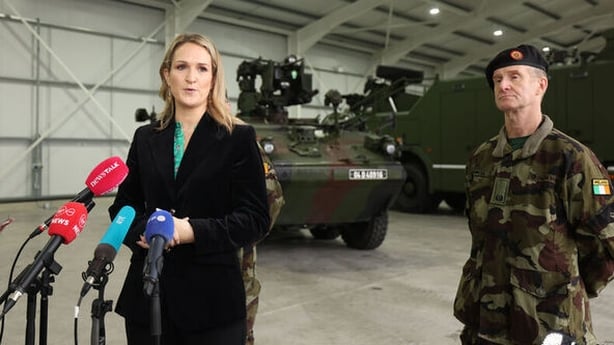
Maybe it was deliberate, or maybe there was nothing newer, but any eagle-eyed attendee at the launch of the spending plans for the Defence Forces in the Curragh this week will have noticed the age of the vehicles that served as a backdrop to the announcement.
An armoured personnel carrier with an 04 D registration, other military vehicles tagged 03 D and 07 D. Three vehicles polished and clean, but older than many of the soldiers that use them.
The army does have some younger fleet, but embarrassment aside, those vehicles effectively demonstrated the need to modernise and upgrade Ireland’s military systems.
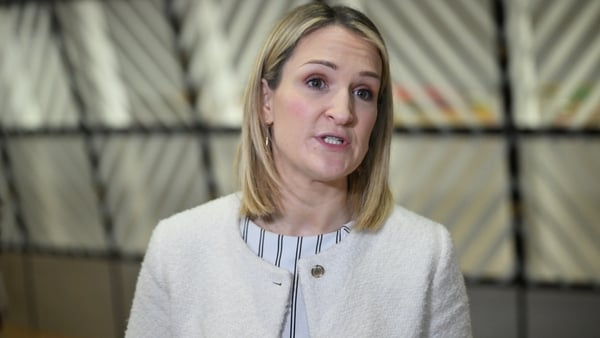
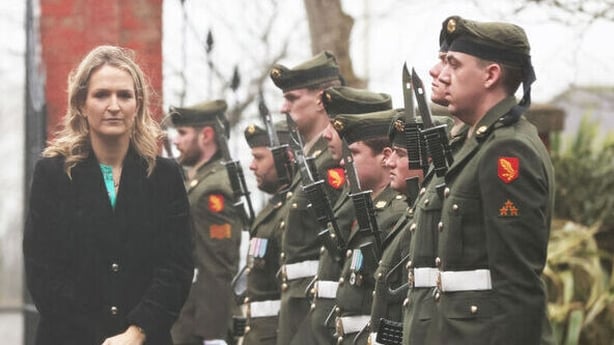
Many will see them as apt metaphor for the Defence Forces despite it being the day for announcing detailed spending plans of €1.7bn by Minister for Foreign Affairs and Defence Helen McEntee.
"It’s essential that we continue to increase our funding, our spending and our focus on the Defence Forces.
"We all know the changing environment and world that we live in. We know the type of changing threats that are emerging and my focus and priority as Minister for Defence is to make sure the Defence Forces are growing, expanding and we are enhancing capabilities," the minister said.
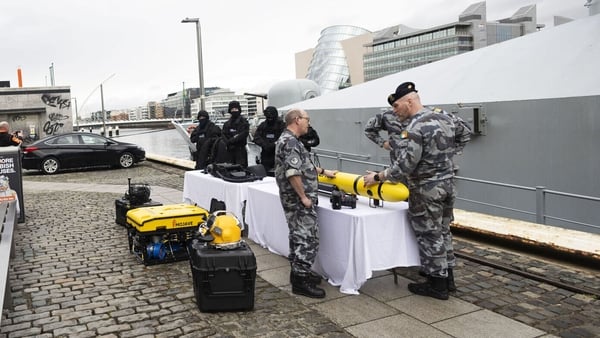
In fact, much of what is in the plan has been well flagged. Military radar to peer into the skies by 2028, counter-drone technology in time for next year's EU presidency, new aircraft, new army vehicles, towed sonar for the Naval Service and multi-million euro investment in IT, infrastructure and ordnance systems.
The expenditure increase reflects the Government’s decision to accept the 2022 Commission on the Defence Forces report and its "level of ambition 2" recommendation to get expenditure past €1.5bn.
Watch: McEntee outlines €1.7bn defence spending plan to run to 2030
Of course, much has happened since 2022.
Geopolitical uncertainty has ramped up with the war in Ukraine and the perceived Russian threat to eastern European countries.
US trade and foreign policy positions have engendered global concern, as has President Donald Trump’s attitude towards the EU and European security.
Amid the tension, cyber and hybrid attacks have increased across Europe, and Ireland is not immune to these.
That was brought into sharp focus two weeks ago when unidentified drones took to the skies 17km off the Dublin coast, around the time Ukrainian President Volodymyr Zelensky’s plane was due to land in Dublin.
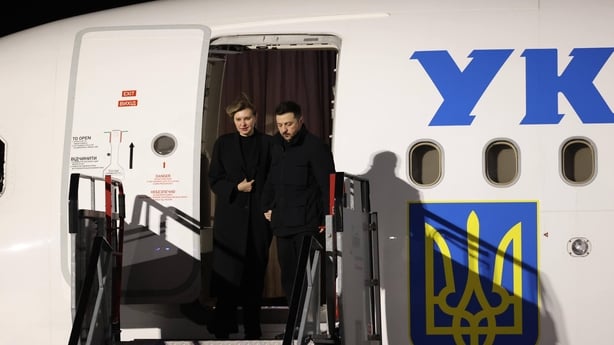
The source of the drones is thought to be a "dark" vessel, sailing without a transponder in the Irish sea.
The Government here and the EU have blamed pro-Russian actors. The Russian Embassy in Dublin denies any involvement.
The fact that the Naval Service was powerless to do anything about these drones is a source of concern for many.
In the last five years, this country has also experienced cyber-attacks, including the costly attack on the HSE, and incidents where Russian military aircraft flew into Irish airspace unknown to Irish authorities, requiring RAF aircraft to intercept them as Ireland has no fighter jets.
Since the Zelensky visit, whether by chance or by design, other voices have emerged urging defence and security to be taken more seriously by the Government.
The business and employers group IBEC said in recent days there is a pressing need to protect businesses with robust national security.
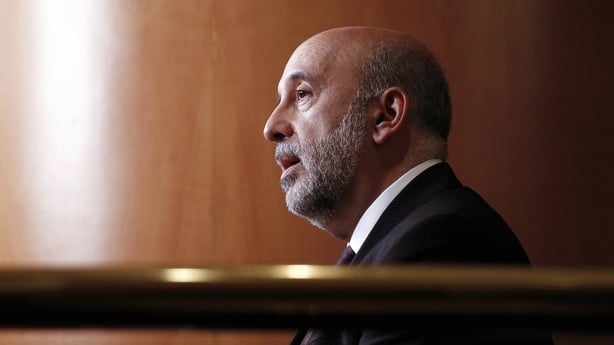
While Central Bank Governor Gabriel Makhlouf said security considerations must be included in planning for economic resilience.
A report from the Institute of Irish and European Affairs and Deloitte this week also highlighted the vulnerability of Ireland’s subsea interconnectors and data cables, cybersecurity, security of ports and the threats of espionage.
The perception that Ireland lags far behind its neighbours when it comes to defence and security is one that is widely held abroad.
Any internet search of 'Ireland, defence, weak link’ yields dozens of articles from news outlets such as the Wall Street Journal and the Financial Times as well as NGOs and think tanks that point to this country’s inability to secure our skies, our waters and sovereignty.
Yesterday, national broadcaster ERR in Estonia, a country that fears like Ukraine it too could be invaded by Russia, features an article on recent defence developments.
Ireland is known as a country without defence and people look at this and they cannot understand it.
"As security and defence has becomes more of an organisational issue for the European Union it provokes surprise that Ireland has not done its homework or preparation" said defence expert Dr Eoin McNamara, of the Finnish Institute of International Affairs.
Dr McNamara has spent years living in Estonia, Finland and northern Europe where the Russian threat is considered real.
He said: "Ireland is known as a country without defence and people look at this and they cannot understand it."
He said other countries also know how security reliant Ireland is on the UK.
Despite Ireland’s reputation as a strong democracy and constructive engager in the European Union, he maintains there is some annoyance that governments in Europe spend on defence where Ireland has not.
"Patience may wear thin with Ireland if not willing to make the sacrifice and spend the resources," Dr McNamara added.
As military tensions across the world are ratcheting up, we need to be a voice against militarism and for peace.
Others view Government spending on defence and security (apart from improved wages and conditions for soldiers) as complying with an international push towards militarism.
TD Richard Boyd Barrett of People Before Profit said: "The instigator of the notion that we should dramatically increase military expenditure in this country, and it's happening all across Europe, is Trump.
"It’s coming from NATO. It’s coming from the powers within the European Union, who first of all, have a fairly bad record on military interventions around the world and who are themselves trying to ratchet up the idea of a European military force and Europe becoming a military power," he said.
He said Ireland should be a voice against militarism and equates military spending with the erosion of Ireland’s long policy of neutrality.
"It’s a serious threat to our neutrality and our best safeguard if you like, our best protection, in my opinion is not being aligned with big military powers.
"As military tensions across the world are ratcheting up, we need to be a voice against militarism and for peace," Mr Boyd Barrett added.
Dr McNamara views the neutrality questions differently. He said: "No one has a problem with Irish neutrality at all.
"Finland and Sweden were neutral for many years and in their understanding that means extra responsibility and not less.
"The way things are presented in Ireland is like its binary between NATO or no NATO."
The debate over neutrality will intensify in the coming months.
The Government is moving ahead with plans to amend the triple lock and remove the need for a UN mandate as a prerequisite for deployment of Irish troops abroad.
That will happen in the New Year, by which time planning for and ensuring safe visits of all European leaders during the EU presidency here will be well advanced.
At the start of the week when visiting Dublin, President of the European Council António Costa expressed "full confidence" in Ireland's capacity to ensure the safety of EU leaders.
It remains to be seen if Ireland can do that itself or whether assistance from near neighbours or EU states is required.
A lot will depend on whether the €19m modern counter drone system the minister promised, as she stood before ageing military vehicles in the Curragh, is delivered on time.