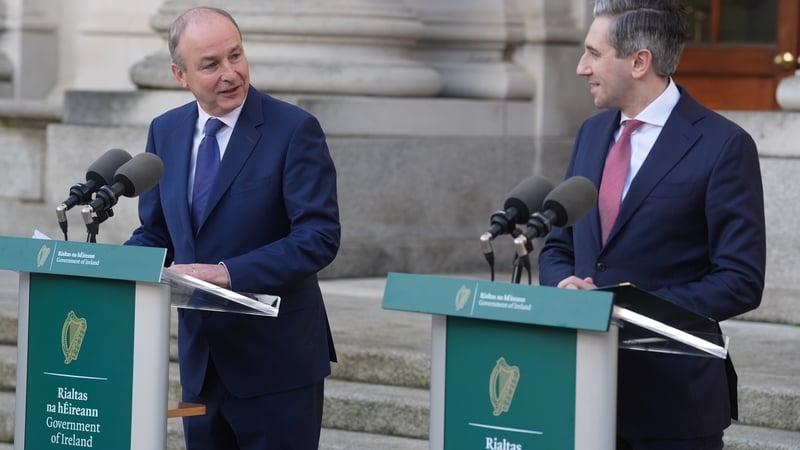

There was a real buzz amongst Government TDs and Senators in Leinster House this week after Public Expenditure and Reform Minister Jack Chambers published his well-trailed "Accelerating Infrastructure report and action plan".
It is a political big bazooka, a new policy which seeks to blast away planning sclerosis, institutional paralysis and overzealous objectors who are partially blamed for delaying the delivery of critical infrastructure.
There has been continuous and substantial backbench pressure on the minister to make significant progress on this front - and quickly.
As one Fianna Fáil parliamentary party member put it to me a few weeks ago: "We demanded that the emergency legislation would actually be an emergency."

The many measures include:
- A mechanism allowing projects to be designated as critical infrastructure "subject to Dáil resolution", with the Government granted emergency powers to ensure it happens.
- Reforms of the judicial review process, as the Government contends there's a need to reset the "imbalance" between individuals' right to object and project delivery.
- And with so many regulators these days, a regulatory simplification unit is to be established to review how they interconnect and recommend reforms.
Crucially, there's an "Accelerating Infrastructure Taskforce" to drive the reform, which includes high-powered and well regarded private sector people like Seán O'Driscoll.
The taskforce will remain in place for two years to ensure implementation of thirty time-bound measures which were devised to overcome 12 identified barriers to development.
One taskforce insider told me: "These 30 measures are water-tight. There's no wiggle-room. It's going to happen."
Opposition parties were not overly impressed as the plan was revealed, and they have reasonable grounds to be sceptical given the rate of housing delivery last year.
Sinn Féin finance spokesperson Pearse Doherty derided the Government's latest plan by saying the Coalition talks "a big game" but, when it comes to delivering homes and critical infrastructure, "they've been missing in action".
The Coalition is keenly aware that its ability to ease the housing crisis, and deliver badly needed infrastructure, will be the litmus test for many people by the time of the next General Election.
One Fine Gael backbencher told me last month: "If we don't deliver, we know we're screwed."
However, the Cabinet also needs to ensure that there are the required checks-and-balances so there's no return of a Celtic Tiger bubble and gruesome bust.
It is a significant issue, even if it runs counter to the current clamour to build as quickly as possible.
When I was RTÉ's Environment Correspondent between 2001 and 2010, the Celtic Tiger roared and then promptly keeled over and died.
Amid the grim aftermath, there was a memorable meeting at An Bord Pleanála headquarters in Dublin.
As usual, I was sitting with Frank McDonald of the Irish Times and Treacy Hogan from the Irish Independent.
We covered beat each day, and had been dubbed by former Environment Minister Martin Cullen to be the "three wise men", albeit that it was delivered in a jocular fashion to ensure we knew what he really thought.
The person we were speaking with that day was the outgoing chair of An Bord Pleanála John O'Connor - a slim, serious man who had a thatch of grey hair, steel rimmed glasses and who rarely smiled.
He had been in office for more than a decade as construction first went off the scale and then crashed and burned until there was nothing but ashes.
There was some mea culpas from Mr O'Connor, as he expressed regret that so many housing developments over the previous decade had been too large and built in places which were too remote.
In sentiments he repeated at a later planning conference in Galway, he said that his board should have intervened in a more robust fashion to stop the madness.
However, he wasn't taking all of the blame by a long shot.
Mr O'Connor also had a right go at local politicians who facilitated bad re-zoning decisions and builders who capitalised on them.
Land owners were given a right dig for trying to get around rules rather than complying with them, something which unscrupulous developers facilitated.
It was quite a rogue's gallery: politicians, planners, developers, builders and land owners.
From memory he did not mention the banksters, but their nefarious role in the property disaster was already writ large.
These incredibly painful lessons must be taken into account by the Coalition today, as it seeks to super-charge development in response to a clear need.
Read the latest political stories
Government TDs regularly cite the Greater Dublin Drainage Project as being emblematic of an inability to deliver critical infrastructure on time and on budget.
Yet, equally, It would be unconscionable to loosen the laws to such an extent that cowboy culture returns to wreak havoc.
It also must be accepted that not every objector is either being malicious or mendacious.
We need to get this right.
Afterall, the Government has committed to spending an incredible €112bn on critical infrastructure over the next 5 years.
And we know, to our great cost, that big money can deliver big problems rather than real results.