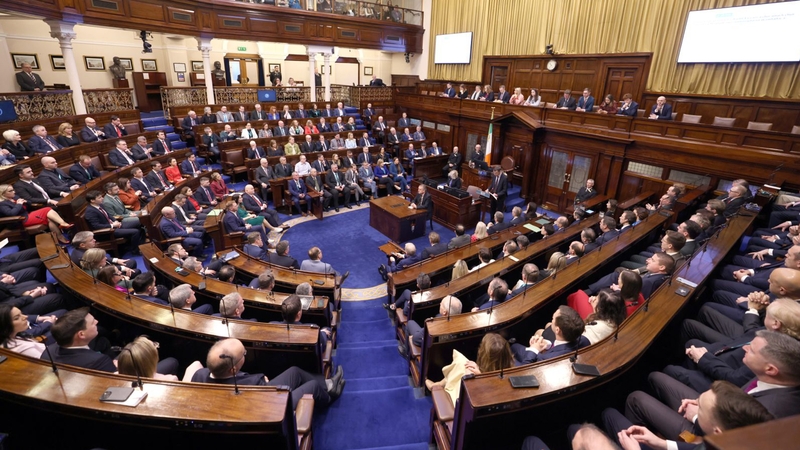

We are in the eye of the storm when it comes to the Dáil speaking rights row.
The Coalition scored a victory of sorts last night at the Dáil Reform Committee.
It used its majority to vote through a plan to give regional TDs and Government backbenchers the chance to put questions to the Taoiseach.
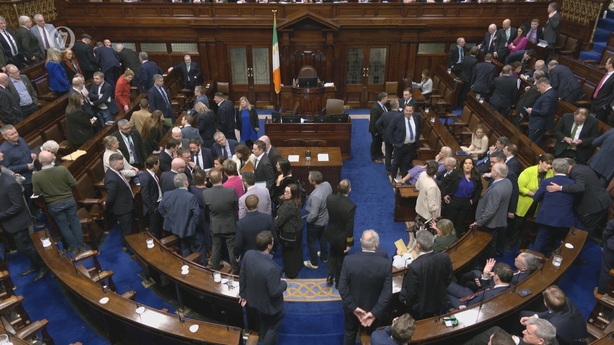
But the proposal still has to be debated in the Dáil next Wednesday, in what is likely to be a tumultuous affair.
The Plan
We do not know the details of how the Government proposes to change the Dáil's Standing Orders.
The final proposal, it is expected, will not be forthcoming for a few days.
However, the broad principles are contained in a document submitted to the Dáil Reform Committee by the Chief Whip Mary Butler.
It used to be the case that only Opposition TDs could participate in the high-profile Dáil slots of Leaders' Questions and Priority Questions.
This will now be changed to allow regional TDs and Government backbenchers to do the same.
The mechanism is to create a new Standing Order to allow for "Other Members' Questions."
The Consequences
Opposition parties despise both the plan, which they characterise as bending to the will of Independent TD Michael Lowry, and the approach which the Government has adopted.
It has led to a unique level of coordinated action by five Opposition parties.
In response to last night's vote, the combined Opposition today withdrew pairing arrangements for Government TDs.
Pairing is a procedure which involves an opposition TD abstaining in a vote if a deputy on the government side has urgent business to attend to or is ill.
The row, which has run for six weeks and will continue for a while more, has also led to Oireachtas committees not functioning.
The absence of entities like the Dáil Public Accounts Committee means political scrutiny of public bodies is not taking place.
It also means that proposed legislation is not being considered.
Opposition parties say they are not ruling out anything in their bid to fight back against the plan to amend Standing Orders.
That means there could even be a walk out by Opposition TDs from Dáil Eireann.
The Language
At times the language employed by both sides in this dispute has appeared to be out of kilter with what is being argued over.
When Micheál Martin failed to be nominated as Taoiseach last month, he railed against what he termed the "subversion" of the Constitution.
Last night, the Sinn Féin leader Mary Lou McDonald characterised the approach of the Government as "dangerous".
The intensity reflects the depth of feeling about this issue on both sides.
It also raises the possibility of the row infecting the entire relationship between Government and Opposition in this Dáil.
The Compromise
Opposition parties have renewed their calls for a meeting with the Taoiseach and the Tánaiste to resolve the dispute.
There is a week to find some formula of words which can make the Government proposal more palatable, given a final text has yet to be circulated.
But the omens are not good.
In the Leaders’ Question slot today, Sinn Féin's Matt Carthy accused the Tánaiste of being "hell bent on plunging this Dáil into chaos".
Simon Harris replied in kind, slating Sinn Féin for "utterly childish behaviour" in demanding "minority rule".
And as the row rolls on, there are reports of tariffs in the order of 25% barrelling across the Atlantic at a pace.
It would be best for the Government, Opposition and public if the rhetoric ended and a resolution was found behind closed doors.
And fast.