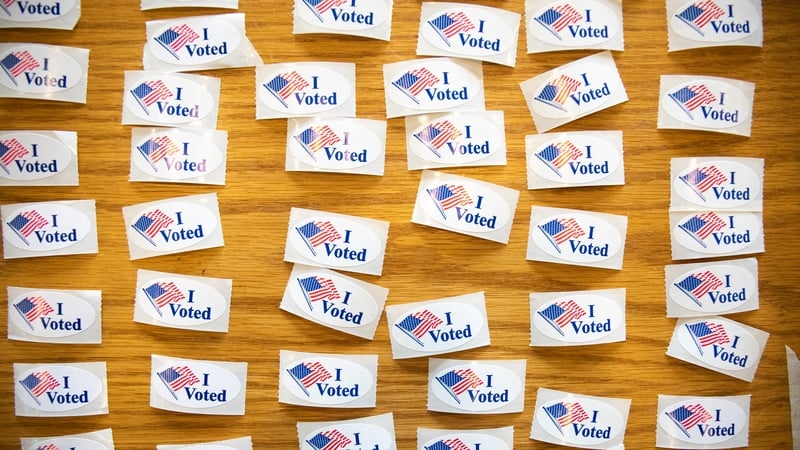

We trekked through snow covered countryside to find one on the outskirts of Exeter, New Hampshire, during the Republican primary in that state in at the end of January.
It was a short distance from the New England Dragway - a drag racing strip, where two cars race each other to be first across the finish line.
Sometimes the cars are old models that have been worked on and enhanced for years; sometimes they are newer models, benefiting from the innovations that constantly occur.
In the end it is a combination of engine power, transmission system, tyres and driver skill and control that determines the winner.
And of course, you can see where this rather obvious simile is taking us. New Hampshire was the first presidential primary election of the year and effectively the last one as well.
Only one challenger to Donald Trump limped out of that brawl to hang in the fight while all others has fallen: Nikki Haley.
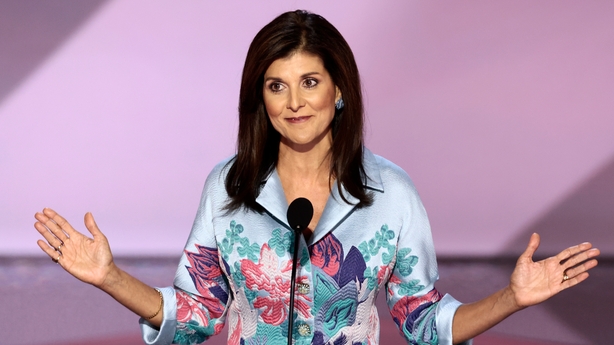
Her pitch to the Republican Party was - it's time to change generations. It was summed up in her stock answer for TV interviews and gatherings like the one in that snow-bound high school theatre, and answer that sets her up as the prophet of this election cycle: "The first party that withdraws its 80-year-old candidate will win this election."
It was a challenge to both the big parties that dominate politics here. Now the Democratic Party has taken up the challenge - on Friday night Kamala Harris formally gathered enough votes in a virtual roll call vote of delegates to the Democratic Convention to get the party nomination for the US presidential election.
There is a two-decade age gap between her and Donald Trump.
The Nikki Haley test is on. Were this the New England Dragway, we would be talking about a race between two well known old timers suddenly becoming much more interesting with the replacement of the most venerable vehicle with a much newer model - different lines, different engine note, different tyres, relatively unknown driver.
A whole new contest.
Exactly the type of thing to perk up a jaded crowd.
Novelty. Change. Challenge.
For the first half of this year, the US presidential election has been one of the most boring ever - the absolute dominance of Trump and Biden in their respective parties sucking the air from the primaries and nomination process.
So much of the country's politics was taking place in the shadow of the two oldest candidates to contest the presidency that at times it appeared as if there were no other politicians of note in the United States.
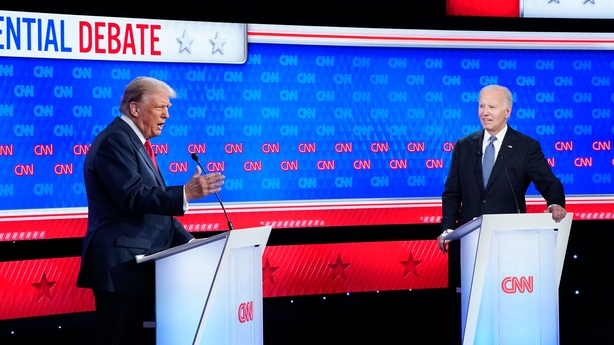
Which of course was never true.
Now, after one of the most extraordinary months ever in US politics, it has become one of the most energised and fascinating presidential campaigns ever.
Former British prime minister Harold Wilson is usually credited with the phrase "a week is a long time in politics".
Imagine how long the past month has felt for politicians and their retinues.
It is only two weeks since Biden dropped out of the race, only a matter of hours since Harris was formally locked in as his replacement. But of course, there are polls. And there are enough of them to draw a few broad conclusions.
First, it is not all over - for either candidate. Trump is actually scoring a higher approval rating now than at any time since the start of 2020.
Not that it is a high approval rating: in fact more voters have an unfavourable view of Trump than a favourable one in the latest Wall Street Journal poll, which gives him a 47/50% favourable/unfavourable split.
But that is a big improvement on the nine previous polls in the series going back to 2021, in which Trump never got more than a 37% favourable rating.
In the 538 website’s aggregation of polls, Trump has also gained some favourability among voters - but he is still 8.8 points behind a favourable rating.
In all the polls since January 2021, Trump has never been ahead in the favourability rating.
Kamala Harris used to be ahead on favourability... for the first six months of her time as vice-president.
But from late July 2021 until now, Americans surveyed found her more unfavourable than favourable - usually by a 15-point margin.
She seemed to track the Biden favourable/unfavourable chart, both falling out of favour when the retreat from Afghanistan turned bad, and never recovering.
Until now. In the past week she has closed that gap to 6.6 percentage points.
And that was something Biden was not able to do. 538’s aggregate of opinion polls on voting intention - 28 of them since 26 July - put Harris on 45% and Trump on 43.5%.
That gap of one and a half points is within the equivalent of a margin of error in a poll aggregating exercise like this.
So essentially they are neck-and-neck.
More polling in the battleground states will add detail for these states, which will be more informative than national polls in trying to see where the race is going.
But most of the polls from battleground states echo the broad trend of Harris closing the gap that had opened up between Trump and Biden. Still it is early days for Harris, just a fortnight into what will be the shortest campaign for a presidential candidate in modern history.
When y’all over in Ireland come back from your bank holiday, it will be just 90 days to election day.
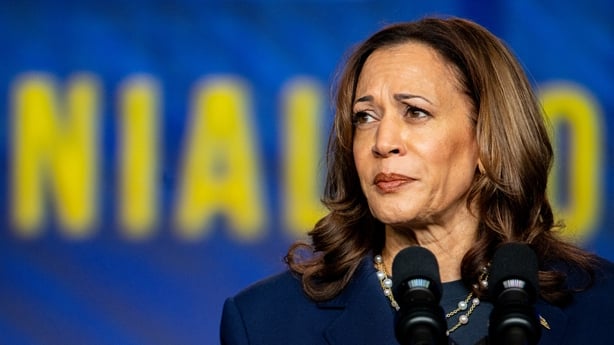
So Harris needs to move quick. The polls indicate that she has gained momentum, and won back some of the voters that brought Biden to power in 2020, but who had turned away over the past year: young voters and people of colour.
A New York Times/Siena poll found Harris is now much stronger than Biden was at any point during this year among young voters, Blacks and Latinos, and is scoring close to parity with Biden among older and white democrat voters.
But Harris is still short of the numbers that Biden won with in 2020 in all those demographics, so has plenty of work to do in the time available. But right now Harris has momentum, and she has an energised base and party machine, two big things that Biden lacked.
And those polls were taken before Trump's appearance at a conference of Black journalists on Wednesday, in which he engaged in an unedifying set-to with a journalist from ABC News in which he attacked Harris on racial lines ("she was Indian, she suddenly became Black").
Some state level polls (more important than national polls, because the presidency is decided by the outcomes of 50 state elections), show Harris consolidating the Democratic Party in states that should be rock solid Democrat votes in the electoral college, such as the afore mentioned New Hampshire, where two polls show Harris getting the kind of lead Biden won there four years ago, and Minnesota giving her a six point lead over Trump, close to Biden’s winning margin of seven points last time.
This is reassuring to Democrats, who had been unsettled by Republican claims that Biden’s debate performance was so bad that some traditional 'blue' states were becoming open contests where Trump could win - hence the talk of a landslide in the wake of the assassination attempt and Republican convention.
Now the situation has turned around so rapidly that the election nerds of America seem to think Harris has opened up more pathways to the winning target of 270 electoral college votes than Biden had - by bringing more states into play.
Biden’s path to 270 had narrowed to the so-called 'blue wall' of Pennsylvania, Michigan and Wisconsin: lose any of them - especially Pennsylvania - and it was all over for Biden on 5 November.
All the other battleground states - Georgia, Arizona, Nevada - were deemed lost to Biden.
Mainly because Biden was doing so badly among the Black, Latino and youth voters, mostly because of his position on the war in Gaza.
By winning back a large chunk of the voters that Biden lost, Harris has brought these states - and possible more - into play for November, giving her more paths to 270.
North Carolina, with a large black population and several university towns, may also be edging into contention. Some Democrats even fantasise about Florida, Trump’s new home state, coming into play over the abortion issue - propelled up voters list of concerns by a new six-week abortion limit in the state.
But the Republican party is very strong in the state, with the Governor, Ron de Santis, and both senators, Rick Scott and Marco Rubio - the latter a one-time potential vice presidential pick for Trump, and a near rout of the Democrats in the last house election (after a skillfully engineered and legally watertight gerrymander by the governor).
It is full of retirees, who tend to vote for Trump, and he is after all the local candidate.
Even so, the prospect of a strong Harris performance will mean the Republicans will have to divert some resources from elsewhere to head off that challenge.
And that might be the case in other states as well, where more resources will have to be expended in combatting a Harris candidacy than a Biden candidacy.
Biden has got a huge bounce in the polls over the past fortnight in one respect: his decision to drop out of the race has proven to be wildly popular with the voters, especially Democrats.
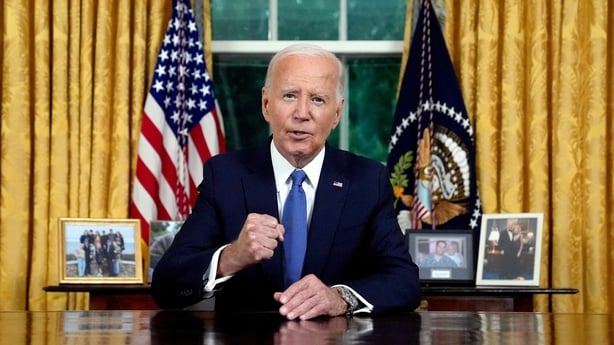
His general approval rating was 39% before he dropped out, but the decision to quit the race was approved by three in four voters in the New York Times/Sina Poll.
A Fox News poll in Pennsylvania found 78% approved of Biden dropping out.
By voter affiliation that same poll found 86% of Democrats approved Biden’s move to exit, compared with 69% of Republicans.
For the Trump campaign, which was largely built around fighting Joe Biden for the presidency, the switch out has been a problem - requiring them to recalibrate the campaign to go after an entirely new candidate (though once again, it was Nikki Haley who warned through out her primary campaign: "vote for Biden, get Harris").
There was some contingency planning, but clearly a refocus is under way.
That wrong-footing so soon after the Republican convention has given Harris precious time to define herself for the American voters, many of whom don't know much about her.
Clearly thought about well in advance was her immediate tag line: "The Prosecutor v the Felon."
The immediate Republican response was to label her a "radical left San Francisco liberal" - a collection of words that signals the kiss of death among hard core Trump voters.
But they were never going to vote Democrat anyway. It is the potential swing voters - suburban women, Independents, even perhaps (mostly) white manual workers - that neither side has nailed down yet, and where the campaigns must focus next in the race for votes.
Harris should enjoy additional media buzz and potential voter bounce in August, with a choice of vice presidential pick coming in the next few days, and the Democratic National Convention taking place in Chicago from 19 August.
If he is wise, Trump will use this time well, re-tooling and recalibrating his campaign to be ultra-competitive when it counts in the autumn.
If he is not wise, he will risk looking desperate by chasing the limelight in August, instead of doing just enough to remind people he is out there, enough to throw a bit of grit in the wheels of the Harris image making machine without turning too many voters against him, and be fresh for the off in September.
Because the traditional start of the full-on presidential campaign is after the Labour Day public holiday on the first Monday of September, which this year falls on 2 September.
By then we probably will be able to wheel out the drag race analogy with a bit less shame: two cars at the start line; the noisy old timer against the sleek newcomer. By then there will be 54 days of campaigning left.
After a campaign that has felt like an eternity, Trump and Biden slowly stalking each other for the past three and a half years, that last sprint really will seem like a drag race.
Suddenly, we have a contest. And America is starting to pay attention.