
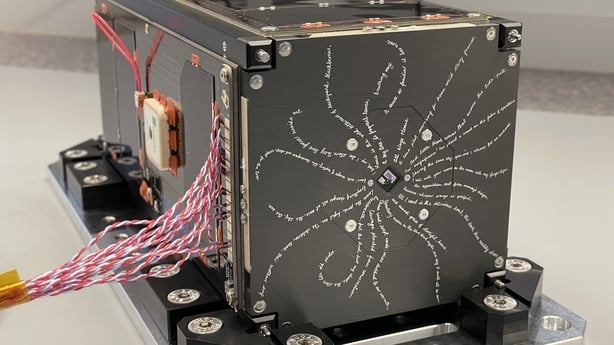
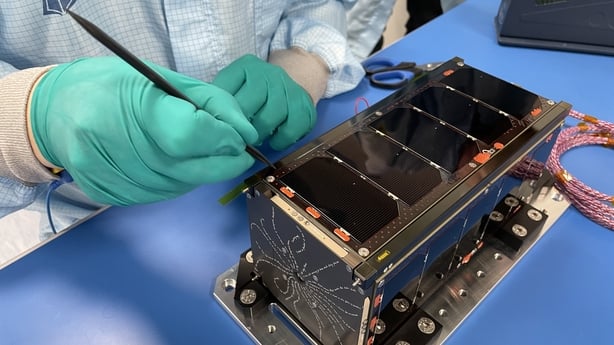
Space. The final frontier. Ireland is about to boldly go, as early as January or February. Our first space mission will be to launch a satellite.
Catchy title? It's the Educational Irish Research Satellite, or EIRSAT-1.
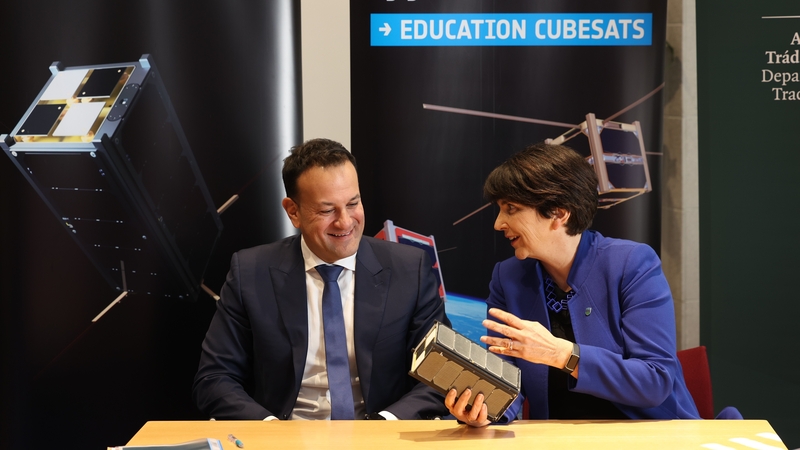
Announcing the mission at Government Buildings last Monday, Tánaiste Leo Varadkar was excited, hailing it a "huge milestone".
However, some of the reaction to a tweet I posted from the event suggested there were others less than impressed.
One such reply was from Jim Fitzpatrick, best-known for designing the iconic red and black image of the Argentine revolutionary, Che Guevara, wearing a trademark beret .
To the news of Ireland’s first rocket adventure, Fitzpatrick quipped: "Hopefully with Leo in it."
Others were equally mocking: "Space cadets this government"; "This IS Waterford Whispers, right???"; "Micks in SPACE"; and "This HAS to be called SpudNik."
Derision is one thing. Outright opposition is another.
Some questioned the timing during an energy crisis, cost-of-living crisis, and housing crisis.
One tweeter, David Swinburne, spoke for them when he responded: "And we still have the homeless on the streets, beggars belief."
Sure, Twitter doesn't reflect the nation at large.
But it is a straw in the wind, I’d suggest, that the public needs to be convinced on the benefits of our space programme.
The reason for Monday’s news conference was that the Tánaiste had just signed an agreement with the European Space Agency.
The ESA is planning to launch EIRSAT-1 from French Guiana some time between late January and late February 2023, on a four-year mission.
It’s hoped that the satellite will tell us more about how the universe is formed.
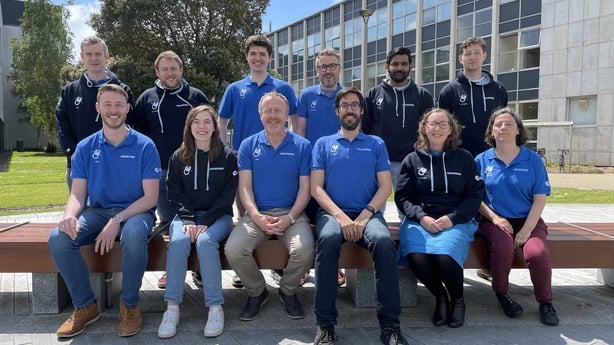
One of the EIRSAT-1 team, Rachel Dunwoody, explained how it includes a gamma ray detector for examining exploding stars.
A PhD student at UCD, she told us that simulations were already being conducted, in advance of the launch.
Also attending the event were the Director of UCD’s C-Space Centre and the EIRSAT-1 project, Prof Lorraine Hanlon, and UCD’s vice-president for Research, Innovation and Impact, Prof Orla Feely.
As well as filling us in on about EIRSAT-1, they also floated the possibility of future missions, including the possibility of launching larger satellites with weather-monitoring capabilities.
The UCD experts advanced the argument that Ireland has the skill set to capitalise on space exploration.
Prof Feely observed that our country had strengths in electronics, advanced manufacturing, artificial intelligence and data analytics.
She contended: "We see a huge opportunity for Ireland to play a major role in space science and earth observation."
The question, however, is what will this atmospheric bursting endeavour cost?
Will the return on the investment shine bright as shooting star, or could the Exchequer be throwing money into yet another black hole?
Independent TD Michael McNamara was following the intergalactic money trail earlier this month, asking a parliamentary question about "the amount paid to the European Space Agency from 2002 to date in 2022".
In reply, Minister of State Damien English stated: "Ireland’s annual contributions … cumulatively is just over €325 million."
He then blinded the Clare deputy with science, referencing "geo-return".
It turns out this means that a proportional amount of the money invested in the ESA is returned to Irish businesses to develop and build new technologies.
Notably, there are 97 of what’s called "space-active" Irish companies with ESA contracts. And the space pie is expanding faster than the Universe.
It’s estimated the global space economy was worth $350bn (€355bn) in 2020, but is projected to grow to $1tn (€1.02tn) by 2030.
In a Dáil speech last July, Minister of State Damien English sought to sell the concept of EIRSAT-1 to the wider public by reminding us how satellite technology is ever-present in our lives.
He referenced sat-nav, weather apps, broadband, TV services, as well as data on the health of our planet.
The minister said: "Satellites can measure air quality in cities and the rate of melting of icecaps, for example, and they can monitor deforestation and inform policy decisions targeting sustainable agriculture all over the world. Critically, in emergencies such as floods or fires, satellite data can be used in real time to assess damage, supporting a safe and informed emergency response."
At the event in Government Buildings this week, the Tánaiste was in agreement, saying: "It has huge spin-off potential for Irish businesses and universities."
Mr Varadkar said Ireland’s contributions to the ESA have been paid back "in multiples".
That view is also shared on the Opposition benches.
Social Democrats co-leader Catherine Murphy spoke supportively in the Dáil about Ireland’s expanding space ambitions.
She asserted that our involvement with the ESA had opened business opportunities for Irish aviation and aerospace-focused companies.
She felt that our participation in ESA-led projects also facilitated learning and development at places like UCD.
Will that win the sceptics over? Probably not.
However, the launch of the EIRSAT-1 satellite will be the most significant moment in Ireland’s engagement with space to date.
Up to this point, our involvement has been limited to providing personnel who have collaborated on space missions - living vicariously through their stellar success.
People such as the legendary Prof Susan McKenna-Lawlor, from both UCD and Maynooth University, who is possibly best known for her participation in the Rosetta mission.
In an extraordinary ESA operation, a spacecraft was launched in 2004 and, a decade later, managed to rendezvous with a comet 405,000,000km from earth.
Unbelievably, the ESA was then able to drop a lander on the comet’s surface - a seven-hour descent at a relative velocity of about three feet-per-second.
More recently, Irish people have been following the trojan efforts of Dr Norah Patten, from Ballina in Co Mayo, to become Ireland’s first astronaut.
Flying as a @PoSSUMAstronaut researcher on a microgravity flight w @NRC_CNRC is a lifetime highlight 🚀 I simply cannot wait until @blueorigin & @virgingalactic start flying researchers like me to suborbital space 👨🏼🚀 Let's do this 🇮🇪 pic.twitter.com/5WC6l3sJ43
— Dr. Norah Patten 🚀 (@SpaceNorah) August 31, 2020
But an actual Irish space mission is unique, albeit that EIRSAT-1 will be just one of several satellites launched by the same ESA rocket next year.
There will undoubtedly be interest in the launch and, it is hoped, successful deployment.
Beyond that again is a bigger and more difficult mission to ensure that the public is brought along on the need and value of Ireland’s ongoing space adventure.
To infinity. And beyond.