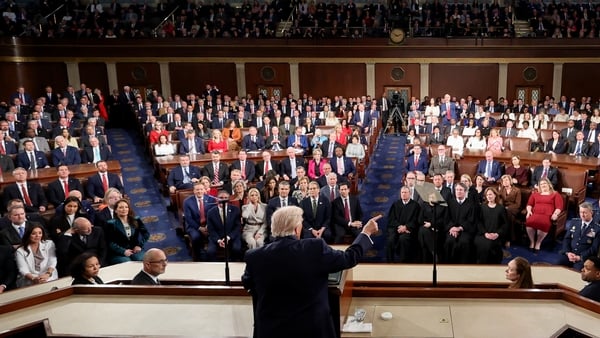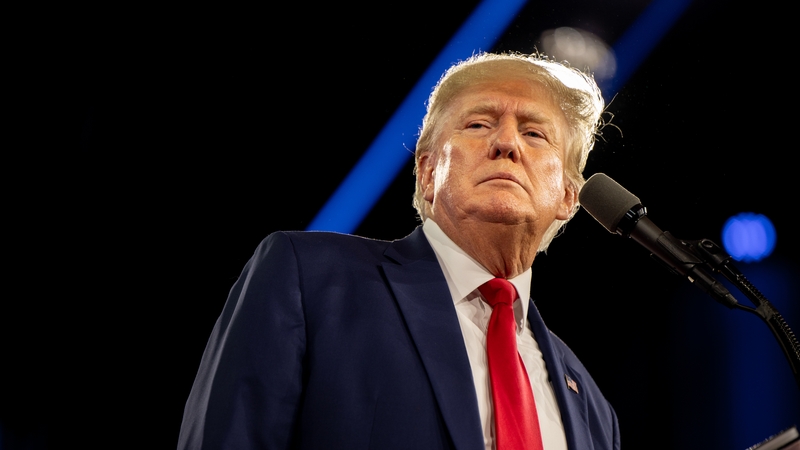

There is a line that connects the past, the present and the future of Donald Trump's dominance of the Republican Party. And that line runs through the elections of 2020, 2022 and 2024.
In 2020 he lost the Presidential election - but has never acknowledged that fact.
In 2024 he seems determined to try and become the President again. But in this year - the midterm year - he is not standing in any elections, but lots of "his people" are.
And that could have a bearing on how things play out in the Republican party between now and then. And perhaps play a role in determining the outcome of the 2024 Presidential election.
They say the best form of defence is attack. Certainly Donald Trump has been playing offence for the past year or so. His chosen vehicle for asserting his leadership over the Republican Party has been the primary elections that have been taking place over the summer months.
The Primaries are the way the US party system selects candidates for the actual elections that will happen in November, by letting party members (and sometimes non-members) vote in elections.
This week's loss by Representative Liz Cheney is the most high profile of the primaries that have been taking place. She was defeated by a candidate backed by Donald Trump.
Although enjoying incumbent benefit, and having a massive financial warchest (about $15 million compared to the average congressional election fund of just under $3 million), and the backing of many establishment Republican party members, including her own father Dick Cheney, she was heavily defeated by Harriet Hageman, a fairly recent convert to the Trump cause.
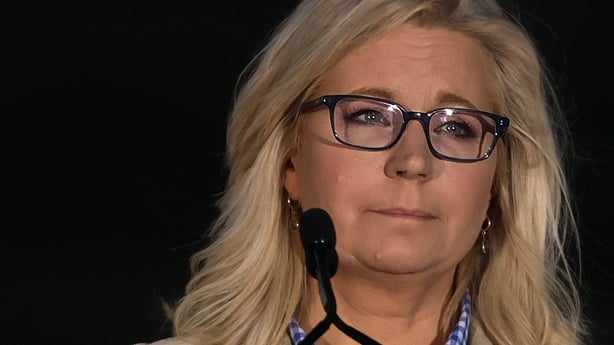
Liz Cheney is the most prominent Republican critic of Trump over his claim that he won the 2020 Presidential election, and his refusal to accept the election result. In the 6 January Committee on Capitol Hill, she has led the charge against Trump, alleging that he was at the very centre of a conspiracy to try and subvert or overturn the outcome of the 2020 vote.
She has backed up her claims with carefully selected video and audio testimony from witnesses who have appeared before the committee, presenting the committee’s findings in prime-time TV slots that have drawn big audiences.
And yet she lost to Hageman - a lawyer who accepts the Trump narrative about the 2020 election - who was overwhelmingly backed by Republican voters in Cheney’s home state of Wyoming.
Much has been made of the fact that Cheney is the eighth of the ten Republicans who voted to impeach Donald Trump in 2021 to not go forward to Novembers elections – four by leaving politics; four who lost Primaries to Trump backed candidates.
In this election cycle, Trump has given a personal endorsement to 222 candidates in House, Senate and State elections.
Overall Trump-backed candidates in seven of the ten seats, and "his" candidates won six out of those seven races. Only one of the ten who faced a Trump backed challenger won his primary (Dan Newhouse in Washington State).
It has largely been seen as a tale of revenge by Trump, taking out his enemies, and sending a message to the rest not to step out of line. A demonstration of power.
But the congressional elections are only a part of the midterm elections story. Also in play are hundreds of state level positions - governors, state legislators, and officials, like attorney generals, Secretaries of state and others involved in state and local government, down to county level.
What makes those posts of interest to an international audience is that many of the local officials who are going through the primaries now, and who will face election in the autumn, will be the people who will organise and certify the next presidential election in 2024.
The theory is, the more pro-Trump people who get elected to key positions of electoral-process influence prior to the 2024 Presidentials, the more likely it will be that some of them will be more amenable to phone calls from a well known candidate who might feel he has been done out of the "right" result.
In this election cycle, Trump has given a personal endorsement to 222 candidates in House, Senate and State elections. So far his preferred candidates have won 94% of the time, according to analysis of primary results to date by the Washington Post.
But the number is rather flattering, due to Trump endorsing 68 candidates in uncontested Primaries, and 93 in landslide wins - many of whom only received a Trump nomination after local polling showed which way the political wind was blowing.
Only 21 wins were in close contests, where the Trump endorsement may have made the difference. Still they all stack up, and help Trump to present himself as the true leader of the Republican party.
The plan is far from foolproof, of course. They still need to get past the primaries – 11 Trump-backed candidates have fallen at this hurdle - and the actual elections in the autumn, where they will face a re-energised Democratic party.
But it is a numbers game - the more horses you back, the more chance you have of some of them coming home. And those horses will feel that they owe Donald Trump a political favour.
One place this strategy has not worked so far is Georgia, the state where associates of Mr Trump - such as his personal lawyer Rudy Giuliani - have been subpoenaed to appear before a Special Grand Jury in a criminal investigation of attempts to influence the outcome of the 2020 Presidential election.
Georgia Republicans do not appear to have much time for the election conspiracy theories pushed by the Trump camp.
The first person to testify to the Special Grand Jury was Brad Raffensperger, the Secretary of State of Georgia.
He also appeared at the 6 January Commission presentation of evidence in Washington, where he was questioned by Liz Cheney about a phone call he received from then president Donald Trump, asking him to help "find" an extra 7,800 votes that would enable Raffensperger to change the declared result of the elections in Georgia, a key state in determining the outcome of the race for the White House.
Raffensperger famously recorded the conversation with Trump, and made it public. It was replayed in the Congressional hearings. It was also cited in the second articles of impeachment against Donald Trump last year.
Journalist Carl Bernstein, who helped uncover the Watergate scandal of 50 years ago, said the Trump call to Raffensperger was "far worse than anything Nixon did".
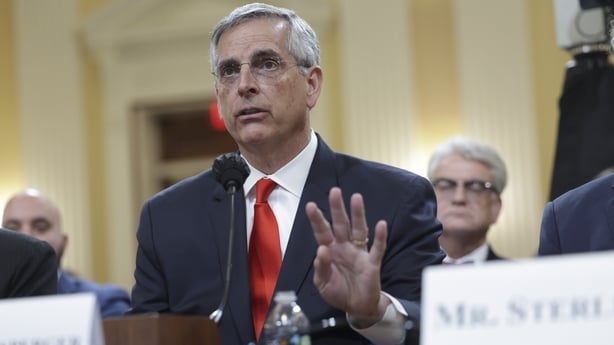
In May, Raffensperger also faced a primary election, to win the right to stand again for the Republican party. Donald Trump backed another candidate to stand against him.
That candidate, Jody Hice, claimed Raffensperger did not do all that he should have to investigate claims of election irregularities and look for other evidence that could have delivered the state to Trump.
He lost the challenge - Raffensperger came home with a twenty-point lead, winning an absolute majority and avoiding a runoff.
Georgia Republicans do not appear to have much time for the election conspiracy theories pushed by the Trump camp, at least when it comes to choosing their own state officials.
Primaries for the Governor of Georgia, and the State’s Attorney General also saw the incumbents rout their Trump backed challengers by 50 pint margins. But it was not without hard work, particularly by Raffensperger, who claims to have put 40,000 miles on his car, touring the state to talk to small groups of Republican voters.
He had to overcome death threats and intimidation as well to pull off what veteran Republican consultant Chip Lake told NBC news was "the biggest political comeback I have seen in that state".
Elsewhere, the Democratic Party has helped some of the more extreme pro-Trump candidates to get on to the ballot for November's elections. Party tacticians think it will be easier to beat the more extreme candidates.
Now political pundits are speculating on what could happen if a Governor refused to certify the slate of electors.
But this is a high risk play: it is quite possible that some individuals holding extreme pro-Trump views will get elected to positions that could make it easier for Donald Trump and his supporters to influence the outcome of the 2024 elections.
And the Democrats will have made their election easier by helping them to get into pole position for November’s elections.
The one to watch here is the race for Governor of Pennsylvania, a key battleground state for 2024.
The Republican nominee is Doug Mastriano, a retired army colonel and state senator since 2019. He won through in a field of eight, but only received Trump’s endorsement three days before the poll, after being the clear leader for the previous six weeks.
He is an "election denier", who tried to overturn the result of the Presidential election in his own state, claimed the election was riddled with fraud and irregularity, and said that if elected he would de-certify voting machines used in counties he claims held suspect elections.
He was a key local figure in the "stop the steal" campaign, organising a meeting in Gettyburg weeks after the 2020 election that featured an address by Rudy Giuliani.
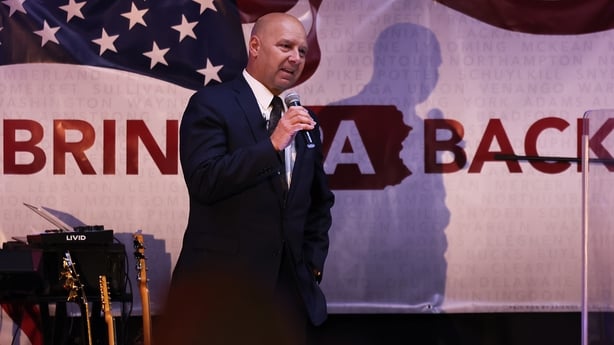
He also helped commissioned an audit of voting machines used in rural counties, and pushed in the State house to have its members decide who should bear the State’s 20 electoral college votes to Washington, not the pro-Biden voters determined by the popular vote in the State (which Biden won by 80,000 votes).
But it’s the future election, the one in 2024 that is play in this state in 2022.
In Pennsylvania, the Governor directly appoints the Secretary of State, who serves as the chief elections officer and certifies the results for the State.
Mastriano told Steve Bannon’s "war room" podcast in April that he already has someone in mind for the job, whom he described as a "voting-reform-minded individual who has been travelling the nation and knows voting reform extremely well". The Governor personally has the job of certifying the electoral college result for the state.
Now political pundits are speculating on what could happen if a Governor refused to certify the slate of electors. Remember, the 6 January committee is investigating a scheme to submit alternative or "fake" elector lists to Mike Pence to scramble the process to officially declare the winner of the 2020 Presidential election - the very reason Congress was meeting on 6 January 2021.
Mastriano was also present at the 6 January rally in Washington, and appears in videos moving towards the Capitol. He says he did not cross police lines, and left the scene when it turned violent. He did not enter the Capitol building.
His focus on the November 2020 election is what won him the Republican nomination. But Republican strategists have said it won’t be enough to win a general election - he will need to broaden his appeal and moderate his tone to reach out beyond the party base.
Which is why Democrats mostly like the idea of standing against Mastriano - the more extreme his message, the better for them, they argue.
A sign that Mastriano may be willing to do that came yesterday, when he agreed to have the Florida Governor, Ron DeSantis, hold an election rally for him in Pittsburgh.
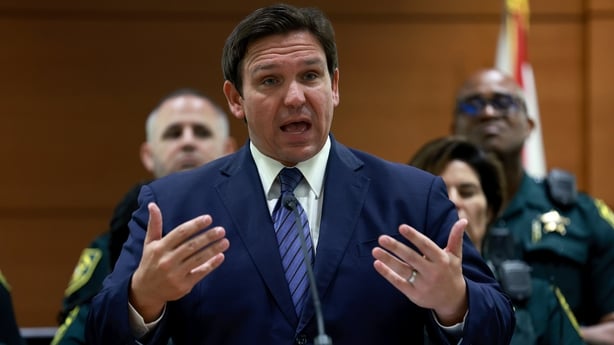
DeSantis is the leading contender to stand against Donald Trump for the Republican party nomination for the 2024 Presidentials. He is hardly a moderate figure - but neither is he Donald Trump.
And that could help Mastriano (as well as giving DeSantis an excuse to hold a high profile rally in yet another state as part of his own electoral tour of the nation, a prelude to a declaration sometime next year).
Thus the elections of 2020, 2022 and 2024 are all bound together by the refusal of Donald Trump and his supporters to accept the outcome of the 2020 race.
And the consequences of that refusal, which are playing out right now - an electoral counterweight to the sundry investigations into Donald Trump and that refusal to accept the outcome of an earlier election.
The line that links past, present and future.