The Coalition is facing into a severe test over Ireland's relations with Israel, the results of which are unlikely to please everyone.
Eight years and three governments since it was first introduced in the Oireachtas, the Occupied Territories Bill finally made its way to the Cabinet last week and is expected to become law by July.
Minister for Foreign Affairs Helen McEntee said that while the legislation "won’t change the decisions or action by the Israeli government," everything must be done to try to achieve the overall objectives of "a peaceful solution, a two-state solution".
The problem for Ms McEntee and Taoiseach Micheál Martin is that many in the Dáil - including some within their own parties – believe they should be doing more, while an influential minority will be worried about the consequences of even taking this course of action.
It’s a terribly tricky tightrope at a time of heightened public sentiment following Israel’s treatment of Irish activists – including President Catherine Connolly’s sister – on the Global Sumud Flotilla to Gaza.
The decision not to include a ban on trade in services such as IT and finance from Israeli settlements in the occupied Palestinian territories has opened the Government to criticism that it has "gutted" the original bill.
Opposition politicians argue the Coalition is simply bringing forward a "half-hearted" measure which is more "symbolic than impactful".
By not including services, 70% of trade with the Occupied Territories is outside the scope of the legislation. Indeed, the Taoiseach told the Dáil on Tuesday how "about 200,000 worth of goods, fruit and vegetables, come in from the settlements", underscoring the limited tangible effect of the bill.
Coalition sources argue that including a ban on services "would not be effective or legally robust under EU law" and that Ireland would be open to legal challenge in the courts. The Taoiseach has insisted that including services would "not be implementable".
This is a view disputed by the Irish Human Rights and Equality Commission, who argue there is "no legal basis" for the Government's decision.
Taoiseach Micheál Martin said this week including services in the bill was 'not implementable'
The Oireachtas Foreign Affairs Committee last year recommended that services be included in a ban on trade with illegally occupied territories in Palestine and Government members of this committee have queried why their advice was not followed.
"We are very aware of what the public mood is on this issue. I believe Minister Helen McEntee must explain herself to the committee. If we marched up the hill on this, we need to see compelling evidence to beat a retreat," said Fianna Fáil TD and former ceann comhairle Seán Ó Fearghaíl.
"I’ve been to the Middle East in a personal capacity," explained Fine Gael TD Brian Brennan, who added: "I’ve seen firsthand the devastation."
"I’m disappointed that services aren’t covered in the bill. I understand if there is legal advice to say services can’t be included, but we need to see that advice and see the devil in the detail," he said.
For some, the bill even as it currently stands risks serious consequences.
The employers’ group IBEC didn’t comment this past week, but it has previously told the Oireachtas how if the Occupied Territories Bill was limited to trade in goods, it would still likely cause international reputational damage.
The group has said that US companies based in Ireland are deeply concerned with anti-boycott legislation in many US states, which were introduced to protect Israel, and the damage this could pose on them. There was also a fear amongst companies that Ireland could be viewed as "anti-Israel".
Oireachtas Foreign Affairs Committee Chair John Lahart denied suggestions on RTÉ’s Drivetime last week that the US had "nobbled" the Occupied Territories Bill, but American concerns must be at the back of Coalition minds.
Afterall, in politics, the economy trumps all.
The Taoiseach insists he must "protect 250,000 jobs" as he recoiled against Opposition suggestions for a total boycott of Israel.
"It is great to be virtuous," said Micheál Martin across the Dáil to People Before Profit’s Richard Boyd Barrett, "but for the workers’ representative, he lacks all virtuosity when it comes to protecting Irish workers".
Govt 'speaking out of both sides of its mouth' on sanctions for Israel, says Boyd Barrett
Independent Senator Frances Black – a pioneer of the legislation – says she will work with the Opposition over the coming weeks to bring forward amendments to change the legislation.
And with the Government still waiting for potential EU-wide action against Israel, Mr Martin and Ms McEntee are likely to remain between a rock and a hard place on the Occupied Territories Bill.
On top of this, the Coalition faces a searching challenge in how it deals with the international soccer matches against Israel later this year – the images of which will be beamed all over the world.
As things stand, the Israeli team is due to play in Dublin on 4 October in the Nations League.
Government ministers say they won’t attend the match, while the Taoiseach has said Ireland doesn’t want to be "self-defeating" in its approach, with a boycott likely to severely hinder Heimir Hallgrimsson’s team’s chances of qualifying for Euro 2028 owing to a potential six-point deduction.
The FAI has insisted it must fulfil the fixtures.
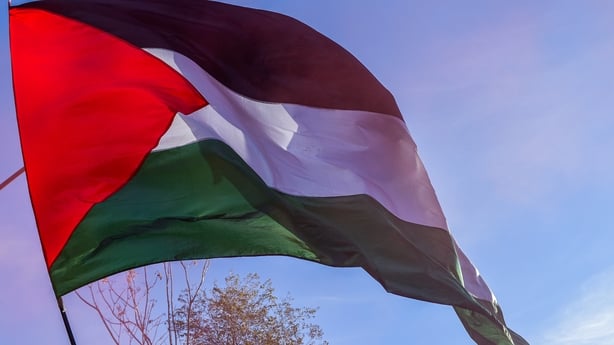
Ireland’s friendly on Thursday was twice briefly interrupted in the first half when home fans threw tennis balls featuring the Palestinian flag on to the pitch, prompting serious logistical concerns over how a fixture with Israel could go ahead in the same venue.
Solidarity TD Ruth Coppinger has suggested major protests at the fixture. If the game goes ahead as planned, will the Government feel comfortable with the potential booing of Israeli anthems and players being beamed worldwide?
And if there is a boycott, how will the Coalition explain it to business interests already concerned by the Occupied Territories Bill in its current iteration?
Whilst the Taoiseach insists "the Government doesn’t run FIFA", the Irish team believes the Coalition should be the ones to make any difficult choices.
"We are the football players; we are coaches. This is from a political level and those who are in Government should take these decisions," said Hallgrimmson after Thursday’s match.
On Friday, members of the FAI’s General Assembly secured an EGM to discuss fresh calls to overturn the FAI’s plans to fulfil the Israel matches.
Read more:
Latest Middle East stories
Latest political stories
Interestingly, senior figures from the FAI were spotted around the corridors of Leinster House last week, without any official Oireachtas engagements listed. A sign, perhaps, discussions are ongoing in the background on how to approach October’s game.
The Stop the Game campaign – run by the Irish Sport For Palestine group - insists Ireland must not play Israel at all due to what the United Nations has called a genocide in Gaza.
But there is a sense from some of those involved that having the Dublin match moved to a neutral venue would at least "represent a 0-0 draw".
The political pressure is unlikely to abate either, with Sinn Féin bringing forward a motion when the Dáil resumes on 9 June for the Government to support calls for a boycott "in protest on legal and moral grounds".
The Coalition insists it has done more for the Palestinian people than others in Europe.
But its approach to the war in Gaza is about to face one of its sternest examinations yet.