


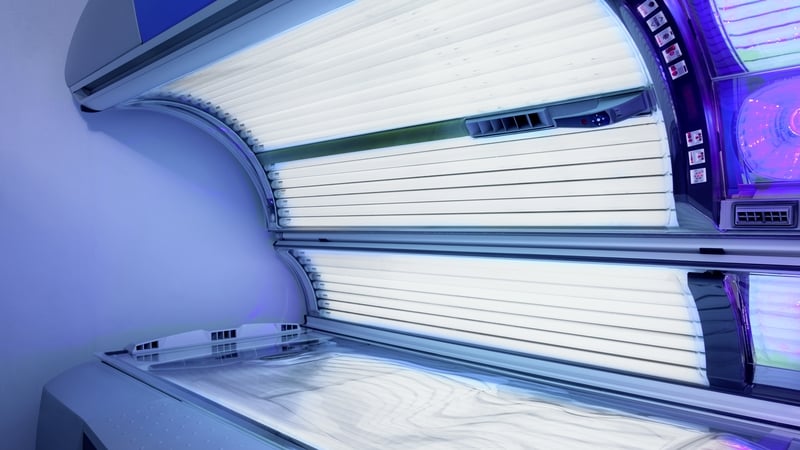
A new coalition is "urgently calling" for the Government to set out a timeline for when it will introduce a "blanket ban" on sunbeds.
Sunbeds can cause both melanoma and non-melanoma skin cancers.
Last year, Taoiseach Micheál Martin said a total ban is something he would be "advocating for".
The newly launched Coalition Against Sunbeds said the banning of sunbeds would help save lives by decreasing risk factors for melanoma, and save the taxpayer around €9.7 million a year in costly treatments.
The coalition is made up of the Irish Cancer Society, the Irish Skin Foundation, Melanoma Support Ireland, the Irish Association of Dermatologists, the Irish College of GPs, Breakthrough Cancer Research, the Marie Keating Foundation and others.
According to the group, sunbed use increases a person's risk of developing melanoma. It added that the risk increases by 75% for people who use sunbeds before the age of 35.
The group said the number of people who will be diagnosed with melanoma is set to double by 2045.
It added that around 120,000 people in Ireland use sunbeds, and one in 20 children aged between 10 and 17 has used sunbeds, despite legislation prohibiting their use by young people under 18.
Consultant Dermatologist in Tallaght University Hospital Professor Anne-Marie Tobin said the link between sunbeds and skin cancer "is clear".
"The WHO categorises sunbeds as a Group 1 carcinogen, meaning their cancer risk is in the same category as tobacco and asbestos exposure," she said.
Prof Tobin added that "5.4% of melanomas, the most serious and dangerous form of skin cancer, are directly linked to sunbed use".
"This means over 70 people are diagnosed with melanoma in Ireland each year due to sunbeds," she added.
Speaking on RTÉ's Morning Ireland, she said Irish people are genetically disposed to developing skin cancer.
She said there is no monitoring of the emission of the radiation that sunbeds emit, but it would be far greater than anything the sun would emit in Ireland - even on the sunniest days.
The Programme for Government committed to exploring the feasibility of a sunbed ban, and the Department of Health’s Sunbed Working Group subsequently recommended the ban.
While the Coalition Against Sunbeds welcomed the move, it is calling for a total ban of all sunbeds, including those in a residential setting.
Patient advocate with Melanoma Support Ireland Gill Costelloe said she used sunbeds when she was younger and is now "paying the price" as she is living with stage 4 melanoma.
"My melanoma was caught early when I had a mole surgically removed, but five years later, it came back without any warning and spread right through my body, nearly killing me.
"Thankfully, I'm doing a lot better four years on, but I will now be on cancer treatment for the rest of my life. Some day that treatment may stop working and I have to live with that at the back of my mind every single day," Ms Costelloe said.
She said there was very little education about the dangers of sunbeds when she was younger, but now there is more information available.
"I fully support the Coalition Against Sunbeds because we know what damage sunbeds do," she added.
According to the HSE, skin cancer is the most common form of cancer in Ireland, with more than 11,000 cases diagnosed every year.
However, the Sunbed Association, which represents tanning salon operators in the UK and Ireland, said a blanket ban would move the industry into homes, back rooms and to underground black market settings with "zero supervision and zero enforcement".
Speaking on same programme, Sunbed Association chair Gary Lipman said over-exposure to UV is what causes issues and said the statistics being used are at least 20 years old.
He said the association has a code of practice and high industry standards are in place.
"We check for age verification to make sure that no one is under 18. And we make sure that the sunbeds they use are appropriate and the session time is recorded...and make sure that people don't overexpose."
On the risk of a blanket ban driving sunbed use underground, Mr Lipman said: "There's a clear example in Australia where they banned professional sunbeds and those beds were then transported into people's homes and they're now being used by the public without any form of supervision, without any form of regulation.
"The key problem here is that the Government has been woefully negligent in implementing EU regulations."
