


Almost 50 countries have condemned what they said are threats by Russia against embassies in Ukraine in a joint statement at the United Nations.
Russia called on the United States to evacuate its Kyiv embassy yesterday, threatening "systematic strikes" on the Ukrainian capital amid similar warnings to other diplomatic missions.
"We also condemn recent threats by Russia to diplomatic institutions and embassies in Kyiv. This is something which we cannot accept," said the joint statement delivered by Ukrainian UN representative Andriy Melnyk.
The statement was signed by European countries, Japan, South Korea and others.
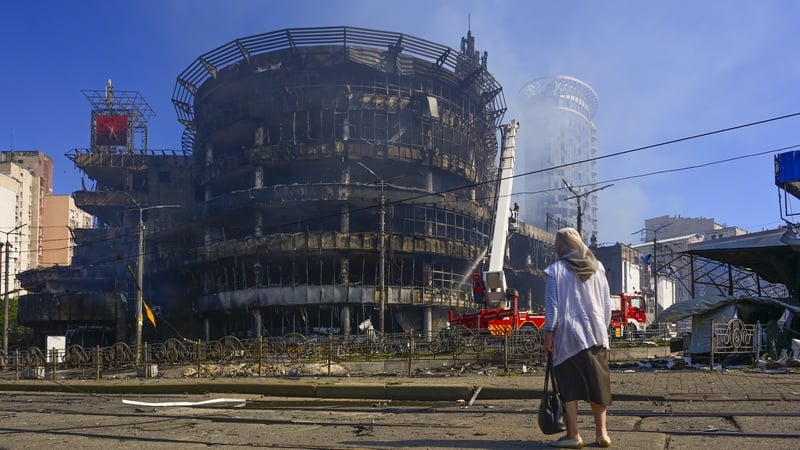
A weekend barrage by Russia, involving dozens of drones and missiles, killed four people and caused widespread damage across the Ukrainian capital.
UN Secretary-General António Guterres registered his concern over Russian attacks.
"I am deeply concerned by a recent announcement by the Russian Federation to launch consistent and systematic strikes against Ukrainian defence enterprises in Kyiv, as well as against decision making centers and command posts following reports of an Ukrainian drone attack on a college building and dormitory in the Ukrainian city of Starobilsk, presently occupied by the Russian Federation," Mr Guterres told the UN Security Council.
"Now more than ever, it is imperative to avoid any escalation of a conflict that has already exacted a devastating toll on civilians and that risks making the search for peace even more distant," he added.
Among the weapons Russia used at the weekend was its Oreshnik hypersonic missile, which can travel 10 times the speed of sound and is capable of carrying nuclear warheads, according to Russia.
The strikes followed Russian accusations that Ukraine hit a vocational school in the Russian-occupied Lugansk region, killing 21 people. Russian President Vladimir Putin ordered his military to retaliate.
Russia 'trying to destabilise' European democracies with drone alerts
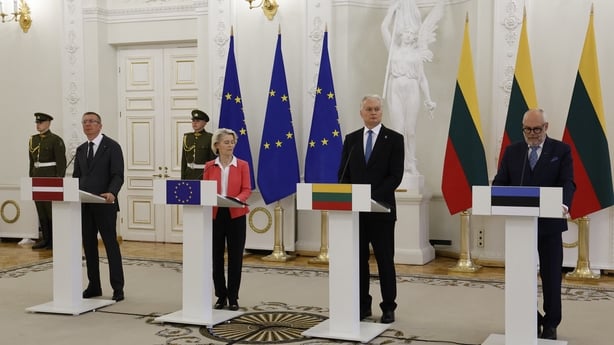
Meanwhile, EU chief Ursula von der Leyen has accused Russia of "trying to destabilise" European democracies by triggering recent drone alerts in Baltic states.
The European Commission President, speaking at a news conference with leaders from the region, conceded that the spate of air raid alarms had "exposed vulnerabilities" in the continent's defences.
Her visit came a week after Lithuanians were ordered to head for the bunkers following a brief drone alert in the capital Vilnius, a first for the general population since Russia invaded Ukraine in 2022.
"People in the Baltic countries have been experiencing what many believed belonged to another era," Ms von der Leyen said, standing alongside the presidents of Lithuania, Latvia and Estonia.
"Air raid alerts, families sheltering, schools closing, transport interrupted. This is the reality on Europe's eastern border in 2026," she said.
"These are not isolated incidents. This is a deliberate strategy from Russia, trying to destabilise our democratic societies.
"But very much like on the battlefields of Ukraine, Russia is failing," she said.
Drone alerts have become increasingly common in recent months in the Baltic states as Ukraine steps up strikes against Russian targets in the Saint Petersburg region, close to Estonia and Finland.
The ex-Soviet Baltic countries have accused Russia of deliberately diverting Ukrainian attacks intended to strike industrial facilities and fossil fuel infrastructure.
While the incidents have caused neither casualties nor material damage, they have demonstrated the inability of the Baltic countries' air defences to intercept every drone.
At the briefing, Ms von der Leyen admitted that "these incidents have exposed vulnerabilities" and warned that Russia's use of the tactic could spread westwards.
"What you are experiencing today, the rest of Europe could face tomorrow," she said.
Ms von der Leyen vowed stepped-up efforts to tackle the problem, "starting with more unified alert systems and improved cross-border coordination".
