


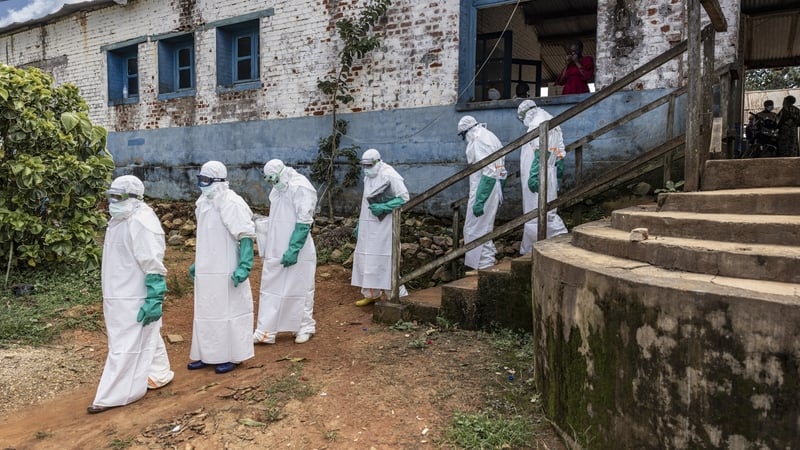
Ebola is going to spread further due to tensions in the Democratic Republic of the Congo, an Irish medic with Médecins Sans Frontiéres (MSF) has said.
It comes as an Ebola treatment centre in eastern Congo was set on fire yesterday by people who were upset they were being prevented from retrieving the body of a local man.
Around 600 suspected cases of Ebola have been recorded in the DRC and more than 140 deaths, prompting the World Health Organization to declare a public health emergency of international concern.
There are growing fears in the DRC about the spread of Bundibugyo strain of the virus.
The outbreak is "extraordinary" as there are no approved Bundibugyo virus-specific therapeutics or vaccines, unlike for Ebola-Zaire strains, the WHO has said.
MSF is active on the ground in the regions.
Dr Eve Robinson, an epidemiologist working with MSF, is currently in Goma, which is close to DRC's border with Rwanda.
Speaking on RTÉ’s Morning Ireland, she said Ituri, in the north east of the country, is where the outbreak started several weeks ago and since then the "situation has evolved rapidly".
Read more:
What do we know about the Ebola outbreak in the Congo and Uganda?
She said the current estimated number of suspected cases and deaths is likely an "underestimate of the true situation".
Dr Robinson said MSF has already set up a treatment centre in the worst-affected area, which is operating at full capacity.
She said the situation in Ituri is very difficult, with clusters of suspected and confirmed cases starting to spread to bordering provinces.
"I’m very concerned and MSF is very concerned. Where I am here in Goma, although we have only had one case, it feels like the calm before the storm," she said, adding that by this time next week, she thinks it will be a very different situation.
She said there are a lot of trade routes between Ituri and where she is in the province of North Kivu.
"We are expecting this outbreak to spread further," she said.
Dr Robinson said there are several pillars in managing an Ebola outbreak, but community engagement is one of the key ones.
She said that for any Ebola outbreak, there is going to be fear and tension in the community.
"Especially in this region, where there is already a lot of active conflicts, so tensions are already high. I think this is going to be further exacerbated with this disease outbreak.
"So one of the really important pillars is working with the communities," she said.
"You don’t control an Ebola outbreak in the treatment centres, although they are really important. You control it by working in and with the communities."
She said this was through health promotion, explaining the disease, its symptoms and the need for isolation procedures, especially highlighting that safe and dignified burials are "absolutely vital to control the outbreak".
Dr Robinson said it could be several months before a vaccine is developed for this strain of Ebola.
We need your consent to load this rte-player contentWe use rte-player to manage extra content that can set cookies on your device and collect data about your activity. Please review their details and accept them to load the content.Manage Preferences
US Ebola patient in Berlin hospital not critically ill, family tests negative
A US citizen who contracted Ebola in the Democratic Republic of Congo is not critically ill and his wife and four children have tested negative, the Berlin hospital where the family is being treated said.
"Because the course of the illness can change, he remains under close observation and is receiving treatment," Charite university hospital said in a statement. "He is being cared for in the high-security area of the specialised isolation unit."
The patient's wife and four children "are currently asymptomatic and quarantined in a separate part of the unit - an initial PCR test detected no Ebola virus infection."
The patient, identified by the Serge Christian mission organization as medical missionary Dr Peter Stafford, contracted Ebola while treating patients in the DRC, where he had been living with his family.
The White House said Dr Stafford and his family had been brought to Germany because it is 12 hours closer to the DRC than the United States.
Charite said in its statement that the patient room had been made as child-friendly as possible, adding that the children were able to see their father "through a glass partition, and family members can communicate via an intercom."
Additional reporting Reuters
