


A Stormont department should have considered all "reasonably practical means" to prevent access to a culvert close to where Noah Donohoe's body was found, a safety expert has told an inquest.
Belfast Coroner's Court also heard a claim that refurbishment work carried out on the culvert by the Department for Infrastructure (DfI) three years before Noah died had made it "easier to access" for children.
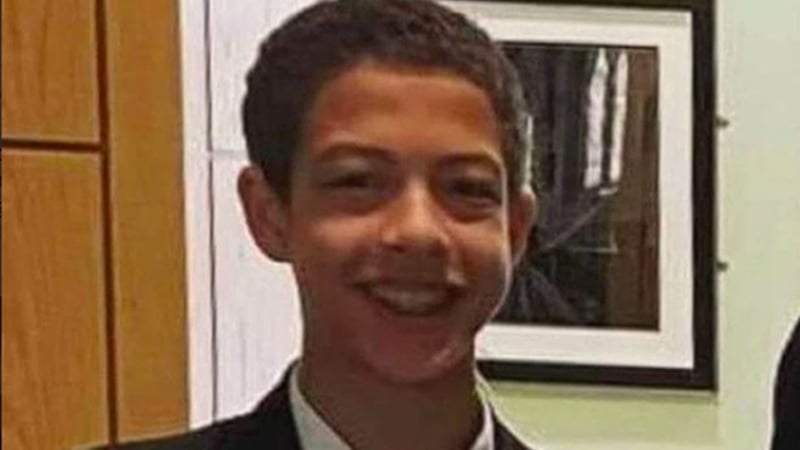
Noah, a pupil at St Malachy's College, was 14 when his naked body was found in the underground water tunnel in north Belfast on 27 June, 2020, six days after he left home on his bike to meet two friends in the Cavehill area of the city.
He was found more than 600m downstream from where he had last been seen close to the culvert inlet behind houses at Northwood Road in north Belfast.
A post-mortem examination found the likely cause of death was drowning.
The long-running inquest, which has entered its fifteenth week, heard further evidence from civil engineer Brian Pope and risk assessment expert Dr Mark Cooper on Monday.
They were among a group of four experts who had provided joint responses to a series of questions about the culvert for the proceedings.
The DfI is responsible for the operation of the culvert.
DfI barrister Neasa Murnaghan KC asked Dr Cooper about his evidence that there should have been fencing at the rear of four houses on Northwood Road which provided access to the site where the culvert is located.
He said: "There should have been limited access from that side of the stream.
"The point is to deter people from entering the stream and ultimately the culvert."
The witness added: "The elephant in the room is that, as far as I can see it, the Department for Infrastructure didn't do a risk assessment prior to 2017 and one would have thought that it was at that point that you would look at all reasonably practical means to prevent access."
The inquest has previously heard that the department carried out refurbishment work at the culvert entrance in 2017, building new access steps and adding a new debris screen.
The witnesses were shown photographs of the culvert from before and after the work was carried out.
Ms Murnaghan asked Mr Pope about comments in his report that the refurbishment had "increased accessibility" to the site.
He said the difference was "marginal".
He added: "My view was if a child was in the area, the steps previously were in poor condition and these steps take you right down to the screen itself and are new and in better condition and easier to access."
The inquest has previously heard evidence that the culvert was covered by a debris screen, rather than a security screen, when Noah entered it in 2020.
Dr Cooper told the court: "It was a finely balanced decision about whether to have a debris or a security screen and, if you took fuller consideration of the safety issues you would be swayed to go to a security screen."
Ms Murnaghan asked Mr Pope if there was a "presumption against screens generally" over culverts.
He said: "If screens can be avoided where access would be limited and it would be normal practice to consider not having a screen, then you would be moving towards a debris screen and then a security screen."
She asked: "The security screen is the option of last resort?"
Mr Pope said: "It is the most onerous in terms of preventing access....while also dealing with the debris issue as well."
The barrister said: "It creates problems?"
The witness said: "It can increase the chances of blockage and therefore there may be different maintenance requirements to be carried out. It can increase the amount of debris."
Ms Murnaghan continued: "And can you agree they increase the risk of death by entrapment that doesn't exist with a debris screen?"
He said: "There is an increased risk of entrapment, the theory is with a debris screen somebody could climb through the bars and be washed through the culvert safely.
"In this particular case there is a very serious drowning risk downstream, so that needs to be taken into account as well.
"Entrapment is a serious risk for screens and should be considered."
The barrister said: "There is a presumption against screens, if you can avoid it?"
"If it is practical, one would prefer not to have a screen."
The inquest will resume on Tuesday.
