


World Health Organization chief Tedros Adhanom Ghebreyesus will travel to the Spanish island of Tenerife tomorrow to coordinate the evacuation of passengers from the cruise ship hit by hantavirus, interior ministry sources said.
Mr Tedros will accompany Spain's health and interior ministers to a command post on Tenerife "to ensure coordination between administrations, health control, and the application of the planned surveillance and response protocols", the sources said.
Earlier, the Spanish archipelago's regional government said the evacuation of the ship in the Canary Islands must take place between Sunday and Monday because adverse weather conditions will force it to leave then.
"The only window of opportunity we have to carry out this operation is around 12 o'clock on Sunday morning and until conditions change from Monday," regional government spokesman Alfonso Cabello told reporters.
"Otherwise, the ship must leave and no operation could be carried out again in theory... until the end of May," he said, citing wind and swell.
"If the operation is not completed on Monday, the ship must continue its journey because navigation conditions around the port will change significantly," Mr Cabello added.
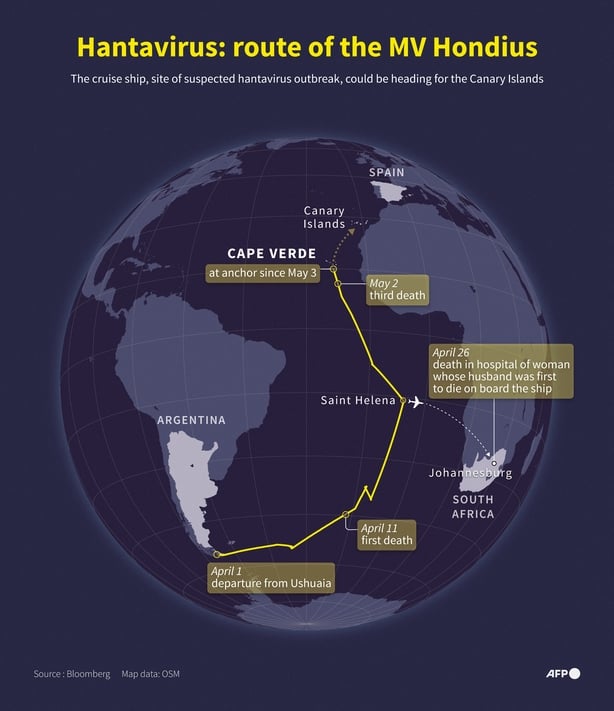
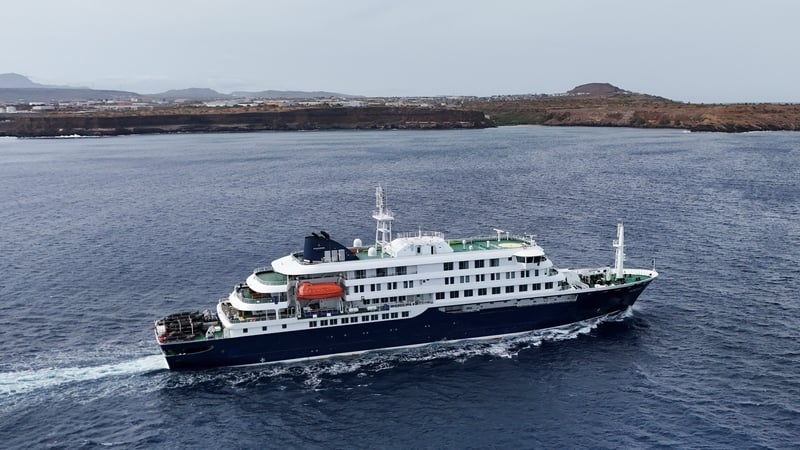
The fate of the MV Hondius has prompted international concern after it emerged that three people on board have died since the vessel departed Argentina in April.
Three people were removed from the ship on Wednesday off Cape Verde, before it headed for the Canary Islands with nearly 150 passengers and crew from 23 countries still on board - including two from Ireland.
It is due to arrive at Granadilla on Tenerife early on Sunday after Spain accepted to receive it despite opposition from the Canaries government.
Mr Cabello said the vessel is expected to reach the port "between three and five o'clock on Sunday morning", earlier than previously forecast.
"The ship is making such good time that the possible time of arrival is being brought forward," head of emergency services and civil protection, Virginia Barcones, said earlier.
MV Hondius will anchor offshore and not dock in Granadilla port. Passengers will be taken on smaller boats and transferred by bus to the airport for their repatriation flights.
Interior ministry sources had earlier said that evacuations would begin on Monday, with European Union countries repatriating their own citizens.
Two new suspected cases of hantavirus were reported today - one in Spain and the other on the remote South Atlantic island of Tristan da Cunha.
The announcements in locations thousands of kilometres apart will fuel concern about a cluster of cases, although the World Health Organization has repeatedly said the risk to the wider public is low and the virus does not transmit easily.
A 32-year-old woman in the southeastern Spanish province of Alicante has symptoms consistent with a hantavirus infection and is being tested, health authorities said.
She was briefly sitting on a plane behind a woman from the Netherlands who had contracted the virus on MV Hondius, secretary of state for health Javier Padilla told reporters.
The Dutch citizen left the flight in Johannesburg feeling ill before it took off on 25 April and later died in hospital.
A British man was also suspected of having the disease on Tristan da Cunha, the UK Health Security Agency said.
Officials there said he was a passenger on the Dutch-flagged ship that made a stop at the island on 13-15 April.
"Based on the dynamics of this outbreak, based on how it is spreading and not spreading amongst the people on the ship, the people who have disembarked, as well, we continue to consider the risk as low for the general population," WHO technical officer for viral threats, Anais Legand, said in an online briefing.
Both new suspected cases have links to the original cluster of cases, officials said.
Watch: 'We don't anticipate a large epidemic', WHO's emergency alert and response director says
The cruise left Argentina in March with around 150 passengers and stopped in the Antarctic and other locations before heading north to waters off Cape Verde, west of Africa, where it has been briefly held this week after news of the cases emerged.
WHO officials confirmed that some of the cases were caused by the Andes strain of hantavirus, the only version that can spread between people, usually through prolonged and close contact with a person who is showing symptoms.
Three people - a Dutch couple and a German national - died following the outbreak, the first of its kind on a ship.
Four others confirmed to be infected, two Britons, a Dutch and a Swiss national, are being treated in hospitals in the Netherlands, South Africa and Switzerland, and a fifth case is suspected, according to the WHO.
The figures do not include the suspected cases on Tristan da Cunha or in Spain.
Cruise operator Oceanwide said there were no people with symptoms of a possible infection remaining on board the ship.
The cruise ship stopped at Tristan da Cunha between 13-15 April, with passengers disembarking to go on nature tours and visit the shop and pub, online footage of the tour showed.
The UK Health Security Agency did not go into further detail on the British passenger with suspected symptoms.
Tristan da Cunha, home to only around 200 people, is halfway between South Africa and South America and the world's remotest inhabited island, more than 2,500km and a six-day boat trip from St Helena, its nearest inhabited neighbour.
The Spanish woman has "mild respiratory symptoms" and had been to a hospital where she will be tested for the virus, with results expected 24 to 48 hours later, according to a statement on the regional health department's website.
Mr Padilla said the woman was sitting two rows behind the cruise ship passenger, but the contact between them "was brief" since the passenger had only been "on board for a short time".
He added that Valencia's regional health authorities were tracing the people the woman has been in contact with over the past few days.
The US Centers for Disease Control and Prevention has classified the hantavirus outbreak as a 'level 3' emergency response, the lowest level of emergency activation.
Other experts have also stressed the low probability of a widespread contagion, but the outbreak has put authorities on high alert as they urge all who have been in contact with passengers who left MV Hondius to watch out for possible symptoms.
Several US states have said they are monitoring asymptomatic residents who returned home after disembarking from the ship.
Singapore isolated and tested two residents who had been aboard the vessel.
