


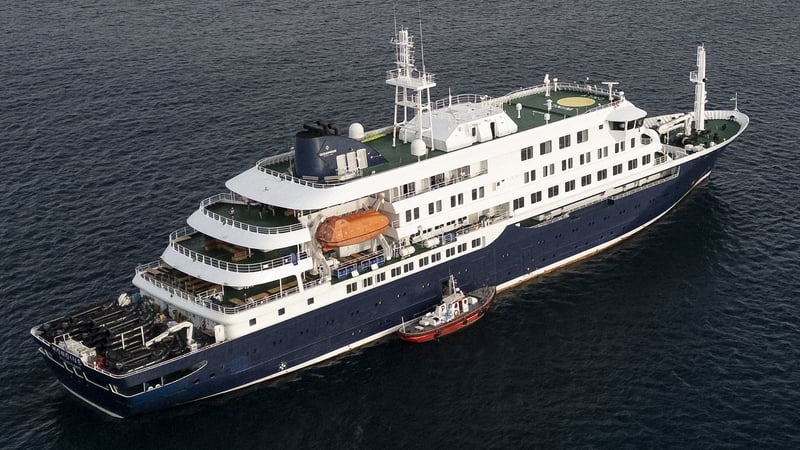
The World Health Organization has insisted that a deadly hantavirus outbreak on a cruise ship in the Atlantic did not mark the beginning of a Covid-like crisis.
"This is not the start of an epidemic. This is not the start of a pandemic," WHO epidemic and pandemic preparedness and prevention director Maria Van Kerkhove told reporters, insisting: "This is not Covid."
The WHO said it expects the outbreak to be "limited", as long as public health measures and "solidarity" are implemented.
"We believe this will be a limited outbreak if the public health measures are implemented and solidarity shown across all countries," the WHO's emergency alert and response director Abdi Rahman Mahamud told reporters.
Five of the eight suspected cases of hantavirus linked to the cruise ship have now been confirmed.
The wider public health threat from the outbreak remained low, Director-General Tedros Adhanom Ghebreyesus said, adding that the WHO was aware of reports of other patients and there may be more cases due to the long incubation period of the virus.
'We don't anticipate a large epidemic', WHO's emergency alert and response director says
It comes as countries worldwide have scrambled to prevent further spread of the hantavirus, after an outbreak on the MV Hondius, by tracking those who had already disembarked before the virus was detected and anyone in close contact with them since.
Minister for Health Jennifer Carroll McNeill said the two Irish nationals on board the luxury cruise ship will have to be medically assessed when they arrive in Tenerife in the coming days.
Three people - a Dutch couple and a German national - died in the outbreak on the MV Hondius.
Eight people, including a Swiss citizen, are suspected to have contracted the virus, which is usually spread by rodents, the WHO said.
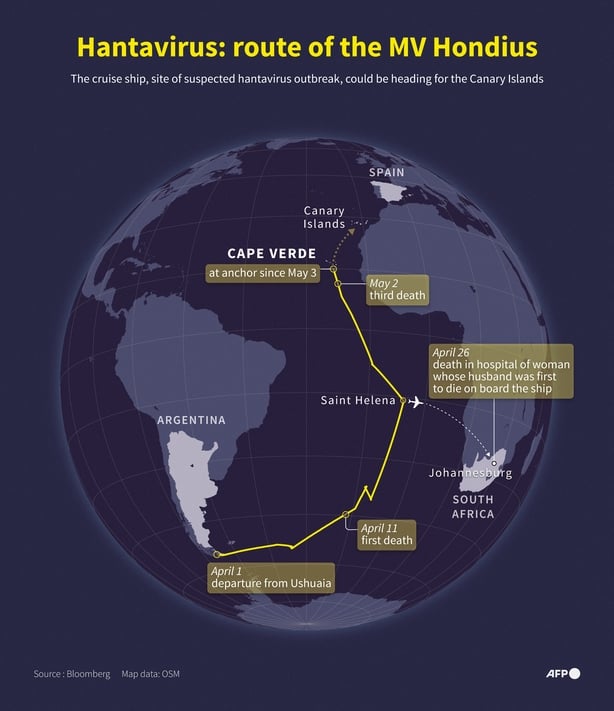
All passengers who disembarked in St Helena in the South Atlantic Ocean, where the ship made a stop on 24 April, have been contacted, the ship's operator said, adding this included people from at least 12 countries among them seven British citizens and six from the US.
The first confirmed case of hantavirus came in early May.
Contact tracing
The ship's operators, Oceanwide Expeditions, said they were now working to establish details of all passengers and crew who embarked and disembarked on various stops since 20 March. The Dutch couple, who are believed to be the first hantavirus cases, only boarded on 1 April.
Dutch airline KLM yesterday said it had taken the Dutch woman off a plane in Johannesburg on 25 April due to her deteriorating medical condition. She died before she could reach the Netherlands.
According to broadcaster RTL, a KLM cabin crew member who had been in contact with her has now been admitted to a hospital in Amsterdam after showing possible hantavirus symptoms.
The Dutch health ministry did not confirm that the woman being tested is a KLM cabin crew member, and neither did the airline.
But crew and passengers who helped the Dutch woman who died are being called daily for health checks, Dutch authorities told public broadcaster NOS.
Contagion requires very close contact
The virus found in the victims has been confirmed as the Andean strain, which can, in rare cases, spread among humans through very close contact.
Experts have stressed that contagion is very rare, but the outbreak has put health authorities on high alert. In the US, the Centers for Disease Control and Prevention (CDC) said it was closely monitoring the situation, adding that the risk to the American public was extremely low at the time.
One French citizen has been in contact with a person who had fallen ill but was not showing symptoms, Foreign Minister Jean-Noel Barrot said.
Argentina's health ministry has said it will carry out rodent trapping and analysis in the southern city of Ushuaia, the origin point of the cruise ship.
Ship heads for Spain
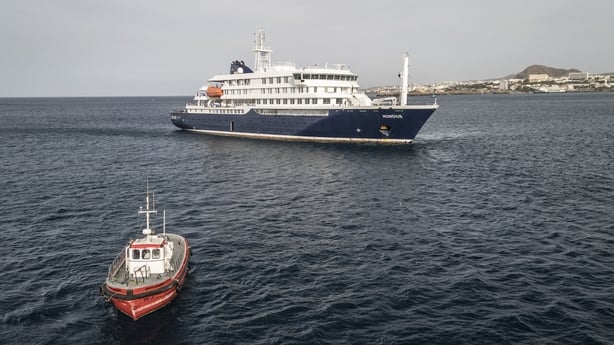
The MV Hondius, with dozens still on board, left its position off Cape Verde yesterday, where it had been marooned for days, and is expected to dock in Spain's Tenerife, in the Canary Islands, on Sunday, the EU's Centre for Disease Prevention and Control (ECDC) said.
There is still no one showing any hantavirus symptoms on the ship, the ECDC said.
Once in Tenerife, if they are still healthy, all non-Spanish citizens are set to be repatriated to their countries, while 14 Spanish passengers will be quarantined in a military hospital in Madrid.
We need your consent to load this rte-player contentWe use rte-player to manage extra content that can set cookies on your device and collect data about your activity. Please review their details and accept them to load the content.Manage Preferences
Evacuations and tests
Three patients were evacuated from the ship yesterday. Two have been admitted to a hospital in the Netherlands, while another one was transferred to Germany for medical care.
One of the three has tested positive for hantavirus, the hospital treating them in the Netherlands said.
"The RIVM (Dutch National Institute for Public Health and the Environment) has confirmed that the admitted patient has the hantavirus. The patient has been informed of this," said the Radboud hospital.
Martin Anstee, an expedition guide, was one of the two in hospital in the Netherlands, according to Sky News, and told them he was "doing okay" but "there are still lots of tests to be done".
The Duesseldorf University Clinic, treating the German evacuee, said she was not a confirmed case but rather a contact and was undergoing tests.
The plane carrying the third patient landed in the Netherlands this morning, and they were taken to a hospital in Nijmegen, in the east of the country.
In Switzerland, a person admitted to hospital on Monday was stable but showed symptoms consistent with a hantavirus infection, including low fever, body aches and a cough, the hospital said.
A Danish citizen who was aboard the MV Hondius has returned home and has been advised to self-isolate as a precaution, Danish health authorities said. The person is assessed to be at low risk, having had no close contact with those who later fell ill.
Plans being developed for care of Irish passengers
Ireland's Department of Health said plans are being developed to manage the care of two Irish passengers on the cruise ship on their return to Ireland.
It said decisions with regard to where they will quarantine will be on a case-by-case basis and that if they become symptomatic they will be assessed and treated as appropriate.
A consultant in Infectious Diseases at the National Isolation Unit at the Mater University Hospital said the the two Irish people are waiting for clinical assessments, which would determine the next steps.
"What we do also know at the moment is that everybody on board the ship seems to be asymptomatic," Professor Christine Kelly said.
Speaking on RTÉ's Morning Ireland, she said the National Isolation Unit is ready in case there was an outbreak.
"We work really closely with the Department of Health on an ongoing basis to prepare for all eventualities of what we call high-consequence infectious diseases.
"There are really robust plans in place for these scenarios. We simulate them, we train for them. That's what we're doing in the background all the time when we don't have outbreaks."
Prof Kelly said they are waiting for further guidance from the European Centre for Disease Control (ECDC) on isolation regulations for those who have come into contact with the virus.
"There seems to be guidance from the ECDC which is recommending isolation for people on the ship," she said.
"(For how long) hasn't been confirmed yet and we're still waiting for further guidance."
The ECDC's Head of Emergency Preparedness and Response said an "expert" from the ECDC boarded the MV Hondius yesterday and is supporting the crew to "set up safe procedures" for its onward voyage to the Canary Islands.
Speaking on RTÉ's Today with David McCullagh, Thomas Hoffman said passengers are isolating in their cabins and if they need to go outside must observe physical distancing, which has been put in place on the ship.
