


A ship hit by a deadly hantavirus outbreak will reach the Spanish island of Tenerife "within three days", with the evacuation of passengers to start from 11 May, the Spanish government has said.
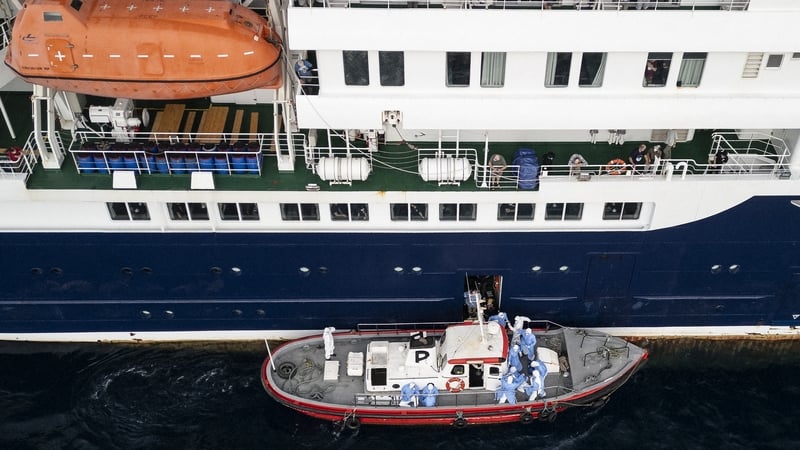
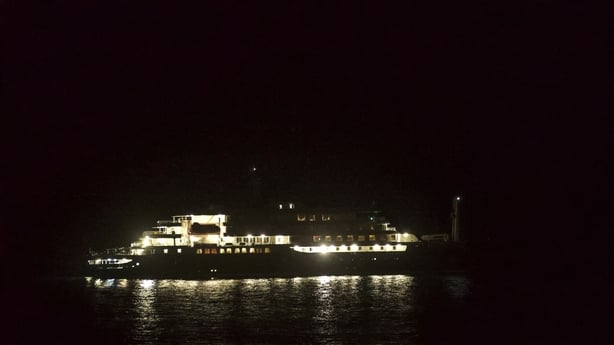
The luxury cruise ship has been marooned since Sunday off the coast of Cape Verde but left for Spain, a Reuters witness said, after three people, two of them seriously ill, were evacuated.
The MV Hondius, with nearly 150 people on board, is expected to dock in Tenerife within three days, Spain's health minister said, adding that those still onboard were not presenting any symptoms of the disease.
Health Minister Monica Garcia told a Madrid news conference that the stricken ship would arrive at Granadilla on Tenerife, where "a joint system for health assessment and evacuation will be put in place to repatriate all passengers, unless their medical condition prevents it".
Interior ministry sources later said the evacuations would begin from 11 May, with EU nations repatriating their own citizens.
The European Commission would intervene if a country was unable to retrieve its own nationals, while the evacuation of non-EU nations was still being planned, the sources added.
"All the passengers will remain on the cruise ship until the arrival of their planes," they said.
The 14 Spanish nationals - including one crew member - on board the MV Hondius will be transferred to Madrid's Gomez Ulla Military Hospital for quarantine, Ms Garcia told the press conference.
The duration of the quarantine will depend on when they potentially had contact with the virus, she said, adding that it has a 45-day incubation period.
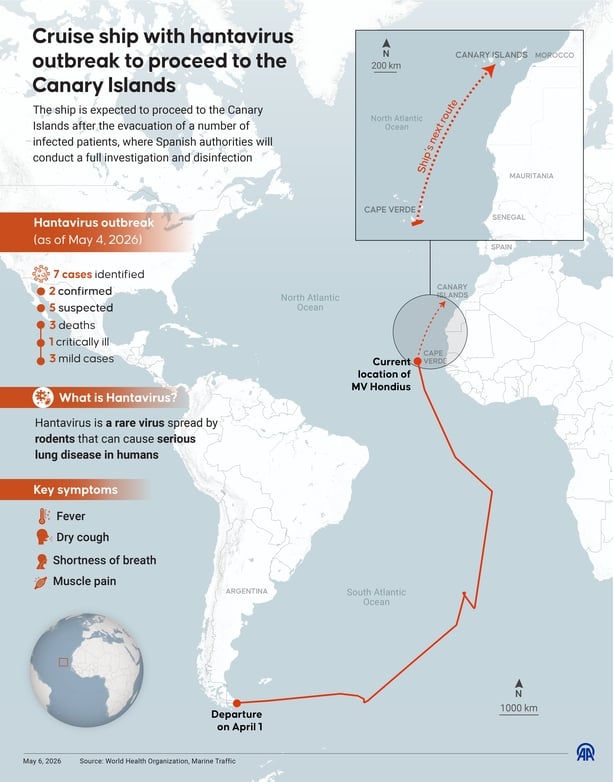
Three people - a Dutch couple and a German national – have so far died in the outbreak.
A total of eight people - including a Swiss citizen who has returned home and is being treated in Zurich - are suspected to have contracted the virus, with three of them confirmed by laboratory testing, the World Health Organization said.
Two people who returned to the UK from the cruise have been advised to self-isolate, the UK Health Security Agency (UKHSA) said.
"UKHSA is aware of two people who have returned to the UK independently having been on board the MV Hondius," the agency said.
"Neither of these individuals is currently reporting symptoms. They are receiving advice and support from UKHSA and have been advised to self-isolate," it added.
South Africa confirmed that it had identified among the victims the Andean strain of the virus that can - in rare cases – spread among humans through very close contact.
"This is the only (hantavirus) strain that is known to cause human-to-human transmission, but such transmission is very rare and... only happens due to very close contact," South Africa's health ministry said.
Nevertheless, some Tenerife residents said they were worried about the ship docking there. "People are scared," said Margarita Maria, 62, adding that the boat should go elsewhere in Spain.
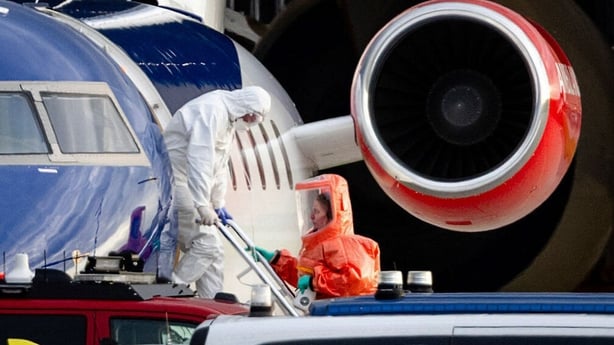
WHO chief Tedros Adhanom Ghebreyesus said in a post on social media that the three people evacuated from the ship were on their way to the Netherlands.
The Dutch Foreign Ministry said these people included a Dutch person, a German and a Briton and that they would be transported to specialised hospitals in Europe.
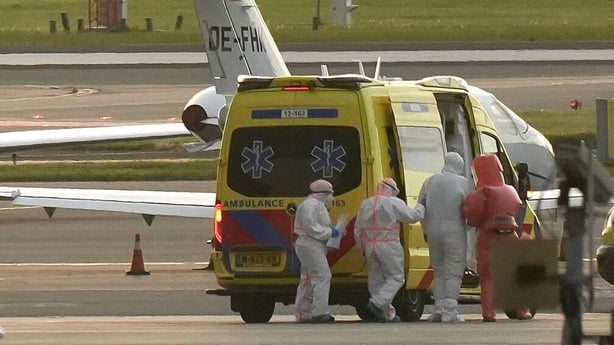
One of the aircraft transporting two patients from Cape Verde to Amsterdam was due to stop in Morocco to refuel, but Morocco refused to allow the aircraft to land, and the plane was instead refuelling at the airport in Gran Canaria, Spain's health ministry said.
While in Gran Canaria, the on-board doctor reported a problem with the patient's life support system, and the patient is now connected to the airport's electrical supply, awaiting the arrival of a new aircraft to continue the journey, the ministry said.
Two of those evacuated presented acute symptoms, the ship's operator Oceanwide Expeditions said.
The third person was closely linked to the German passenger who died on the ship on 2 May.
The Dutch ministry said that person was possibly infected with the virus. The ship set off from the southern tip of Argentina on 1 April and travelled to some of the most remote places on earth, including the British island of Saint Helena.
The Dutch government said in a letter to parliament that around 40 people disembarked at Saint Helena, including the Swiss national who has since developed symptoms.
Cape Verde had been intended as the ship's final destination, but the archipelago nation off West Africa has not allowed the passengers to come ashore because of the outbreak.
Since the start of the outbreak, the WHO has said the risk to the wider public from a virus usually transmitted by rodents is low and it stressed that this remained the case.
We need your consent to load this rte-player contentWe use rte-player to manage extra content that can set cookies on your device and collect data about your activity. Please review their details and accept them to load the content.Manage Preferences
Read more:
Irish people on hantavirus-hit cruise ship to quarantine in Ireland - dept
What is hantavirus and how deadly is it?
Timeline of events on board MV Hondius
"So when we say close contact (for human-to-human transmission),we mean very close physical contact, whether it's sharing a bunkroom or sharing a cabin, providing medical care, for example,(that is) very, very different to COVID and very different to influenza," Maria Van Kerkhove, WHO director of epidemic and pandemic management, told Reuters.
Dr Van Kerkhove said the WHO was working with countries to follow up with passengers who left the boat at Saint Helena in the south Atlantic, before it reached Cape Verde.
South Africa has identified 65 people who have been in contact with people with confirmed or suspected hantavirus cases, and other countries have identified 12, the WHO's South Africa representative Shenaaz El-Halabi told Reuters.
Passenger Kasem Hato told Reuters the ship's captain was keeping passengers updated and that those on board had been advised to limit close contact with other passengers and use hand sanitiser regularly.
"People are taking the situation seriously but without any panic, trying to keep social distancing and wearing masks to be safe," he said.
"Our days have been close to normal, just waiting for authorities to find a solution, but morale on the ship is high and we're keeping ourselves busy with reading, watching movies, having hot drinks, and that kind of things."
