


Legislation is on the way that would prevent someone who had killed their child's other parent from automatically keeping their guardianship rights.
Minister for Justice Jim O'Callaghan will bring his proposals to the Cabinet tomorrow.
According to a Department of Justice spokesperson, the law could be applied retrospectively subject to the discretion of the court.
The spokesperson added that, if passed, the law would apply equally to both married and unmarried couples.
The law would be known as Valerie's Law, in memory of 41-year-old Valerie French, who was murdered by her husband James Kilroy seven years ago in Co Mayo.
The couple have three children. Kilroy was convicted of Ms French’s murder in July 2024.
Speaking on RTÉ’s Morning Ireland, Ms French's brother David said that the "best interests of the children are the most important thing".
"I really look forward to seeing the text of the bill and seeing it go before the Dáil for debate," he said.
"These are complicated situations. Family life is complicated. There's a lot of different configurations and there's a lot of legislation in this space.
"But, as the minister said, this is child protection. This is taking a verdict from the criminal court and applying it for the best interests of children, regardless of the so-called rights of a killer.
"The best interests of the children are the most important thing. If the family's been completely dissolved, there's no point pretending it still exists - it doesn't if one parent has killed the other."
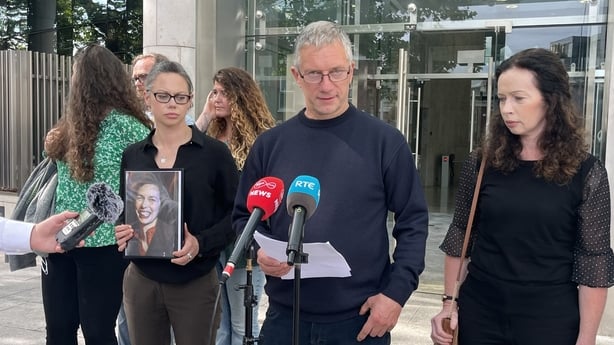
Mr French said it was important for him and his family to pursue this legislation.
"I think we saw the lack of that law in practice," he said.
"We waited five years to see the verdict in the criminal court. But our experience is that the verdict in criminal court, it might as well happen on the Moon, as far as family law or property law or any other venue is concerned.
"That struck us as particularly strange that the rest of the system sees the family as continuing on regardless.
"Murder is absolutely massive. Unless it happens in your family, you don't realise what a massive, massive thing it is. It seems to have no implications outside the criminal court up until now."
Family law expert at University College Cork Professor Louise Crowley said that the legislative changes were badly needed.
"The law, as it stands, would mean that James Kilroy is the sole guardian and sole custodian of the three boys, and which is, in some ways, an abomination to think that he murdered their mother and yet retains those rights," she said on the same programme.
Ms Crowley described the case as "quite the anomaly", given that Kilroy will be in prison for many years.
"The challenge is that because they were married parents of the children, they formed a family unit that's protected by our Constitution," she said.
"It makes it very difficult for anyone else to have lawful status in respect to the three boys, because the court cannot remove him because of his innate and inherent rights as the married father of the children.
"The children's uncle or aunt cannot take over guardianship or custodian status in law, which leaves it very difficult because, obviously, in practice, the children need to be minded and decisions need to be made."

Ms Crowley said that the changes will be applied to cases of married couples specifically.
"It will mean that a parent who murdered the other parent of children can have their guardianship status stripped," she said.
"It seems like a very logical thing to happen, but we need this law enacted for that to arise."
She added that this could still be challenged constitutionally.
"Family rights under Article 41 of our Constitution are very protected. The State can only interfere in a married family in certain circumstances.
"There is absolutely a likelihood that it would be challenged as unconstitutional. However, since 2012, children's rights have been positioned also in the Constitution.
"I would quite confidently say that (in the case of) a parent who had murdered the other parent of those children, the court would have very strong grounds to say that it was in the best interest of the children to have someone else acting as their guardian or custodian."
