


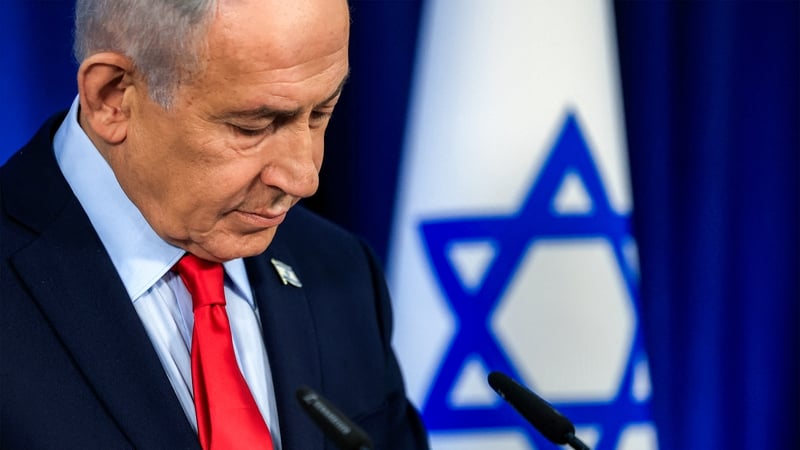
Two of Israeli Prime Minister Benjamin Netanyahu's top rivals have announced they will join forces in an upcoming election to oust his coalition government, with a focus mainly on domestic issues such as military conscription for ultra-Orthodox communities.
But on issues such as Iran, Gaza and Lebanon, the joint party led by right-wing Naftali Bennett and centrist Yair Lapid is expected to pursue a security posture similar to that of Benjamin Netanyahu, who heads the most right-wing government in Israel’s history, meaning Israel’s foreign policy would remain largely unchanged.
The new party, called "BeYachad" meaning "together" in Hebrew, has not released a formal policy platform. However, the positions below are based on recent public comments by Naftali Bennett and Yair Lapid.
Iran
Naftali Bennett, aged 54, and Yair Lapid, aged 62, have both strongly backed Benjamin Netanyahu’s decision to jointly attack Iran with the United States, reflecting broad public support in Israel for the war.
At the start of Israel’s aerial bombardment in Iran, Yair Lapid told Reuters in an interview that it was a "just war against evil."
Both Naftali Bennett and Yair Lapid have since criticised Benjamin Netanyahu, aged 76, for what they describe as a failure to achieve Israel’s main objectives in the war, including toppling Iran’s clerical government.
However, neither Naftali Bennett nor Yair Lapid has called for a resumption of fighting since Israeli and US attacks and Iranian missile fire were halted by an 8 April ceasefire.
A source close to their new party described Naftali Bennett and Yair Lapid as "hawkish" and "tough on Iran".
They are also "pragmatic and understand the need for diplomatic agreements and the work that happens after the military use of force to achieve strategic goals," said the source, who spoke on condition of anonymity to describe their party’s priorities.
Lebanon
Naftali Bennett and Yair Lapid have both strongly supported Israeli military operations in Lebanon while questioning a 17 April ceasefire that has failed to halt fighting between the Israeli military and Iran-backed Hezbollah militants.
Shortly before Israel’s military invaded southern Lebanon in March, Yair Lapid said Israel must take whatever steps were necessary to protect Israelis.
After the ceasefire with Hezbollah was announced in April, Yair Lapid said the only solution was the permanent removal of the threat to northern Israel.
Naftali Bennett sharply criticised the ceasefire, saying in a 17 April Facebook post: "One can already count backwards towards the next round. Hezbollah began this morning to rebuild southern Lebanon and is becoming stronger with missiles ahead of the next round."
Gaza
On the war in Gaza, where Israel has continued to carry out deadly strikes despite a ceasefire last October, both Naftali Bennett and Yair Lapid have criticised Benjamin Netanyahu for not fully destroying the Hamas militant group after the 7 October 2023 attack on Israel that it led.
In January, Yair Lapid said Benjamin Netanyahu’s government had achieved the "worst possible outcome" in Gaza, saying Hamas still has tens of thousands of armed fighters. Hamas retained control of a sliver of territory on Gaza’s coast under the ceasefire.
In a Facebook post this month, Naftali Bennett said Benjamin Netanyahu’s policies — including allowing some aid into the enclave after restricting all humanitarian supplies for three months in 2025 — had helped Hamas regain control.
"This is with the help of hundreds of aid trucks that Benjamin Netanyahu’s government brings them every day," Naftali Bennett wrote.
Benjamin Netanyahu has cast Israel’s devastating military assault that destroyed much of Gaza and killed more than 72,000 Palestinians as a success. He has held out the possibility of resuming a full-scale war if Hamas fails to disarm under a US-backed process, something the group has thus far rejected.
Palestinian statehood
With public opinion polling showing that most Israelis oppose the formation of an independent Palestinian state in the occupied West Bank, Gaza and East Jerusalem, a Naftali Bennett–Yair Lapid government would be unlikely to bring a major policy shift on the Palestinians.
Benjamin Netanyahu opposes the establishment of a Palestinian state, and his government has accelerated settlement building plans in the West Bank, in what ministers in his government say is part of a bid to destroy any future for Palestinian independence.
In 2022, Yair Lapid, who like many in Israel’s political centre and left are not outright opposed to Palestinian sovereignty, said that a two-state solution to the Israeli-Palestinian conflict was the right thing to do.
When asked by US broadcaster ABC during a 2024 interview why he opposes a two-state solution, Naftali Bennett said he believed it would lead to violence against Israelis.
"What we’ve learned over the past 30 years is that every time we gave the Palestinians a piece of land, instead of building it into a beautiful Singapore they turned it into a terror state and began killing Israelis," Naftali Bennett said.
On the West Bank, Benjamin Netanyahu, Naftali Bennett and Yair Lapid have all spoken forcefully against settler violence towards Palestinians. Such attacks have escalated under Benjamin Netanyahu, who critics accuse of allowing settlers free rein to burn Palestinian villages and harm villagers. Benjamin Netanyahu’s office denies this.
