


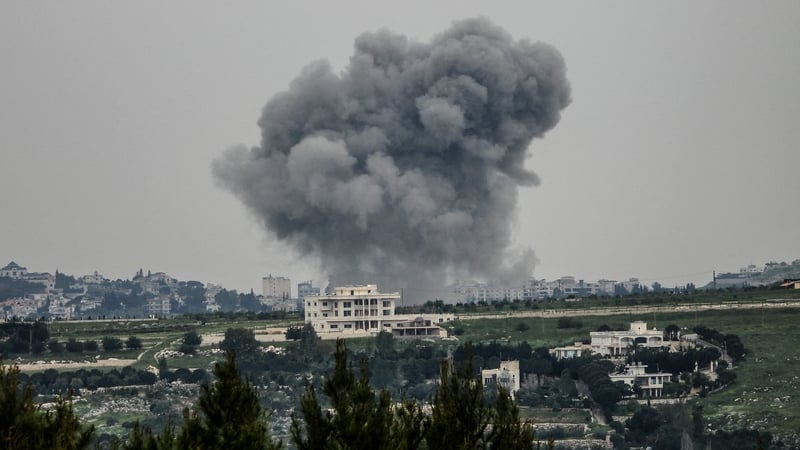
Israel's Prime Minister Benjamin Netanyahu said Hezbollah's actions were threatening the ceasefire between Israel and Lebanon, as he pledged to "vigorously" target the Iran-backed group.
"It must be understood that Hezbollah's violations are, in practice, dismantling the ceasefire," Mr Netanyahu said during a weekly cabinet meeting.
Under the terms of the truce, which was recently extended, Israel reserves the right to respond to "planned, imminent or ongoing attacks" and has been striking targets in south Lebanon almost every day.
"We are acting vigorously in accordance with arrangements agreed with the United States and, incidentally, also with Lebanon," Mr Netanyahu said.
"This means freedom of action not only to respond to attacks, which is obvious, but also to pre-empt immediate threats and even emerging threats."
Shortly after Mr Netanyahu's remarks, the Israeli military said it had intercepted three drones before they could enter Israeli territory.
Hezbollah rejected Mr Netanyahu's accusation that it was jeopardising the ceasefire, and said it would keep responding to Israel's violations and its occupation of south Lebanon.
In a statement, Hezbollah said its attacks on Israeli targets in south Lebanon and northern Israel were "a legitimate response to the enemy's persistent violations of the ceasefire since the first day of the announcement of the temporary truce".
"Hezbollah affirms clearly and firmly that the enemy's continued ceasefire violations ... and above all its continued occupation of Lebanese territory and violations of its sovereignty will be met with a response and a resistance that is ... ready to defend its land and people," the statement said.
Israeli soldier killed, strikes in South Lebanon
The Israeli military said today that a soldier was killed in southern Lebanon.
Sergeant Idan Fooks, 19, died "during combat" in south Lebanon, while "an officer and three additional soldiers were severely injured, along with a soldier who was moderately injured and a soldier who was lightly injured", the military said.
Under the terms of the truce, which was recently extended, Israel reserves the right to respond to "planned, imminent or ongoing attacks" and has been striking what it says are Hezbollah targets in south Lebanon almost every day.
Earlier, the Israeli military issued evacuation orders for residents of seven villages in south Lebanon ahead of planned strikes targeting Hezbollah positions.
Lebanon's National News Agency reported multiple strikes on villages in the south on Sunday, particularly in the village of Zawtar al-Sharqiyah where "an Israeli enemy drone hit a motorcycle".
The agency also reported shelling on several border villages since early today.
Lebanon's health ministry said seven people were killed yesterday in Israeli strikes, revising upwards an earlier toll of six.
US President Donald Trump had on Thursday announced that a 10-day ceasefire which began on 17 April had been extended for three weeks.
Tehran-backed Hezbollah drew Lebanon into the Middle East war on 2 March by firing rockets at Israel to avenge the death of Iran's supreme leader Ali Khamenei in US-Israeli strikes.
Israel responded with airstrikes and a ground invasion in southern Lebanon.
Israel court orders govt to penalise ultra-Orthodox who refuse draft
Meanwhile, Israel's Supreme Court today ordered the state to cut financial benefits to ultra-Orthodox Jews who refuse to answer conscription call-ups.
"Since no concrete steps have been proposed indicating an intention to enforce the obligation to enlist ... there is no alternative but to order practical measures," the court said in its ruling.
There is a long-standing exemption from compulsory national service for ultra-Orthodox men who engage in full-time religious study, which dates back to Israel's founding in 1948.
However, the Supreme Court has repeatedly challenged the exemption this century culminating in a 2024 ruling that the government must conscript ultra-Orthodox men.
Mr Netanyahu, however, relies on the support of ultra-Orthodox parties to sustain his government and so has fought efforts to end the exemption.
With the latest ruling on Sunday, the court is effectively ordering the removal of subsidies granted to the ultra-Orthodox that give them reduced rates for local taxes, public transport and childcare.
