
The Minister for Defence and Foreign Affairs has said the network of subsea cables that lies off the Irish coast is at risk from cyber attacks, hybrid threats and geopolitical tensions.
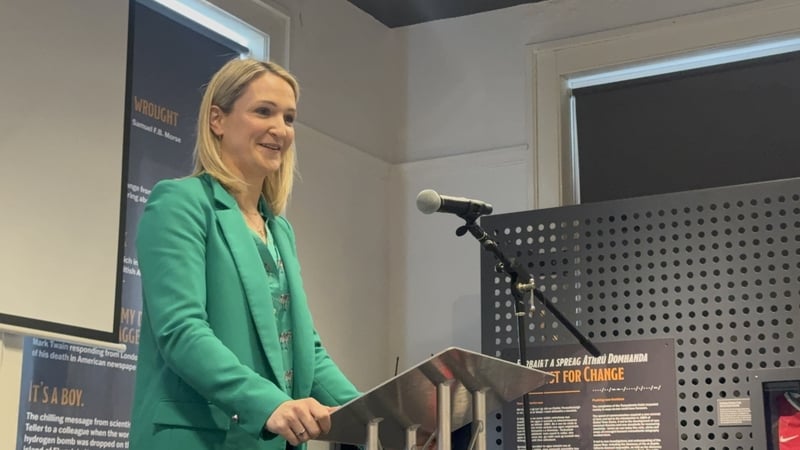
Speaking at a conference in Valentia, Co Kerry, Helen McEntee said protection of the subsea cable network is the central pillar of Ireland's national security.
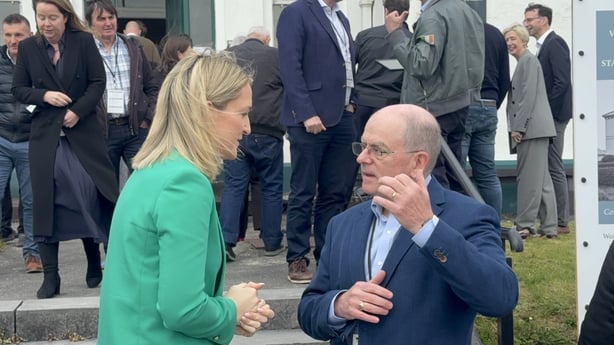
Ms McEntee was speaking at the second subsea cable security and resilience symposium.
The symposium is taking place in Valentia, where the first transatlantic cable was laid between Ireland and Newfoundland in Canada in 1858.
That cable transformed transatlantic communication, allowing what took weeks to take place almost instantaneously. The first transatlantic cable was a catalyst for increasing trade between Europe and North America.
Today, there are many more transatlantic cables, but the geopolitical environment is significantly different -- and far more threatening.
For instance, in November, 2024, the Yantar, a ship described by Russia as a research vessel but widely regarded by Western intelligence as a spy ship, was tracked within 60km of the east coast of Ireland.
It has been monitored by the Irish Navy, as well as by the US and UK militaries.
Its activities around and over subsea cables are partly responsible for increasing concern over threats posed to the Irish network of subsea cables.
Ms McEntee told the conference in Valentia that the protection of the subsea cable network around the Irish coast is central to Ireland's national security.
"As an island nation, Ireland's prosperity, connectivity and energy security are inseparable from the integrity of our undersea infrastructure," Ms McEntee said.
"Subsea cables carry the vast majority of global data flows, underpinning everything from financial systems to public services.
"Every email sent, every video call made, every financial transaction processed, almost all of it travels through fibre-optic cables on the seabed. These networks are the invisible backbone of our digital economy and our daily lives.
"What began as telegraph signals transmitted in dots and dashes has evolved into vast streams of real-time data connecting billions of people and devices worldwide."
Ms McEntee said a strategy to protect the cable network is already being put in place.
"This infrastructure is increasingly exposed – to hybrid threats, cyber-attacks and geopolitical tensions," she said.
"These risks are evolving, persistent and demand a coordinated response. That is why the protection of critical undersea infrastructure is now a central pillar of Ireland’s national security."
Delegates from 15 countries, from the US to Japan, are attending the symposium in Valentia.
Organiser Leonard Hobbs said: "A robust and reliable subsea cable repair ecosystem is essential to safeguarding the security and resilience of critical undersea infrastructure.
"Sustaining uninterrupted connectivity is not only vital for national security but also for broader societal resilience.
"However, both Government and industry have flagged significant challenges within the repair ecosystem that demand urgent attention."
The conference continues until tomorrow.
Meanwhile, the Minister for Justice Jim O'Callaghan said new legislation is being prepared to modernise the legal framework for lawful interception in Ireland which he said is vital for the collection of intelligence to deal with serious and organised crime, terrorism and security threats.
Mr O'Callaghan said it is "absolutely essential" that technology is used in these investigations and that current legislation is outmoded and risks leaving the country’s policing and security services lacking critical intelligence.
The new legislation he said will apply to all forms of communications, whether encrypted or not, and will be accompanied by new legal safeguards, including for the first time judicial authorisation of interception requests.