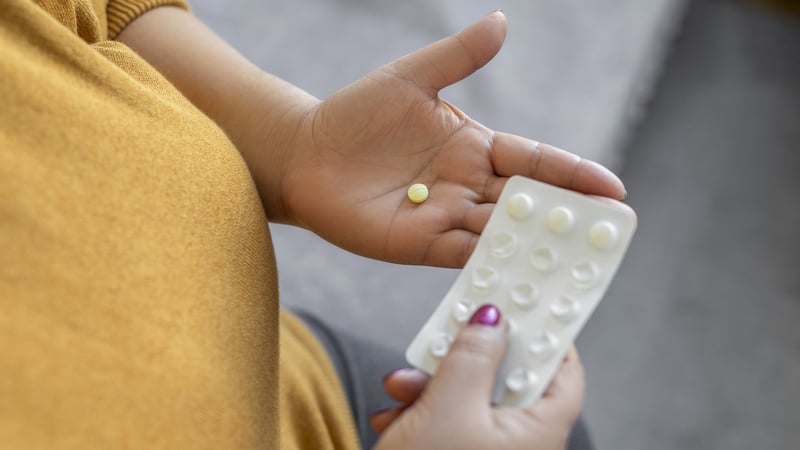
Nearly one in three women experienced barriers in accessing the Free Contraception Scheme, according to new research.
Age limits and the need for a Personal Public Service number were among the limitations cited.
Research also found that marginalised women faced additional barriers.
The Free Contraception Scheme was introduced in 2022 for women aged between 17 and 25.
In July 2024, the upper age limited was raised to 35.
The scheme is viewed as groundbreaking and is accessed by hundreds of thousands of women.
We need your consent to load this rte-player contentWe use rte-player to manage extra content that can set cookies on your device and collect data about your activity. Please review their details and accept them to load the content.Manage Preferences
The research - commissioned by the Department of Health and conducted by the National Women's Council and Trinity College Dublin - looked at barriers to access, with a particular focus on marginalised groups.
The researchers surveyed a sample of 500 women and ran four focus groups with migrant women, LGBTIQ+ people, Traveller women and disabled women.
Approximately 36% of those who responded to the survey said they thought there were barriers to the scheme, with 31% experiencing barriers themselves.
As well as women being ineligible because of their age - the researchers found that the PPS number requirement can exclude international protection applicants or undocumented women.
The report found that many migrant women had a low awareness of the scheme, despite good awareness in the population overall.
While disabled women highlighted that information was not readily available in accessible formats, such as for visually impaired women.
They also said that mobility, visual or other impairments often acted as a barrier in accessing healthcare providers and certain forms of contraceptives.
It also found that there may be cultural beliefs shaping attitudes to contraception, which create barriers to access particularly in Traveller and migrant communities.
Traveller, disabled and migrant women reported a reluctance amongst women within their communities to discuss contraception with male GPs.
LGBTQI+ and Traveller women reported a reluctance to access the scheme due to previous negative experiences within the health system.
The National Women's Council is calling for all eligibility requirements to be removed and for information on the scheme to be produced in multiple languages and accessible formats to reach migrant and disabled women.
It is also asking for gender sensitivity training - including anti-racism and anti-bias training - to be rolled out across the health services.
A spokesperson for the Department of Health said it welcomed the report.
"The report's findings are very valuable for our ongoing work to make contraception more accessible to women and to remove barriers to accessing care, in line with the principles of Sláintecare.
"In conjunction with the results from the Healthy Ireland Survey, 2025, we will be using the outcomes and recommendations of the Report to consider how best to further develop and support the Free Contraception Scheme," the spokesperson said.
GP waiting lists another barrier - National Women's Council
Head of Policy with the National Women's Council Doireann Crosson said one of the barriers included not having a GP due to waiting lists, adding that you "can’t get free contraception without first getting that referral".
Speaking on RTÉ’s Morning Ireland, she said the focus was to understand these groups of women, their experiences and their knowledge of the scheme to date.
She said accessibility for disabled women is not equal across the country.
She added that they spoke to women who, for instance, went to get a coil fitted but the facility did not have the appropriate lifts to accommodate them.
Ms Crosson said the research report was commissioned by the Department of Health, and with the new Women's Health Action Plan due to be developed and launched later this year, they hoped their recommendations would be taken on board.