


The European Union's foreign policy chief Kaja Kallas has said she expects "positive decisions" on the €90 billion loan for Ukraine to be made tomorrow.
"We expect some positive decisions tomorrow on the €90bn loan," she said, ahead of a meeting of EU foreign ministers held in Luxembourg that will hear a fresh call for a suspension of trade relations with Israel.
"Ukraine really needs this loan and it's also a sign that Russia cannot outlast Ukraine," Ms Kallas said.
Russian strikes across Ukraine wounded more than a dozen people in at least four regions overnight, officials said.
In the northeastern city of Sumy, Russian drones wounded 15 people and damaged apartment buildings and a medical facility, the head of the region said.
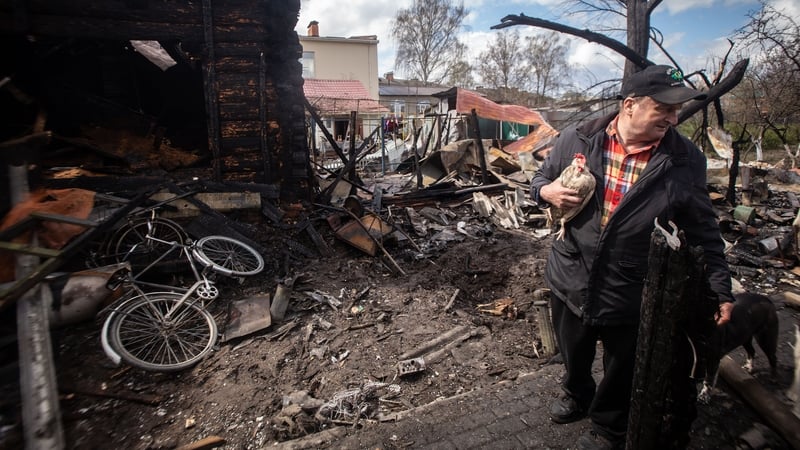
Emergency services released images showing rescue workers in the night dousing cars set ablaze in the attacks and helping evacuate residents from damaged buildings.
"Due to the threat of repeated attacks, rescuers had to suspend their operations several times and move to a safe location," the emergency service said.
Three people were wounded in aerial attacks in the northeastern Kharkiv region and another three in the eastern city of Sloviansk, officials said.
Four more were wounded in the Dnipropetrovsk region, the governor announced on social media.
Russia launched two missiles and 143 drones in the barrage, the Ukrainian air force said, adding that its air defence units had intercepted one of the missiles and 116 drones.
Russia hoped its invasion would quickly topple Ukraine's leadership but over more than four years has spiralled into the deadliest conflict in Europe since World War II, killing hundreds of thousands on both sides and displacing millions.
Russia has taken 1,700 square km of Ukraine this year, general says
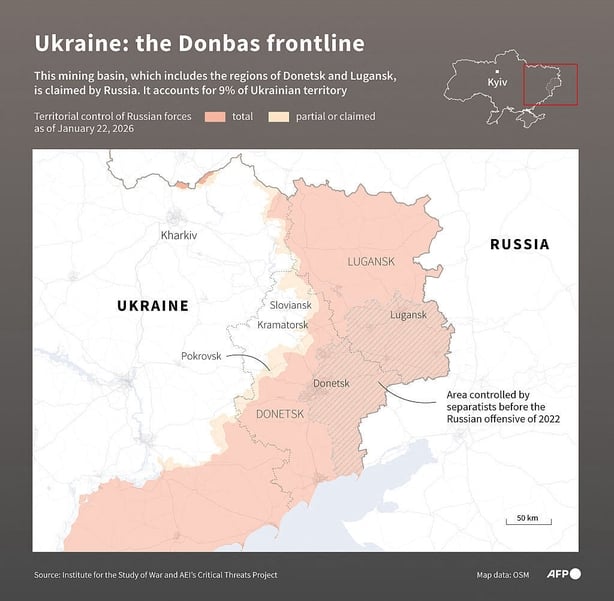
Russian forces have taken 1,700 square km (656 square miles) of territory in Ukraine this year and are advancing on its so-called fortress belt in Donbas, Moscow's top general said, while inspecting his forces.
Russia, has since its 2022 invasion, been seeking to take the whole of the Donbas area in eastern Ukraine, where Kyiv's forces have been pushed back towards a line of cities in grinding fighting.
Kyiv has also reported some gains in the deadliest war in Europe since World War Two. Top Ukrainian commander Oleksandr Syrskyi said in mid-April that Kyiv's forces had regained control of nearly 50 sq km of its territory in March.
"Since the beginning of this year, a total of 80 settlements and more than 1,700 square kilometres of territory have come under our control," Valery Gerasimov, Chief of the General Staff of the Russian Armed Forces, said in footage released by the defence ministry on Tuesday.
Reuters was unable to verify the battlefield accounts and the general staff of the Ukrainian armed forces did not immediately respond to a request for comment. Pro-Ukrainian maps indicate Russia has taken 592 square km this year.
Swedish intelligence says Russia manipulates economic data
Sweden's military intelligence said late yesterday that Russia was "manipulating" financial data to hide the real state of its economy yet maintains its political strategic aims.
Sweden's Military Intelligence and Security Service (MUST) said in a statement that even though official Russian figures showed falling GDP and weak industrial production, the country was "manipulating economic data in order to appear more resilient than it really is."
The intelligence service said that Russia was likely plagued by "higher inflation and a larger budget deficit" than it was communicating.
"Despite the recent period of high oil prices, which has provided Russia with increased revenues, it would take a price of over $100 per barrel for an entire year to remedy the Russian budget deficit," MUST said.
"The weak economy does not affect the strategic objectives," Thomas Nilsson, head of MUST, said.
The intelligence service said that Russia was committed to continuing the war in Ukraine and conducting "hybrid" activities in EU and NATO countries.
"It is a political decision, not an economic one. However, the economic constraints and sanctions do affect what kind of military capabilities Russia can muster, and how quickly this can be done," Mr Nilsson said.
