
The Galway City Ring Road project has been granted approval by An Coimisiún Pleanála after delays of over 20 years.
Galway County Council received notification of the decision this morning.
After two decades of false starts, hundreds of objections and multiple legal challenges, the N6 Galway City Outer Ring Road has been given the green light and there is renewed confidence that the project will finally go ahead.
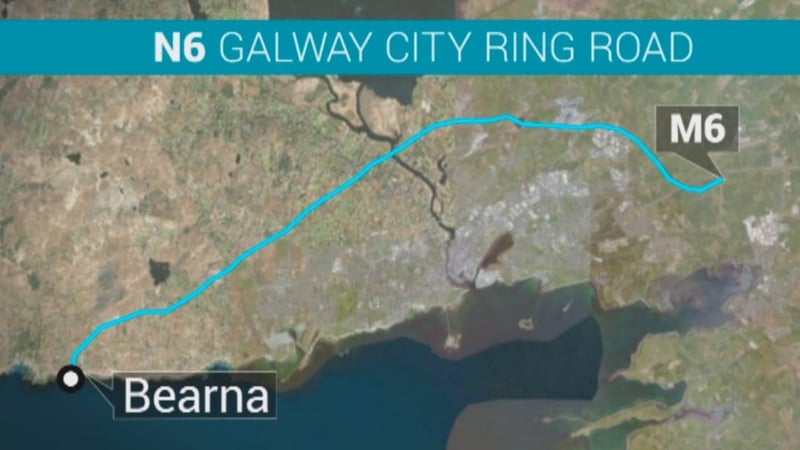
The proposed 18km route would run from the M6 motorway on the eastern fringes of the city to a location west of the village of Bearna.
€1 billion has been committed for the completion of the project under the National Development Plan.
The decision was welcomed by Minister of State for Transport Seán Canney, who described it as a "significant milestone" for Galway and the wider region.
"This is a really important and positive step forward for Galway. The Outer Ring Road has been talked about for many years, and to now have planning permission in place brings a much-needed level of clarity and momentum to the project.
"This is a major piece of infrastructure that has the potential to transform traffic movement around Galway, reduce congestion, and support the future growth and development of the city and surrounding areas."
Minister Canney acknowledged the long history of the project and the impact on local residents, saying: "It's also important to recognise that this has been a long and difficult process for some. There are people and families who were first notified almost 20 years ago that their homes could be impacted by this project.
"We need to keep those individuals to the fore as we move forward. Clear communication, fairness and respect will be essential as the next stages of the project progress."
Minister Canney emphasised that continued work is needed to address transport challenges within Galway City.
"This is a hugely positive development, but it is only one part of the solution. We need to continue looking at how we improve traffic circulation within Galway itself.
"That includes keeping options like a light rail system for the city on the table, alongside other measures that will make it easier for people to move around safely and efficiently."
Many years of twists and turns in the project
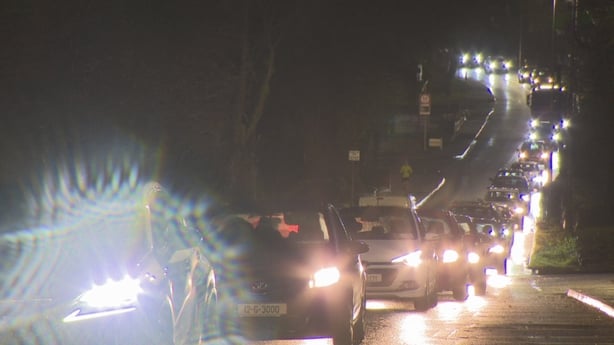
The proposal for an outer city bypass to address Galway's chronic traffic congestion was first mooted in 1999.
In 2008, planning permission was granted for what was named the Galway City Outer Bypass project with a projected cost of €17 million.
A challenge was mounted and in 2011 the decision was found to be in contravention of the EU Habitats Directive by the European Court of Justice.
It was back to the drawing board and in 2015 a new project called the Galway City Ring Road went to public consultation.
In 2018, a planning application for the ring road was first lodged by the two local authorities in Galway and Transport Infrastructure Ireland.
The N6 ring road was initially approved in 2021, only for permission to be rescinded after it emerged the impact of the development on the State's Climate Action plan had not been considered.
That led to the application being 'remitted', with updated data provided in relation to the climate impacts, during both construction and operational phases.
Today's decision will be broadly welcomed by traffic weary commuters but environmental groups opposed to the project will see it is as a "step backwards in the midst of a climate crisis".
Some 126,000 tonnes of carbon emissions will be released into the atmosphere during the construction phase. Officials say these short-term adverse effects are inevitable for any transport infrastructure development.
Officials are describing their forecasts as "short-term major adverse effects on climate" and say these "are inevitable for any transport infrastructure development".
But they also concede that the project would have "a permanent moderate adverse residual effect on climate" over its lifecycle.
It is anticipated that today's decision will be closely considered by Friends of the Irish Environment (FIE) and the likelihood of a legal challenge being mounted cannot be ruled out.
Meanwhile, there are dozens of families facing Compulsory Purchase Orders who say they have been living in a state of limbo for years.
If the project goes to plan, construction is expected to begin in 2028 with a timeframe of up to three years for completion.