


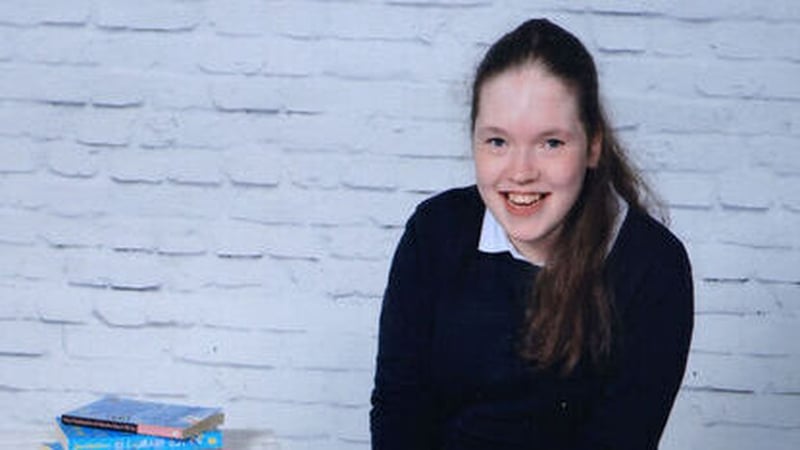
A verdict of medical misadventure has been recorded at an inquest in the death of a 16-year-old girl who suffered fatal brain injuries after surgery to relieve a build-up of fluid on her brain during a time when a pressure monitor provided "falsely reassuring" readings.
Jemma Gardiner, from Ratheskin, Kincon, Ballina, Co Mayo, died at Beaumont Hospital in Dublin on 18 February 2019.
A sitting of Dublin District Coroner's Court has heard her condition deteriorated acutely in the early hours of 12 February 2019 after she had undergone surgery for an endoscopic third ventriculostomy (ETV) - a procedure to create a natural drain to relieve pressure on the brain.
The decision to carry out an ETV was taken after the failure of a shunt - a tube to drain excess fluid from the brain - which had been implanted at Beaumont a month earlier.
That procedure had been performed due to the failure of an original shunt that had functioned without issue for 16 years since shortly after Jemma's birth.
Her mother, Gillian Gardiner, told the hearing that her daughter, although born with congenital hydrocephalus (an abnormal build-up of fluid on the brain), had enjoyed good health for most of her life until December 2018.
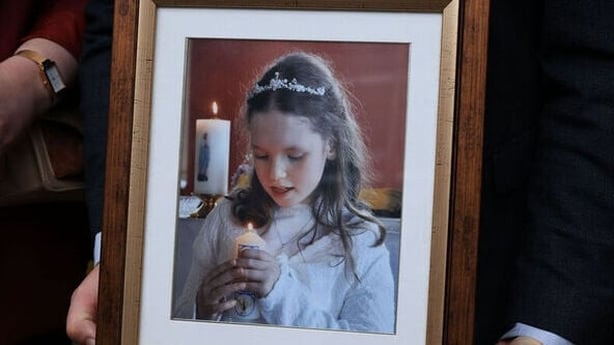
The inquest heard that she was non-verbal and used a wheelchair.
Ms Gardiner said there had been no complications with annual check-ups on the shunt.
She recalled how Jemma was able to return to school a few weeks after being discharged from hospital in January 2019 after surgery to implant the second shunt.
However, they had to return to Beaumont on 8 February 2019 when she became unwell again.
Ms Gardiner gave evidence that both existing shunts were removed at the time of the ETV.
Two external drains were also fitted to drain fluid in the event of the ETV failing, while a monitor to measure pressure levels inside Jemma's head had also been attached.
Following the ETV, Ms Gardiner said her daughter became agitated when she was back on a ward and was continuously trying to remove a bandage around her head.
"I was in such disbelief and all I could do was cry as I knew deep down that if Jemma pulled through, she would not be the same girl we all knew and loved."
She explained how she kept an eye on the monitor reading every few minutes after a decision was taken to remove the bandage.
Ms Gardiner said she had been advised that the monitor should not exceed a reading of 25 and it had never exceeded that level while she was observing it.
She outlined how she alerted nurses when she became concerned that her daughter’s breathing had become unusual.
Ms Gardiner said a doctor who came to examine Jemma, immediately used the external drains to remove fluid before a decision was taken to transfer her to the hospital’s intensive care unit.
She recalled the doctor saying that he had never seen an ETV fail or anyone become so unwell so quickly.
"I was in such disbelief and all I could do was cry as I knew deep down that if Jemma pulled through, she would not be the same girl we all knew and loved," said Ms Gardiner.
The inquest heard that an MRI scan subsequently showed that Jemma had sustained significant brain damage, while further tests confirmed she had suffered a brain stem death.
Ms Gardiner said Jemma "grew her angel wings" when she passed away at 3.20pm on 18 February.
She described Jemma as a very special child who "loved fashion and having her nails painted".
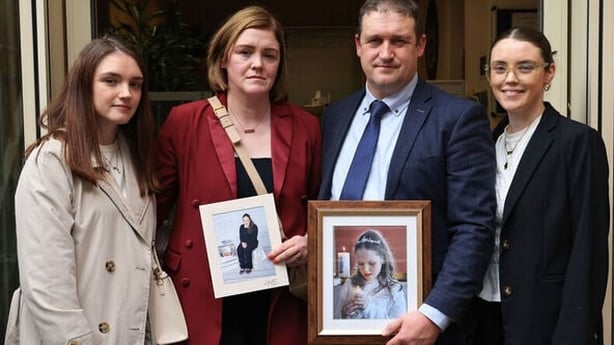
"Her passing has left a huge void in our home and we miss her terribly," said Ms Gardiner, who was accompanied by her husband, Anthony and two of their daughters. Clara and Chloe.
Clara, who represented Mayo in last year’s Rose of Tralee festival, spoke during the contest to presenter Dáithi Ó Sé about the death of her sister.
'We did everything possible to prevent this very complication'
The consultant neurosurgeon who performed the ETV told the inquest that he was "devastated by the outcome."
"We did everything possible to prevent this very complication," Darach Crimmins said.
He estimated that Jemma had experienced severe pressure on her brain for between 60 and 90 minutes before the fluid was drained.
"We didn’t act on the failure of the ETV," he admitted.
Consultant neurosurgeon John Caird said the decision to carry out an ETV on Jemma was "the appropriate next step" due to the failure of the second shunt which he had implanted the previous month.
Mr Caird acknowledged that the pressure monitor had given false low readings.
In reply to questions from counsel for Jemma's family, Roger Murray SC of Callan Tansey Solicitors, he acknowledged that monitoring and assessing a non-verbal patient like Jemma was more challenging.
However, he said her case was "very unusual."
"Jemma wasn't going anywhere without a fight. She fought so hard and we’re just happy we got some answers for her and ourselves."
A registrar in neurosurgery, Vincent Healy, gave evidence that Jemma had suffered "a severe, irreversible and disabling injury."
Dr Healy said her condition had deteriorated "despite inbuilt safety mechanisms, close monitoring and an early appropriate response to her deterioration."
Nurse Mary Scully said she had contacted another registrar, James Clerkin, at 5.35am on 12 February to urgently review Jemma because of her concerns after Ms Gardiner had alerted her to a change in her daughter's breathing.
Dr Clerkin gave evidence that he had been contacted by Ms Scully about Jemma having "an isolated episode of hypertension" about an hour earlier.
Mr Murray SC expressed surprise when Dr Clerkin told him that he was unaware that Jemma was recovering from surgery at the time.
The witness said he went directly to the ward after being contacted the second time by Ms Scully and realised immediately it was an emergency because Jemma was so unwell.
Dr Clerkin agreed with Mr Murray that every additional minute could cause brain damage.
The inquest heard he opened the external drains which removed 50ml of fluid.
A post-mortem showed Jemma died from swelling on the brain due to a lack of oxygen and blood to the brain from an increase in intracranial pressure arising out of a failure of an ETV.
Returning a verdict of medical misadventure, Dr Keane said the early failure of the ETV, despite the procedure being "technically successful," was compounded by the pressure monitor becoming displaced.
The coroner acknowledged that medical staff had reacted promptly once the deterioration in Jemma's vital signs had been noticed.
Dr Keane said she endorsed the change that had already been made at Beaumont Hospital where pressure monitors used in wards now provide a "waveform" reading, rather than just a numeric one, which facilitated easier assessment of a patient’s condition.
She also offered her condolences to Jemma’s family on their "heartbreaking loss."
Following the inquest, Ms Gardiner said they were very happy with the verdict and information they had found out from the evidence.
She also called for better communications between medical staff and families, particularly in relation to vulnerable patients.
Her daughter Chloe said: "Jemma wasn’t going anywhere without a fight. She fought so hard and we’re just happy we got some answers for her and ourselves."
