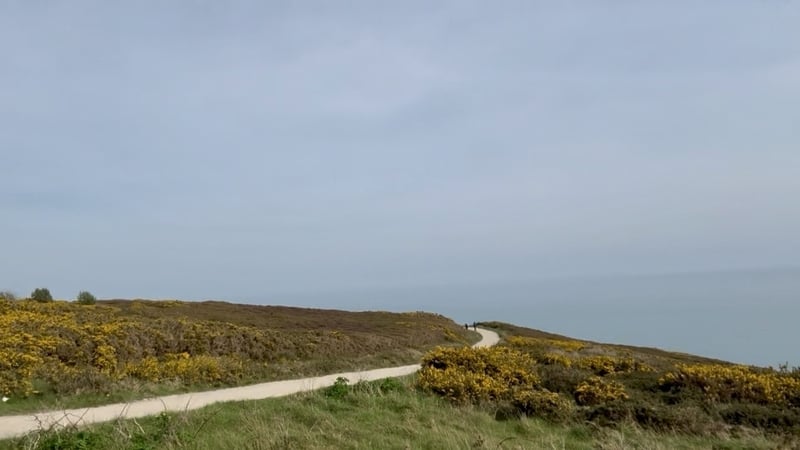

Howth Summit walk is fast becoming one of Dublin's busiest tourist hotspots attracting half a million people last year.
Officials say the walk’s increasing popularity is driven by social media.
But while the rise in numbers is good for local business there is growing pressure on the fragile coastal environment.
Cian McCormack visited Howth to find about the two sides to becoming a popular tourist destination.
"Can you smell it," asks Shane O’Doherty.
As he places his nose to the yellow gorse. I do the same. There's a soft subtle smell with hints of vanilla, maybe coconut.
"It’s kind of like a vanilla coconut fragrance," Shane agrees. He is the owner of Howth Adventurers.
I nod as he continues to talk and inhale more of the fragrance.
"I find it mood altering," he adds.
It's a still, calm March morning on Howth Head with barely a puff of wind. The sun burns slowly through a low haze.
Under where we are standing, the Irish Sea is calm. White flecks dance on its surface. To the right, the Baily Lighthouse is in the distance. In the other direction I catch glimpse of the recently restored white Éire 6 sign from World War II.
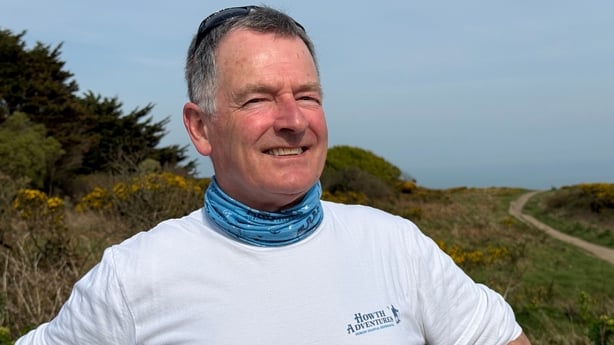
Squeezing through a narrow pathway, there's yellow gorse on each side. Birds are fluttering and singing overhead. Shane is showing me why this area is popular with visitors.
"Most people come for the views and for the nature," he says, adding the first Puffins have just arrived and been spotted in recent days.
Howth has become a big draw for Dublin tourism.
New figures from Fingal County Council show that around half a million people a year now make their way along the Howth Summit Walk. That's up from roughly 400,000 in 2018.
There are reasons for those increases.
"It’s extremely scenic", says council biodiversity officer Hans Visser who adds that it's a bit like the Irish west coast but in Dublin.
"It’s very accessible by both car or by train. It’s like a day out," he says.
Along the summit walk certain views and stops have become 'selfie points' where visitors line up for the perfect shots for Instagram and TikTok.
"There’s almost a fear of missing out," says Shane O'Doherty, adding if people come to Dublin and don’t come to Howth they "feel like they are missing out".
He says the summit walk has become a social media "bucket list tick-off".
"There’s an awful lot of people who come for what you're enjoying now," he tells me as I record a feature for RTÉ’s Morning Ireland.
"But there’s an awful lot of people who come for reasons that they don't understand themselves. They could be at Jamesons, they could be at the Guinness Storehouse … it’s kind of a bucket list tick-off".
The popularity of the walk comes at a cost.
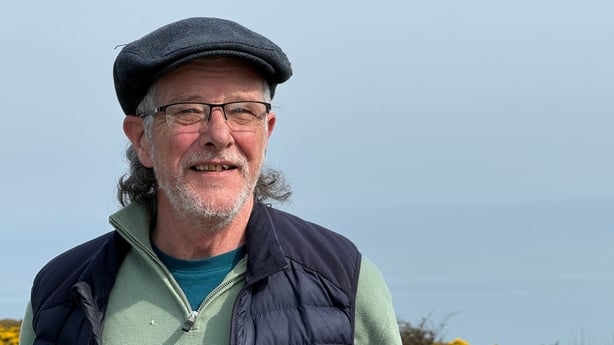
One of the main footpaths provides a vantage point for local historian and environmentalist Philip O'Connor to point at an area 100 metres away, near the cliff edge.
"Look down there. That’s one of the main selfie spots," he says. "You can see the erosion. The heathland has been totally eroded".
While the area is in good condition there are parts of this special amenity area that have been impacted. Vegetation has been trampled and, in some parts, it is stripped down to soil and stone.
There are informal trails, not many but some, that branch off where visitors stray in search of a maybe better angle or something quieter.
Bu Philip, who is chair of the Howth Heritage Society and of the joint County Council-Community Howth Special Amenity Area Committee is pragmatic. He says he has no interest in trying to stop people coming here. He wants the area managed, and that has started already.
"I have no interest in trying to stop it. This is the world we're living in. It's just a matter of sensibly managing it, that you both protect what we have and at the same time make it open for people to enjoy," Philip says.
He adds that managing the summit walk sensibly means that means clearer pathways and fencing off damaged areas to allow them to recover.
"And encouraging people to stay on the paths," he adds. "Not be wandering into the heathland and eroding it further."
Fingal County Council is working to protect the area.
Hans Visser points to efforts to guide visitors along pathways and reduce pressure on the most sensitive spots by fencing them off.
"Places like nose of Howth are extremely popular for photos," he says. "People are always looking for new angles, new locations. So, it’s about trying to confine that as much as possible."
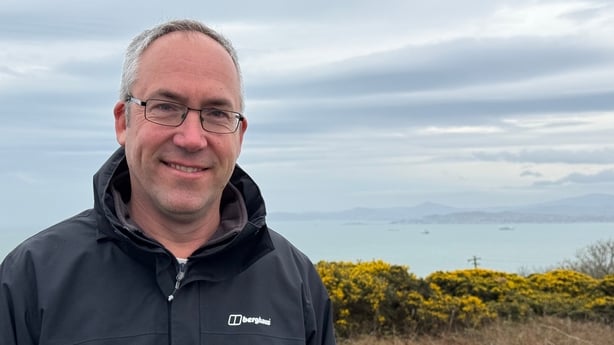
Hans says visitor numbers have risen steadily since 2018 and have increased from around 400,000 to approximately 500,000 in 2025.
One automated counter on the summit at one point recorded figures as high as 900,000 for 2025, but he says this was most likely due to a fault.
Back in Howth village the tourist increase has been gradual and good for business.
"It's great for business," says Declan McManus of King Sitric Seafood Bar and Accommodation.
Tourism, he says, has transformed over time.
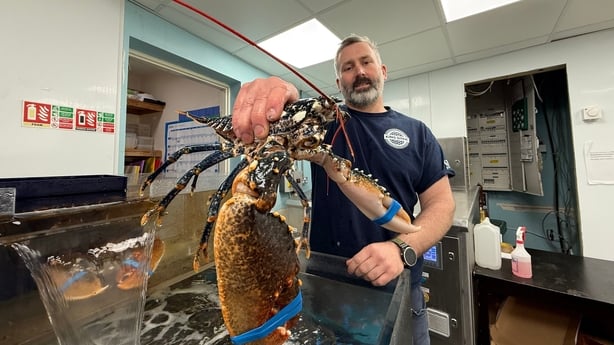
"When we were kids, there was no tourism here. But it’s slowly picked up every year," Declan says, as he hold a lobster from a tank explain how they source them locally.
The challenge for tourist authorities is the even spread of tourists throughout the Dublin area.
Fingal County Council is doing that with its tourism strategy. Senior executive officer for tourism Declan Power says the idea is to get tourist explore other parts of the county.
Fáilte Ireland has worked with Dublin's local authorities to do this and initiatives like the Dublin Coastal Trail, launched in 2022, aim to do just that. It links the coastline from north to south and encourage visitors to discover lesser-known spots.
"It's about showcasing the entire coast of Dublin, all the way from Skerry's in the north down to Killiney in the south and to say, look, there's lots of villages to explore," says Fáilte Ireland Dublin regional manager Helen Cole.
"When visitors come here and spend half a day or a day, they're spending the local shops, the local restaurants and bars. So, it's important that concentration doesn't just. happen in one place and it is spread out through the whole county," she adds.
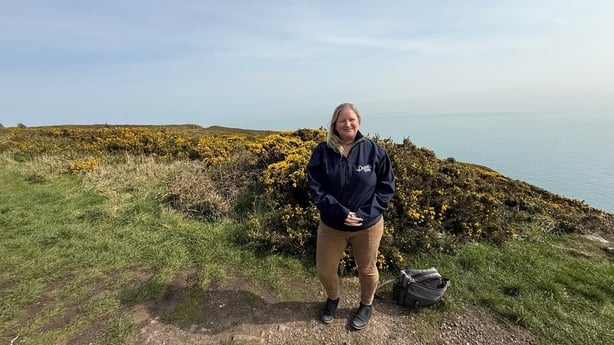
Back on the path, the crowds are still there. The birds are still audible and the sea glints below. The sweet faint note of the gorse lingers in the cooling salty air.
Looking at the view as kayakers pass below are two Italian tourists.
"We saw Howth on social media. It is beautiful," says one woman, who adds this was a day trip facilitated by a short trip by train (the DART) from the centre of Dublin city.
"This is our last day. We wanted to see something beautiful before we got our flight. This is beautiful."
"We had a free day, so we decided to come here because we saw on the internet a lot of things, a lot of people that recommend it online," says the other woman.
The trick for Howth now will be continuing to attract tourists by train and balancing the increase with preserving and conserving the nature and beautiful environment that attracts the TikTok and Instagram selfie takers.
We need your consent to load this rte-player contentWe use rte-player to manage extra content that can set cookies on your device and collect data about your activity. Please review their details and accept them to load the content.Manage Preferences