


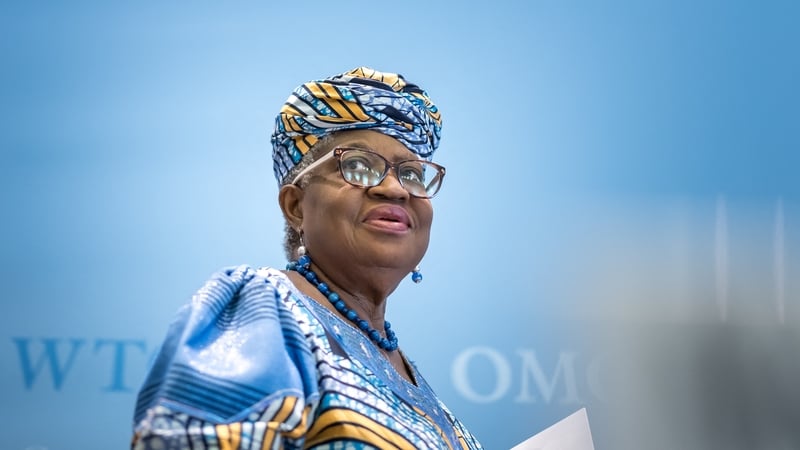
The global trading system is experiencing the "worst disruptions in the past 80 years", World Trade Organization chief Ngozi Okonjo-Iweala warned as the WTO ministerial conference opened today.
"The world order and the multilateral system we use to know has irrevocably changed," she said, adding: "We cannot deny the scale of the problems confronting the world today."
The World Trade Organization's 166 members appear deeply divided as trade ministers gather in the Cameroonian capital for the WTO's top conference, amid global economic turmoil linked to the Middle East war.
Over four days in Yaounde, WTO members will try to revitalise an institution weakened by geopolitical tensions, stalled negotiations and rising protectionism - against the backdrop of the war in the Middle East, which poses a serious threat to international trade.
"The scale of the problems confronting the world today, even before the conflict in the Gulf, destabilised trade in energy, fertiliser and food," Ms Okonjo-Iweala said.
"National governments and international institutions alike have been struggling to navigate rising geopolitical tensions, intensifying climate pressures and rapid technological change.
"Accompanying these shifts has been an increasingly loud questioning of multilateralism."
Ms Okonjo-Iweala said these disruptions were just one symptom of broader upheavals shaking the international order created after World War II to prevent a repeat of the disasters of the first half of the 20th century.
"It feels appropriate that at the moment when the world is in turmoil with conflict in the Middle East, Sudan, Ukraine, and elsewhere, at this time of great disruption and uncertainty, we have gathered in Africa to discuss the road ahead for the global trading system," she said.
"Africa is the continent of the future."
WTO ministerial conferences are typically held every two years. This is the second to be held in Africa, after Nairobi in 2015.
Mideast war could spark financial system stress - ECB
The Middle East war is a threat to financial stability, a senior European Central Bank official has said, warning that it could spark "systemic stress" in the markets.
The turmoil unleashed by the war has come at a time of growing worries about a bubble in tech stocks driven by euphoria over AI, as well as the health of the private credit sector.
"This conflict could trigger the unravelling of interconnected vulnerabilities and cause systemic stress," ECB Vice President Luis de Guindos said in a speech in the Estonian capital Tallinn.
"It threatens to derail market sentiment at a time when asset valuations are high," he said, adding it could also be "amplifying stress in the non-bank financial sector".
Mr de Guindos, whose role at the ECB includes monitoring financial stability, added however that the "spillovers to the euro area financial sector have so far remained contained".
Markets have been roiled by the Mideast war, sparked last month by US-Israeli attacks on Iran, with stocks falling and oil and gas prices jumping.
Iran has declared the Strait of Hormuz - a vital sea lane that normally transports about a fifth of the world's oil and gas - closed to the shipping of countries it considers allied with the United States and Israel.
Warning of "far-reaching repercussions for the global economy", Mr de Guindos said the economy "was facing a supply shock".
"The scale of the impact and the implications for price and financial stability will depend on how much the war spreads, and how long it lasts," he added.
Speaking in Frankfurt yesterday, ECB President Christine Lagarde said there were reasons to think any inflationary shock would be less intense than in 2022 after Russia's full-scale invasion of Ukraine.
Traders have raised their bets on the ECB hiking interest rates as soon as next month to tame an expected surge in inflation.
