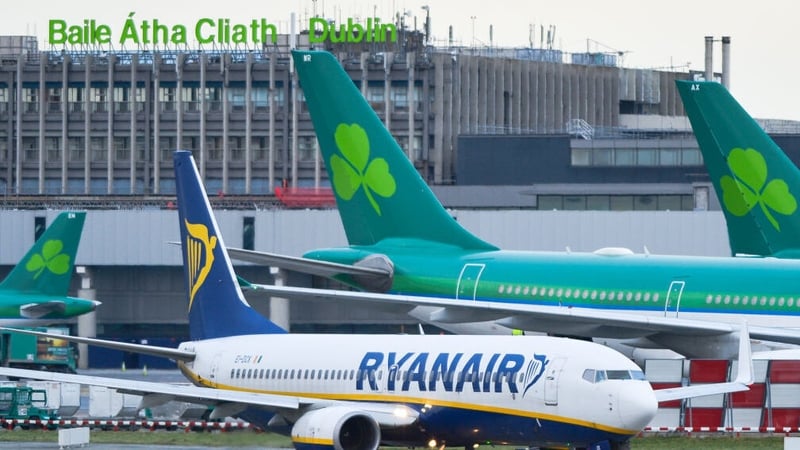

The deputy chief executive of daa, which operates Dublin Airport, has insisted there "won't be a free-for-all" as a result of the removal of the passenger cap.
However, Nick Cole has forecast that passenger numbers at the airport will grow to around 50 million a year by the late 2030s or early 2040s.
He made the prediction during an appearance before the Joint Oireachtas Committee on Transport at Leinster House.
The committee is holding hearings as part of the pre-legislative scrutiny of the Dublin Airport (Passenger Capacity) Bill 2026.
Last month, the Cabinet approved draft legislation to lift Dublin Airport's 32 million passenger cap, which was a condition in a 2007 planning permission.
Mr Cole told the committee that "connectivity is constrained and under threat" due to the restriction.
"The ongoing uncertainty discourages airlines from investing in new routes that Ireland wants, such as direct flights to India and Brazil."
He claimed that the limit "sends a clear signal to international businesses that good connectivity is not a given".
The daa deputy CEO said the passenger cap allows competitor airports, such as Manchester and Glasgow, to "lure flights away".
In his opening statement, Nick Cole said the restriction has also led to "price increases and reduced choice" for consumers.
"This is not theory, it is fact," he insisted.
He said when the Irish Aviation Authority took the cap into account when allocating take-off and landing slots during the winter 2024/25 season, "fares on European routes at Dublin Airport increased by 13% year-on-year" and he said capacity fell by 3%.
"The following winter the cap was parked due to legal reasons. Capacity rose and air fares at Dublin were flat in line with the European average."
The restriction has been suspended by the High Court pending the outcome of legal proceedings referred to the Court of Justice of the European Union.
Mr Cole said it is the view of the daa that "removing the cap is as critical to aviation as corporation tax certainty is to FDI (foreign direct investment)".
"With a decision imminent from the European Court of Justice that could force Ireland to significantly slash Dublin Airport's passenger numbers from 36.4 million last year to 32 million, the importance of this legislation cannot be overstated."
"The blunt cap artificially restricting Dublin Airport must be resolved and resolved soon," he added.
During questioning from TDs and Senators, the daa deputy CEO insisted a lifting of the cap is "not a free for all".
Nick Cole said there will be "safeguards" in the new legislation.
"There are environmental safeguards. We will have to do environmental impact surveys, etc. And there are other limitations on growth."
"We will comply with all relevant legislation and ensure that any growth that we continue to deliver at Dublin Airport is part of this new legislation. So, in short, I would say it won’t be a free-for-all. We will still be monitored and we will comply."
Community engagement 'a priority'
The daa told the committee members that engagement with the local community "is and remains a key part of its strategy and a priority" for the Dublin Airport operator.
Nick Cole said the commercial semi-state company has committed over €50 million in community related funds, schemes and initiatives "to improve the lives and welfare of our neighbours".
He said half of all flights to and from the airport are now quieter, next-generation aircraft and he said the daa "continues to incentivise this".
Mr Cole said 82% of Fingal residents "continue to view Dublin Airport as a positive force in their community", according to recent research carried out by Red C.
To date as part of aircraft noise mitigation measures, he said daa has offered to fully buy out 41 homes with a premium of 30% above market value, have fully insulated over 200 homes at an average cost of between €80,000 and €100,000 each
He also said a new bedroom insulation scheme was announced last year for another 1,000 homes with a grant of €30,000 and five schools have been insulated.
The daa Chief Governance and Strategy Officer, Miriam Ryan, said the buy out offer is based on a Red Book valuation of the properties, but she said it "also has an uplift of 30%" on the market value.
She said the company will also pay for the homeowners to get their own independent valuation done, as well as offering relocation expenses and paying Stamp Duty costs.
Asked if the daa would extend the August 2026 deadline for applying for the Voluntary Dwelling Purchase Scheme, Ms Ryan said the daa would "certainly consider" the request.
She also told the committee that Dublin Airport is "firmly on track" to meet its target to reduce emissions by 51% by 2030.
40 million passengers by 2030
After reaching a record 36.4 million passengers last year, the daa Chief Commercial and Development Officer, Vincent Harrison, said the growth in is set to be constrained in the coming years due to what he described as "the slow passage" of a planning application to construct new facilities including piers and aircraft stands.
The Infrastructure Application is currently progressing through Fingal County Council.
"We expect the passenger throughput, until we see significant infrastructure and pier development advanced, to be constrained to 1% or 2% per annum growth," Mr Harrison said.
On that basis, he said passenger numbers are expected to grow to around 40 million by 2030.
In terms of more long-term growth, the daa deputy CEO said it would be 10 to 15 years before passenger numbers reach 50 million.
"If you were to look at, let's say 50 million passengers, we’re certainly looking in the region of the late 2030s to the early 2040s," said Nick Cole.
But he said there "isn’t an absolute number".
The daa executives were also questioned about the flight path being used by aircraft that take off from the North Runway.
At a hearing of the committee last week, resident and community groups raised the issue of planes being required to take a 30-degree turn right on departure.
Managing Director of Dublin Airport, Gary McLean, insisted that the aircraft are following flight paths that were the subject of a public consultation in 2016.
He said the Standard Instrument Departure (SID), which refers to an aircraft's pre-defined flight path when taking off, was designed in advance of the opening of the runway.
Mr McLean said the airlines are "flying compliantly" with that SID, with the non-compliance figure in the region of 10%.
Original cap plan envisaged a third terminal - IAA
The Irish Aviation Authority (IAA) has said the Dublin Airport passenger cap was "expressly not a cap on the whole airport" but rather on terminal one and two combined at a time when a third terminal building was envisaged.
The chief executive of the IAA, Declan Fitzpatrick, told the Oireachtas Transport Committee that it was a condition contained in a local area plan adopted by Fingal County Council 20 years ago.
"That 2006 plan, which has since elapsed and been replaced, envisaged that passenger numbers would grow to 38 million passengers by 2025 and provided that passenger capacity over 30 million should be provided by a third terminal building on the western side of the airport."
He said the limit was designed to ensure there was "balanced development" at the airport.
"In 2007, An Bord Pleanála then imposed the 32 million conditions on terminals one and two, so that there would be sufficient future passengers to use this terminal three, and thus the airport would develop in the manner envisaged in the 2006 local area plan, with balanced development on the east and west sides."
The IAA CEO said the restriction was "not designed explicitly as an environmental mitigation measure and will not be efficient at mitigating any noise, aviation CO2 emissions or other environmental issues at the airport".
"It did not result from any road capacity analysis and it was not intended that the 32 million conditions would in themselves prevent congestion as a standalone measure, but rather that they would ensure balanced access to the three planned terminals."
Mr Fitzpatrick said given that the EU Slot Regulation requires that available land and take off slot capacity "must preferentially be allocated to airlines which have historic slots", any airport constrained by an annual passenger cap "cannot facilitate any additional traffic for new routes or new entrants at any time of the day or year at times when capacity is otherwise available".
"It also means that no additional passenger flights can be added for peak demand periods, such as Christmas or Easter or for special events such as major sporting events."
"Such unintended consequences may explain why, as far as the IAA is aware, no other EU airport is subject to an annual passenger cap", he added.
He told the TDs and Senators that the authority "welcomes the objective of the legislation to remove the annual passenger cap".
"Any physical infrastructure constraints or environmental impacts can be more effectively addressed with targeted measures within the capacity setting process," said Mr Fitzpatrick.
Tomorrow, airline representatives will appear before the committee.