


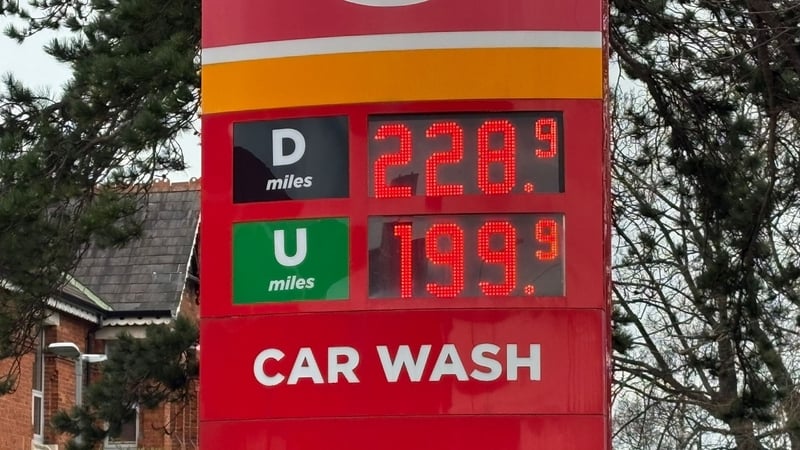
Tánaiste and Minister for Finance Simon Harris is bringing forward proposals to Government to cut excise duty on diesel by 20 cent and by 15 cent on petrol until end of May.
The measures being announced are set to include a temporary increase in the maximum rebate allowable under the Diesel Rebate Scheme, which is administered by Revenue, to 12 cent per litre (from 7.5 cent per litre) until 30 June.
This will take effect immediately upon passage of a resolution in the Dáil and will be backdated to 1 January, at a cost of approximately €10 million.
This will mitigate the additional fuel costs currently being borne by hauliers and passenger transport operators.
Wider sectors of the economy, which are dependent on haulage for distribution services, may also indirectly benefit from this measure.
'Nimble' response
Mr Harris said he believes the proposed cuts to excise duty on petrol and diesel will make a "real difference" to people's pockets - and did not rule out further interventions.
Speaking before a meeting of the Cabinet, he said the Government wanted to be nimble in its response and introducing six-month measures would be "foolish".
"The idea that you can stitch anything in today for six months would be foolish.
"We have to be nimble in our response, so providing a window of clarity, but also keeping it under review and making sure we have the flexibility as a country to amend, respond, revise as this economic challenge unfolds," Mr Harris said.
Watch: Tánaiste says six-month fuel measures 'foolish'
He added that the cut to excise duty on petrol and diesel until the end of May was to "recognise that Mystic Meg and her descendants can't predict where the world's economy is going to be at the end of May".
"And then you look at the volatility yesterday alone, and the most irresponsible thing a government could do, but the worst thing we could do for the Irish people is sign ourselves up to a load of measures that may actually end up being the wrong ones by the end of May.
"It's not that we're ruling out further interventions. It's not that we're ruling out further measures. It's that we're taking measures now... and to see how this situation occurs, and also to see what the economic impact is.
"But I do think these two measures - in terms of excise on petrol and excise on diesel - will make a real difference," he added.
The overall package, which will also include targeted energy supports for pensioners, carers and people with disabilities, is set to cost €235m.
The excise measures will take effect from midnight tonight subject to a financial resolution being passed in the Dáil.
On the fuel front, there is expected to be a pause of the National Oil Reserves Agency (NORA) levy for two months but this will require the passing of legislation.
It is charged at two cents per litre on motoring fuel and home heating oil.
Once the legislation is passed, it would mean that there would be an effective cut in levies of 17 cent on petrol and 22 cent on diesel.
'Targeted and temporary'
Taoiseach Micheál Martin said that Government party leaders decided on a two-month period for the cut to excise duty on diesel and petrol on the foot of advice heard at the European Council.
Mr Martin said introducing "targeted and temporary" measures was the key recommendation that the Government decided to act on.
"What we're endeavouring to do here is to reduce pressure on people.
"Governments are ultimately limited in terms of what they can do over a prolonged period in respect of a crisis such as this arising from a war," Mr Martin said.
He added: "We urge that this conflict and war ends as quickly as possible as that's the most effective way to get the world economy back on some equilibrium.
"Temporary, targeted [measures] are the key recommendations globally as to how to deal with a situation as this and that's what we're doing here today."
Minister of State Seán Canney said short-term measures to tackle the energy price crisis were taken due to the volatility of the situation in the Middle East after Israel and the United States began attacking Iran.
"These are the first measures we've taken, the scale of the problem is not really known yet, it's volatile.
"We saw the price of crude oil drop 10% yesterday off one statement, so it's so volatile at the moment, it's hard to judge what's going to happen," Mr Canney said.
He added that the Government would be monitoring the situation and the effects on the economy on a daily basis.
Read more:
Live: Updates as they happen
Govt leaders agree cut to excise duties on diesel and petrol
How much are fuel increases really costing us?
Sinn Féin has accused the Government of abandoning those dependent on home heating oil and said it would seek to amend the financial resolution in the Dáil.
Social Democrats deputy leader and finance spokesperson Cian O'Callaghan has expressed deep concern that the Government response to the energy crisis is going to be wholly inadequate.
Deputy O'Callaghan said: "It has taken this Government nearly a month to respond to this escalating energy crisis - and I am now deeply concerned that this belated response is going to be wholly inadequate.
"While a cut to excise duty, to provide relief at the pumps, is welcome, there is so much more the Government should be doing to target supports at those who are struggling the most.
"Even before this latest crisis erupted, 320,000 households were in arrears on their energy bills. That is hundreds and thousands of people all over the country who simply can't meet soaring energy prices.
"For months now, the Social Democrats have been asking the Government to introduce a targeted €400 energy credit for the 800,000 households who are struggling most, based on household income. This measure has been fully costed, at €362 million, and would provide real support to people who need it most."
The party said this would be a targeted measure to support low income households faced with huge increases on home heating oil and other cost of living price increases.
Labour in calls over remote working
Labour called for a cut of 10% on public transport fares and said it wants more people to be able to work from home.
Labour Party Spokesperson on Finance Ged Nash said his party supports the measures being introduced by the Government, adding that "the response needs to be a mix of financial measures for hard-pressed commuters, some for workers and small businesses across the country, but also a policy intervention".
Speaking on RTÉ's Morning Ireland, he said that "we need to return now to a real focus on enabling people to work from home to ensure that we get the benefits of remote work and that workers aren't overly penalised by having to get into their cars or use expensive public transport on a daily basis.
"I think Government needs to lead by example and ensure that there's a renewed mandate now across the civil and public service to ensure that people can work from home."
