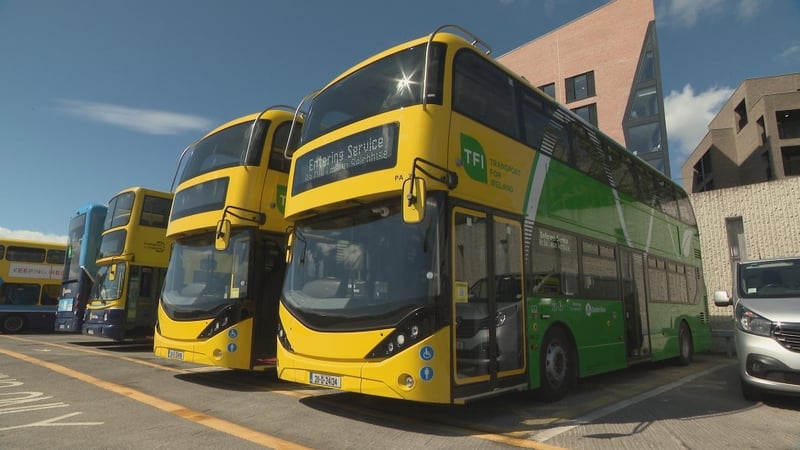

Chair of the Public Accounts Committee (PAC) John Brady said that a "serious litany of failures" led to more than 130 State-funded electric double-decker buses remaining unused because there is nowhere to charge them.
Mr Brady said the National Transport Authority's (NTA) response is "totally insufficient".
"It outlines a timeframe for some of those buses to come into use, some of them aren't due to come into use until 2027 - a full year away," he said.
The Sinn Féin TD added that: "This is totally unacceptable".
The committee will write to Minister for Transport Darragh O'Brien, and the NTA, requesting clarity on the matter.
Mr Brady said: "When we had the NTA in before us, a number of very specific questions were put to them in terms of electrical buses and the number which had been ordered, which aren't currently being used."
He said there had been a "serious attempt" to "downplay the seriousness of the issue".
Mr Brady said the NTA's "inability to forward plan seems nonsensical".
Local authorities in two different areas have taken different approaches in terms of planning, he added.
He said the committee would also ask how many "diesel guzzling" buses have been taken out of storage to address the gap left by the electric vehicles.
'No loss to bus system capacity' - minister
The Minister for Transport Darragh O'Brien said in a statement that 132 buses are available for delivery but "require the installation of charging infrastructure in depots".
"I want to see all of these buses into service as soon as possible," he said.
The minister said there is "no loss to bus system capacity and operations continue to run diesel buses to ensure no loss of service in the interim".
He said 250 battery-electric buses are currently in operation across the country, "including the fully electric services in Limerick and Athlone".
"Of the 85 additional buses available for Dublin, 16 are being prepared for delivery and will enter operation shortly. The remainder are targeted to enter operation in Q3 as additional charging infrastructure is installed in Phibsborough and Harristown.
"In Galway, four buses are being prepared for delivery shortly and a further 43 buses are expected to begin entering service from Q4 of this year as additional charging infrastructure is installed in Galway bus depot," he said.
Mr O'Brien said manufacturing buses and installing charging infrastructure are "very different activities and require the use of different suppliers with distinct skillsets".
"It can take between one and two years from when an order is placed for a new bus until it is available for delivery, and it is therefore virtually impossible to fully align bus and charger installation schedules. This is not unique to Ireland and has been a common challenge globally as bus fleets go electric," he said.
The NTA is in the process of finalising an Electric Bus Charging Infrastructure Framework procurement competition," he said.
Yesterday, the NTA said battery-electric buses are "built to order and incorporate specific design features to meet the needs of Irish public bus operators".
"The time between the placing of an order and actual delivery for battery-electric buses is typically in the order of 12 to 24 months.In addition, there can be up to a year between the delivery of the first bus and the last bus under a single order," it said.
The Assistant General Secretary of the National Bus and Rail Union (NBRU) Tom O'Connor said the rollout of electric buses "has been slow".
Speaking on RTÉ's Morning Ireland, he said going through the planning permission process "delays everything".
"They're operational bus depots. The charging infrastructure takes up space, so you have to move buses out while maintaining the operations," he said.
No BusConnects corridor delivered in Cork yet
Fianna Fáil TD Séamus McGrath said €75 million has been spent to date for BusConnects in Cork.
He said one element of this was €44.5m for infrastructure development of bus corridors.
"To the best of my knowledge, there has been no bus corridors delivered yet, but €44.5m has been spent," he said.
Mr McGrath asked for further information on what projects that money was for.
"It's a substantial amount of money, we haven't seen any progress on the ground, that I'm aware of," he said.