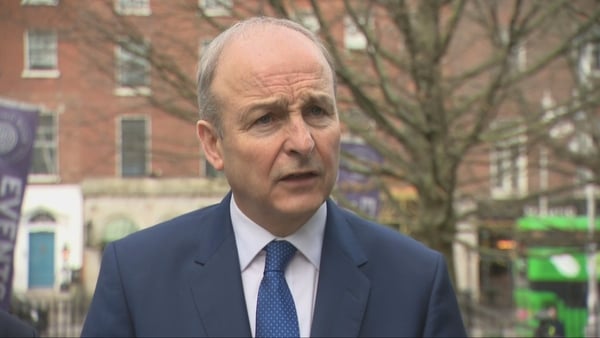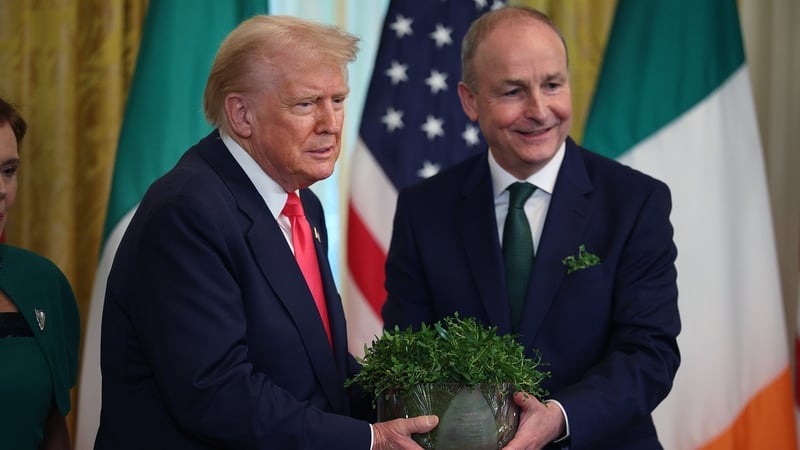

He's been here before. Micheál Martin has done the St Patrick’s Day White House visit with US President Donald Trump.
In 2025, the spectre of tariffs loomed large, and there was an awkward volley of comments from Donald Trump about the trade imbalance between Ireland and the US, particularly in pharmaceuticals.
While the topic of tariffs has yet to be fully played out, the stakes for this visit are arguably higher.
It’s more than two weeks since the US and Israel launched airstrikes on Iran, and while there have been repeated comments by the commander-in-chief about a short war, the end date is unclear.
Iran could be viewed as a welcome distraction, as Mr Trump’s focus is elsewhere, and Ireland’s pharmaceutical industry is no longer top of the agenda.
But the war itself is a tricky talking point that the Opposition wants the Taoiseach to address.
Sinn Féin wants Mr Martin to use the opportunity of the bilateral meeting with Mr Trump to uphold Ireland’s support of international law, and to call for an immediate ceasefire and an end to the aggression in the Middle East.
A spokesperson for the party said: "The threat to peace, stability and human suffering must end; diplomacy and respect for international law must have primacy."
The Social Democrats are calling on Mr Martin to tell Mr Trump the war is illegal while the Labour Party and the Green Party think the White House visit shouldn’t happen at all.
"Micheál Martin is a highly-experienced politician, but the challenge here, is that the rules of the game are different."
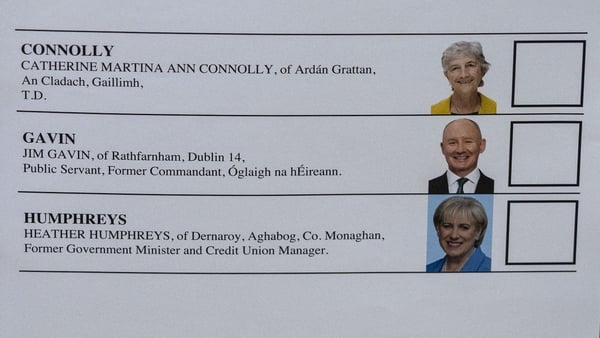
Upping the ante even further, are the recent comments by President Catherine Connolly that the situation in the Middle East was a "deliberate assault on international law".
A Government spokesperson responded to those comments, saying: "Successive governments have always stood firm in support of international law, it's especially important for a small country like Ireland.
"The Government fully respects the constitutional role and office of President Connolly, but it is important to recall that responsibility for international affairs rests with Government."
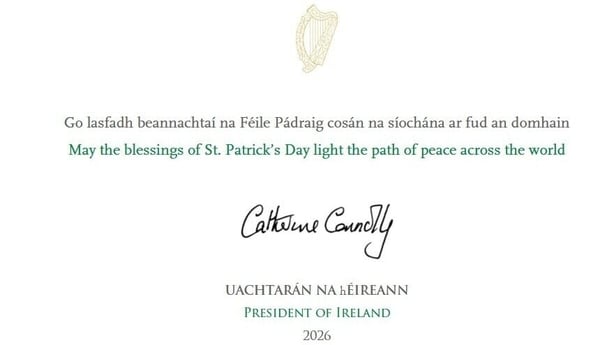
In her St Patrick’s Day message, released today, President Connolly could be seen as doubling down.
She said: "The normalisation of war can never be accepted. Now, more than ever, we must renew our commitment to peace and diplomacy in line with the principles of international law as set out in the United Nations Charter."
Micheál Martin, for his part, has repeatedly called for a de-escalation of the conflict.
He also said the campaign "was not in accordance with a UN mandate".
But he, and the Government, have been careful not to label the war "illegal".
There’s clearly a delicate balance to be struck between holding the line on supporting international law and not criticising the American administration’s decision to attack Iran.
This is the nub of the Taoiseach’s problem.
We are repeatedly reminded how rare it is to have a standing appointment with the sitting US president on St Patrick’s Day. And the current president is known to dislike criticism.
Mr Martin is a highly experienced politician, but the challenge here, is that the rules of the game are different.
'We've all seen it go wrong,' says former Government adviser
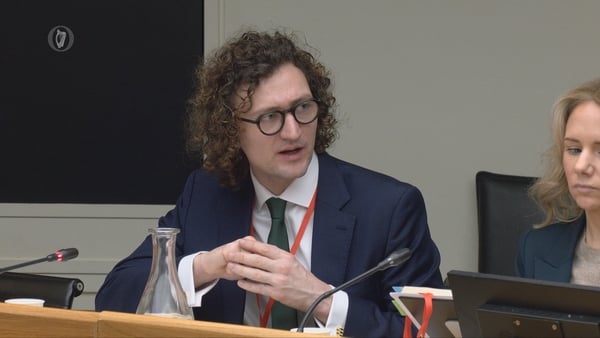
Former government adviser Gerard Howlin said if things go wrong with the White House visit, it will be because of factors outside the Taoiseach’s control.
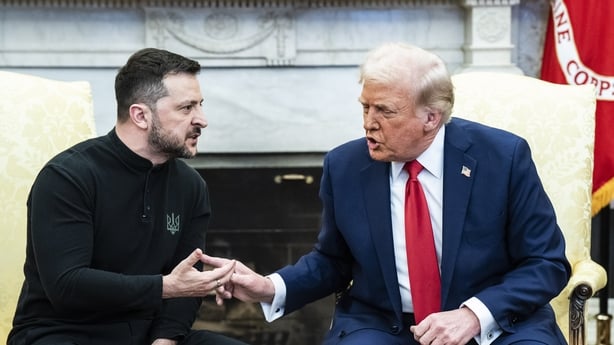
Citing the disastrous first visit of Ukrainian President Volodymyr Zelensky to the White House in 2025, Mr Howlin says "we’ve all seen it go wrong".
He said it's not that Donald Trump might lose his temper, but rather that he’s focused on something else, and he may feel he needs to boost his ratings by hauling the Taoiseach over the coals for another issue.
Mr Howlin also points out that Ireland is so economically dependent on US multinationals for corporation tax that it limits the Taoiseach’s ability to speak plainly.
"This is not about Ireland being helpless or hapless, it's about Ireland's vulnerability ... it’s about dependence on corporation tax and about energy dependence."
But he said these aren’t "two strings that Ireland appears ready to address - they're the leashes we are on".
If he were giving the Taoiseach advice, it would be that "he has a good story to tell about Ireland and the US - both historically and future tense".
This would appear to be the direction of travel for the Taoiseach who said before his departure that he looked "forward to marking USA 250 and paying tribute to the role of the Irish diaspora in the foundation and development of the United States".
Safe ground indeed, but the Taoiseach also said he expected there would be "an opportunity to discuss global matters, including how Ireland and the EU can work with the United States to reach peaceful resolutions in the Middle East and Ukraine". This is what to watch out for.
Wandering around a sunny DC, the city seemed quiet. Even the president tends to leave the US capital for Florida at the weekend.
But there were a couple of noisy protests near the White House, with demonstrators carrying Palestinian and Iranian flags.
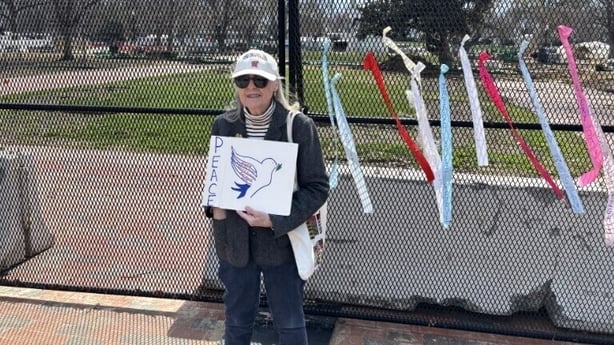
Alongside chants by protesters including by Orthodox Jews calling for a ceasefire in Gaza, I spoke to an older woman on the sidelines carrying a sign saying "Peace" about her reasons for protesting.
Bonnie Boyle-Coté, who it turned out had Irish heritage and was wearing a shamrock brooch, said Donald Trump was waging an "unjust war".
"Our founding fathers had a process," she said, "Donald Trump and this administration has no process for anything."
"We should not be in this war. We the people are the ones. We elect our representatives, and it’s Congress that declares war and he ... sidestepped that option, and here we are. It’s very disconcerting and anti-democratic."
Micheál Martin will not go that far, and while he may mention Ireland’s wishes to de-escalate, he won’t go as far as President Connolly either.
Whether her comments will register with Mr Trump is debateable.
Gerard Howlin said in previous administrations, "the key relationships before were different - and key messages were pre-delivered and assimilated and understood".
The public affairs consultant ponders whether that is the case with this administration.
"Do we know that now? Is it in his mind? That is part of the unpredictability of the man and his presidency," he said.
Once thing that is certain, is that Mr Trump is a businessman, and appreciates business deals.
The Taoiseach will be banking on this when he brings the message on Irish investment in America to the White House.
Enterprise Ireland revealed to the Wall Street Journal earlier in the week that Ireland has become the fifth largest source of Foreign Direct Investment in the US.
As they put it in their headline, "Ireland's Gift to Trump: Shamrocks and a $6.1 Billion Investment Pledge."
This is a good story to tell with the top ten Irish investors employing over 125,000 people across the US.
Three firms - Smurfit Westrock, Kingspan and Glanbia - are behind the major investments announced last week.
It’s not near the three US multinational firms responsible for €13bn worth or almost half of corporation tax receipts in Ireland in 2024, but clearly investment goes both ways.
That’s the message the Taoiseach will really want to deliver.
We’ll find out if that’s the case tomorrow.