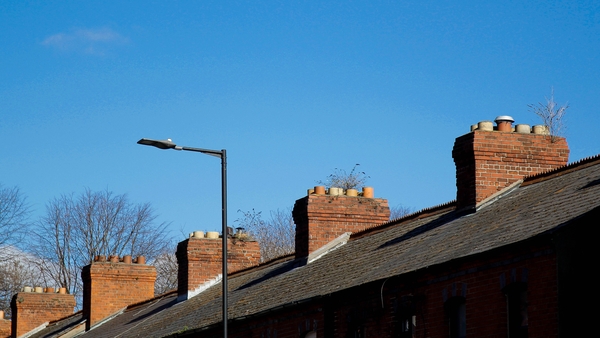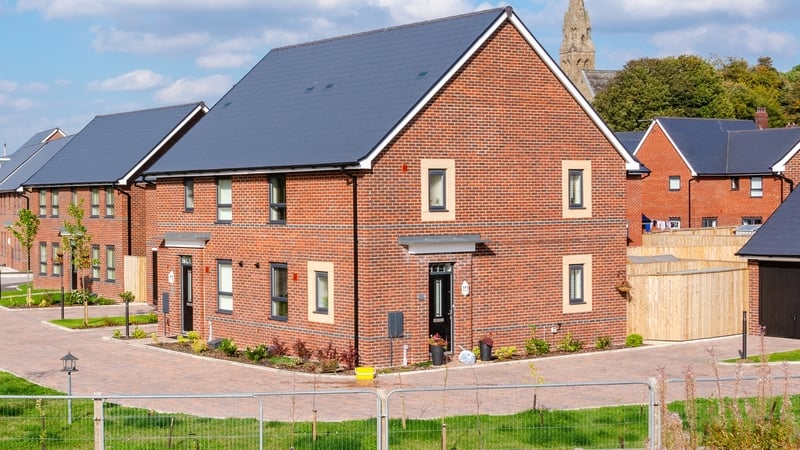

Many are asking whether it is worth their while at all investing in a home energy upgrade.
This is after an ESRI review published last week found very little variation in actual energy consumption between homes with different BER energy ratings.
The review called it "a striking observation" that "average energy consumption is similar for an A-rated house and a G-rated house".
It referred to a study that showed households consume around 10,869 kWh of energy per year and that this does not vary considerably by BER rating.
It said the median cost of a deep retrofit ranged from €16,000 to €43,000 depending on whether it was an apartment or a detached house.
It also said the monetary cost of the disruption and having to vacate a home during a retrofit ranged between €9,000 and €24,000.
And after all that, it said, in the real world, a typical G-rated house consumes only 3.7% more energy per year than an A-rated house.
Ordinary people are confused and wondering if it means energy upgrades are just a big waste of money.
Also, feathers are ruffled at the SEAI- the state agency that doles out hundreds of millions in grants for energy upgrades.
The ESRI review suggests one of the key reasons why there is so little variation in the annual energy use between BER ratings is because households increase their energy use when the home becomes easier to heat.
It quotes research that says the actual energy consumption in the least efficient, F and G-rated homes, is actually 56% below the theoretical energy consumption assumed by the BER rating.
These homeowners consume 10,964 kWh of energy per year to heat their homes although the theoretical model suggests it should require 24,900 kWh for them to be comfortable.
Perhaps they are using another fuel not captured by the figures to make up for the heating shortfall.
Also, E-rated homes use 39% less energy than the BER prediction, while for D-rated homes the undershoot is 24 per cent the review says.
All this means that houses with energy ratings from D down to G are likely to feel uncomfortably cold at times.
They are so expensive to heat that people cannot afford to heat them properly.
Against this, the research referred to by the ESRI suggests A and B rated houses are over-heated.
The review says real world energy consumption in these highly energy efficient homes is actually 40% above what the BER rating predicts.
They use an average of 10,569 kWh of energy per year for heat, but theoretically they should be able to manage on just 7,549 kWh.
People in most efficient homes sweltering
This suggests people in the most efficient homes are sweltering. They are too warm and use far more energy than they need to stay comfortable.
So, at one end of the BER energy spectrum people use far less energy for heating than the theoretical models suggest they should do.
At the other end of the spectrum people use far more than they need.
This is why there appears to be such little variation in the energy consumption for different BER ratings.
People do not behave like the BER models suggest. They make different choices about energy use depending on circumstances that are not captured in theoretical models.
This brings us back to the question many people have been asking this week on foot of the ESRI publication. Is it worth investing in a home energy upgrade?
Well, the answer to that appears to be yes, if you can afford it and can allow enough time for the investment to pay off.
The Central Statistics Office publish household energy consumption figures every three months.
They show that homes with A and B energy ratings, that use electricity for heating, consume just 39 kWh of electricity per square meter.
This compares to 66 kWh per square metre for dwellings with a C rating, and 58 kWh for an F or G-rated home.
Dwelling type matters too. For instance, detached houses consume 77 per cent more electricity than mid-terrace houses but they have 82 square metres extra to heat.
It is a similar story for homes heated by gas, with 69 kWh of energy consumption per square metre of space in A and B rated homes and 94 kWh for the least efficient F and G-rated homes.
Houses account for a quarter of all energy consumption in Ireland, and we use 80% of that energy for heating living spaces and water.
It is expensive, carbon intensive, and the overall energy efficiency of Ireland's housing stock is poor.
30% of heat lost through poorly insulated roofs
Typically, 30% of heat is lost through poorly insulated roofs. Another 30% is lost through walls, 20% through floors, and the remaining 20% through doors, windows, and air infiltration.
The Climate Action Plan is very specific about the national targets for tackling that.
It says 500,000 existing homes should be upgraded to a B2 energy rating by 2030.
Also 400,000 heat pumps are to be retrofitted into existing homes by that date.
An additional 200,000 heat pumps are to be installed in newly built homes, also by 2030.
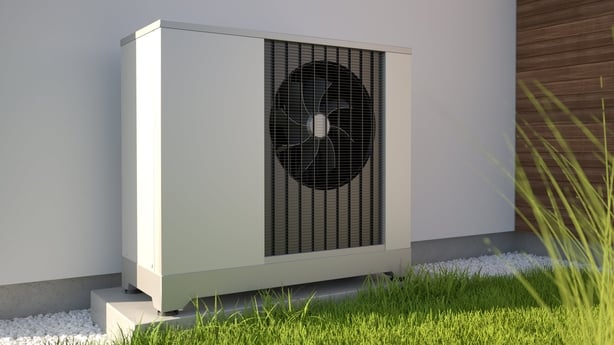
Many ask why heat pumps are such a big deal in the Climate Action Plan, especially when they are expensive to install.
The SEAI says it is because they are cleaner and use less than a third of the energy that oil and gas boilers use.
They suck in heat from the outside air, compress it to intensify it, and use that intensified heat to warm radiators and water throughout a home.
The ESRI Review of Residential Heat Decarbonisation said Ireland has only installed 3.5% of its 2030 heat pump retrofit target to date.
Ireland has fourth highest penetration of heat pumps in Europe
Nevertheless, some progress is being made, particularly with the target of 200,000 heat pumps for new dwellings.
The most recent data from the European Heat Pump Association shows Ireland now has the fourth highest penetration of heat pumps in Europe.
It says 17 heat pumps were sold here in 2024 for every thousand households.
This is almost 5 times higher than the UK.
And for anyone who might worry about how effective a heat pump can be, it is worth noting that Europe’s coldest countries - Norway, Finland, and Sweden – are the places where heat pump penetration is highest.
The data shows 48 heat pumps were sold in Norway for every thousand households, 33 in Finland, and 30 in Sweden.
It is much easier, of course, to ensure heat pumps are installed in new buildings - it is just a matter of enforcing building regulations.
The task of retrofitting older dwellings is a far more difficult nut to crack.
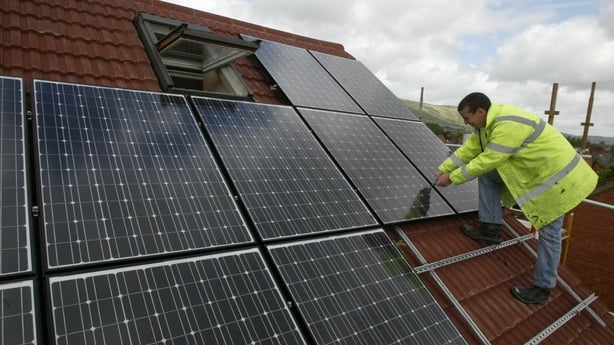
Since 2018, SEAI has grant aided a total of 100,000 solar panels. A third of them were installed last year, so clearly the interest and momentum is strong among homeowners.
Two years ago, it supported 47,000 residential energy upgrades. Last year it was 58,000. It is expecting to do another 73,000 this year on top of that.
Overall, the benefits for homeowners include warmer cosier healthier dwellings, lower energy bills, reduced carbon emissions, and an increase in the value of the home.
Yet, as the ESRI review shows, unless an energy upgrade brings a house up to the B2 standard it is not counted at all towards the targets in Ireland’s Climate Action Plan.
Only about 26,000 of the 58,000 grant-aided energy upgrades last year achieved a B2 rating.
The ESRI review suggests the remaining 32,000 would be excluded when calculating how far off target the country is.
One must wonder why that is, especially when the householders have been grant-aided by a state agency.
More: Ireland 'lagging considerably behind' on heat pump, retrofit targets - ESRI
The old phrase about "perfect being the enemy of the good" springs to mind here.
The ESRI review also highlights how people must overcome various planning, finance, and behavioural barriers before undertaking an energy upgrade in the first place. So, for a householder any energy upgrade at all is a big deal.
It is worth remembering too that BER energy ratings only measure the energy efficiency potential of the so-called "fabric" of a dwelling.
They tell us nothing about how many people live in any dwelling or how they behave.
Nothing about how high they set the temperature, how long they leave lights on for, or the windows open.
Nothing about whether they tend to be frugal or wasteful.
An energy efficiency upgrade from an E grade to a C grade means the house is less carbon intensive.
That is a good thing.
It can be added to with a further upgrade later. It might be just a stepping stone on the way to that highly prized B2 energy grade.
Why should all domestic energy upgrades not be counted in some manner towards our 2030 targets.
After all there is no question that they do contribute to the end goal.
Read more: Calls for more Government funding to retrofit social homes