


A graffiti artist from Bristol in the UK has been identified as renowned street artist Banksy, an in-depth investigation by the news agency Reuters has found.
Robin Gunningham, who was born in the southwest English city in 1973, was confirmed by the news agency to be the man who has evaded being publicly named for decades. Mr Gunningham later took the name David Jones.
The investigation focuses on pieces of art in Ukraine which Banksy confirmed on Instagram were his in 2022.
In late 2022, an ambulance pulled up to a bombed-out apartment building in this village outside Kyiv, Reuters reports.
Three people emerged. One wore a grey hoodie, another a baseball cap. Both had masks covering their faces.
The third was more easily identifiable: He was unmasked, and had one arm and two prosthetic legs, witnesses told Reuters.
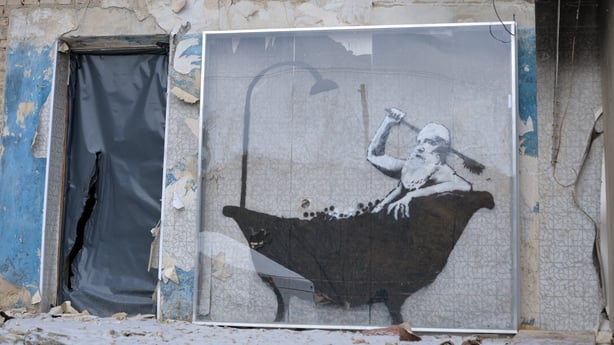
The masked men carried cardboard stencils from the ambulance and taped them to what had been an interior wall of an apartment before the Russians obliterated the place.
Then they pulled out cans of spray paint and got to work.
An absurd image appeared in minutes: a bearded man in a bathtub, scrubbing his back amid the wreckage.
Its creator was Banksy, one of the world's most popular and enigmatic artists, whose identity has been debated and closely guarded for decades.
Banksy is best known for simple yet sophisticated stencil paintings with searing social commentary.
His work has generated tens of millions of dollars in sales over the years.
Once an annoyance to authorities who viewed him as a vandal, he has become a British national treasure.
In one survey, the British public rated him more popular than Rembrandt and Monet.
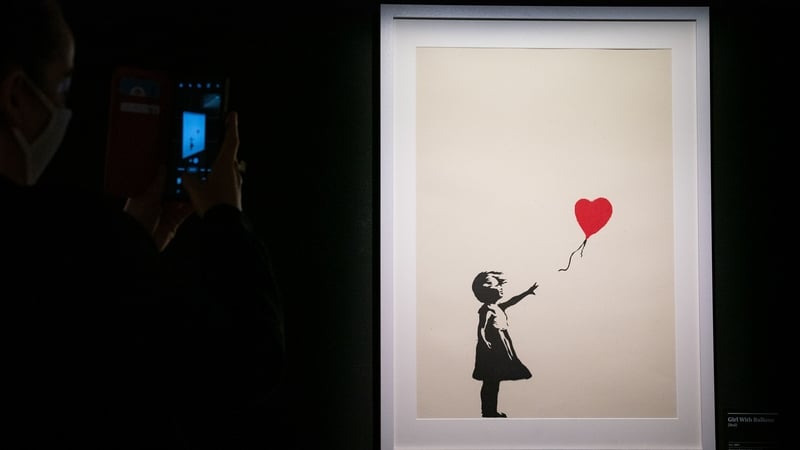
In another poll, his "Girl with Balloon" painting was voted the favourite piece of artwork Britain has produced.
Some critics believe Banksy’s anonymity is as important to his work as stencils and paint.
The British press has run many articles over the years that tried to deduce his identity.
Still, Banksy and his inner circle won’t talk about it.
Some have signed non-disclosure agreements.
Others keep quiet out of loyalty, or fear of crossing the artist, his fans and his influential company, Pest Control Office, which authenticates his work and decides who gets the first chance to buy Banksy’s latest pieces.
When the bathtub mural and other Banksy pieces began appearing in Ukraine, Reuters wondered about the artist and how he had pulled off the stunt.
Horenka was less than eight kilometres east of Bucha, where Russian forces had left behind at least 300 civilians dead seven months earlier.
After the Ukraine murals appeared, Banksy posted a video on his Instagram confirming the pieces were his.
The footage also showed a painter wearing a grey hoodie in Horenka.
It was filmed from behind the man, hiding his face.
Reuters reporters visited Horenka weeks after the mural appeared.
They brought photo a lineup of graffiti artists often rumoured to be the artist and showed the pictures to locals to see if anyone recognised him.
Among the possible Banksys in the Reuters photo lineup was Thierry Guetta, a street artist who goes by Mr Brainwash.
Mr Guetta was featured in Banksy’s Oscar-nominated 2010 documentary, "Exit Through the Gift Shop".
Mr Guetta is French; Banksy has said he’s from Bristol, England.
Given Mr Guetta’s nationality and his role in the film, he seemed a longshot candidate.
Still, the idea that Banksy would covertly feature himself on screen might fit with his reputation as a prankster who hides in plain sight.
Another candidate, perhaps the prime one, was Robin Gunningham.
The Bristol native had been "unmasked" as Banksy in 2008 by The Mail on Sunday.
The British tabloid said its year-long investigation had "come as close as anyone possibly can to revealing" Banksy’s identity. But it hedged a bit.
Its cover featured a photo of a man "believed to be Banksy".
When the photo first surfaced years before the 2008 story, the artist’s manager denied it depicted Banksy.
A third artist in the lineup was also from Bristol: Robert Del Naja, frontman of trip-hop band Massive Attack.
A graffiti pioneer known as 3D, Mr Del Naja hosted a 2013 exhibition of art he produced for Massive Attack.
It was held at the London gallery of Banksy’s former manager, Steve Lazarides.
In 2016, a Scottish writer had found that several Banksy street pieces appeared at the same locations and around the same time Massive Attack had just performed.
Horenka resident Tetiana Reznychenko told Reuters she made coffee for the two men who did the bathtub mural and saw the two painters without their masks.
As the reporters swiped through the lineup on a cellphone, Reznychenko shook her head no.
Then, when shown one of the photos, her eyes widened, even as she denied having seen the man in the picture.
That man was Robert Del Naja.
Her reaction proved nothing, Reuters reporters said.
Two men who painted the wall were escorted there by Giles Duley, the man with one arm and two prosthetic legs.
Mr Duley, a documentary photographer, lost his limbs in Afghanistan in 2011.
His Legacy of War Foundation donates ambulances to local NGOs in Ukraine.
After painting the Ukraine murals, Banksy publicly thanked Mr Duley for lending him an ambulance to travel in the region.
Mr Duley had an interesting link to one candidate.
His photography has served as backdrop visuals at concerts of Massive Attack, Mr Del Naja’s band.
Not long after the Reznychenko interview, Reuters reporters got another lead.
A source had stopped by the Kyiv Hilton during Banksy’s time in Ukraine.
"You’ll never guess who I met," the source said. "Robert Del Naja of Massive Attack!"
The reporters later learned from people familiar with Ukrainian immigration procedures that Mr Duley and Mr Del Naja had indeed entered Ukraine.
They crossed the border with Poland on 28 October 2022, shortly before the Banksy murals began to appear.
But there was no evidence that Mr Gunningham, Mr Guetta or any other rumoured Banksy travelled to Ukraine in that period.
However, Reuters identified that a man with the name David Jones left Ukraine in November 2022, a name believed to have been taken by Banksy.
David Jones is one of the most popular names among British men.
In 2017, for example, there were about 6,000 men named David Jones in the UK, according to data analysed by GBG, an identity-data intelligence company.
David Jones also is the given name of David Bowie, whose Ziggy Stardust alter ego inspired a Banksy portrait of Queen Elizabeth.
On 28 October 2022, the day Mr Duley and Mr Del Naja entered Ukraine, a "David Jones" also crossed the border at the same location, according to a source familiar with immigration procedures.
The source also told Reuters the date of birth listed on Jones’ passport.
It was the same as Robin Gunningham’s birthday.
Gunningham listed under New York graffiti arrest
Another key clue identified by Reuters came in the form of an arrest made for graffitiing in New York in 2000.
Reuters showed that on 18 September 2000, authorities found a man defacing a billboard on the roof of 675 Hudson Street.
Because damages exceeded $1,500, police sought to charge him with a felony.
The man who confessed was Robin Gunningham.
In addition to his signature, Mr Gunningham is repeatedly named in court and police documents related to the arrest.
Reuters also reported that Banksy's anonymity act nearly collapsed after a run-in with a Jamaican photographer named Peter Dean Rickards in 2004.
While Mr Rickards did not name Banksy, he posted 21 photos of Banksy at work in Jamaica, 14 of which show his face from various angles.
In July 2008, The Mail on Sunday ran its Banksy investigation.
Citing an anonymous source, the paper identified the man in the Mr Rickards photo for the first time as Mr Gunningham, an artist from Bristol who was born in 1973 and attended the Bristol Cathedral School.
Archived copies of the student magazine, The Cathedralian, contain numerous mentions of Gunningham. These include a comic strip he created around age 11.
Later, Mr Gunningham earned school awards for his artwork and was lauded in the Cathedralian for his acting and athleticism.
A nimble artist with a theatrical streak: key traits of Banksy, the persona Gunningham would embrace.
'I don't want to be the guy who exposes Banksy'
Banksy, born Robin Gunningham, later took the name David Jones. Whether he still uses that name is unclear.
And Robert Del Naja, Mr Gunningham’s graffiti idol, friend, and a man himself rumored to be Banksy, has on at least one occasion been his secret painting partner.
Banksy was not the Massive Attack frontman, whose 2024 climate action concert drew more than 30,000 fans to Bristol.
But he has become a star performer in his own right.
Case in point is the wild 2018 Sotheby’s auction in London of his iconic "Girl with Balloon".
The painting had recently sold for $1.4 million.
When it went up for resale that day, the art world was shocked to watch the piece get partially shredded by a device Banksy had secretly built into its frame.
That piece, renamed "Love is in the Bin," sold three years later for about $25 million.
Art dealer Casterline was at the auction and remembers when the shredder began to beep. He pulled out his phone to take pictures.
"Unfortunately, there was one person standing in front of me," blocking the view, he said. It was an eccentric-looking man with a broad neck scarf and thick eyewear.
Oddly, the man wasn’t watching the painting get shredded. He was looking in the other direction, observing the crowd's reaction.
Only later, reviewing what he shot, did Casterline notice that the man’s glasses appeared to have a small camera built into the bridge. (Banksy later posted a video of the stunt, including shots of the astonished audience.)
Having seen Rickards’ 2004 photo of Robin Gunningham, Casterline is "pretty sure" it was the same man, thinner and older.
He echoed what many say in Banksy’s protective circle of friends, partners, collectors and critics.
"I don’t want to be the guy who exposes Banksy," he said.
