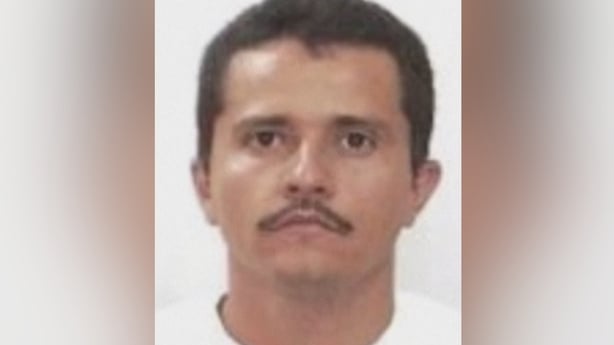
Before last week, few outside Mexico had heard of the Jalisco New Generation Cartel, let alone its formidable but elusive leader, 'El Mencho'.
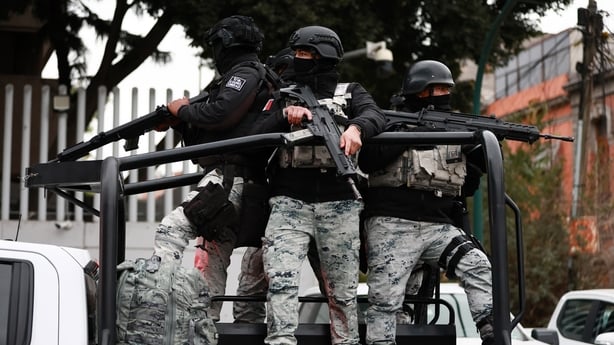
But that all changed last Sunday, when the crime boss - whose full name was Nemesio Oseguera Cervantes - died in custody after a dramatic early-morning shootout with Mexican special forces.
His capture and killing, which made headlines around the world, were hailed as a significant victory for Mexico in its protracted war against drug gangs.
The operation had been aided by intelligence from the United States, which has classified his CJNG cartel as a terrorist organisation, accusing it of sending cocaine, heroin, methamphetamine and fentanyl into the US.
However, the success of the operation was tempered by the violence and chaos that immediately followed.
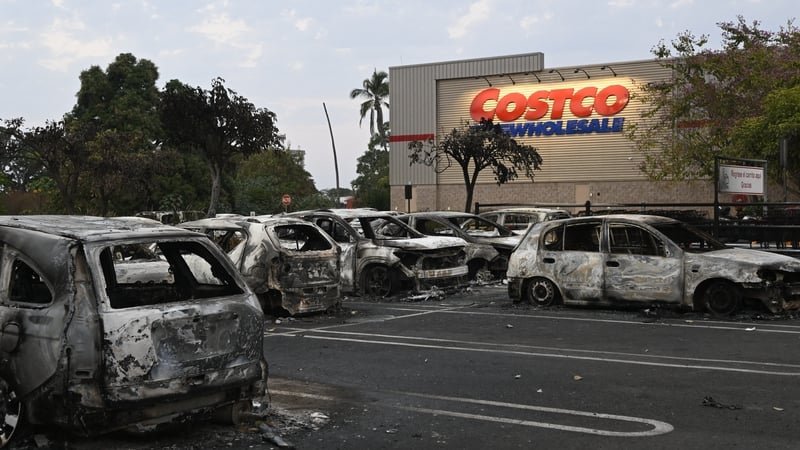
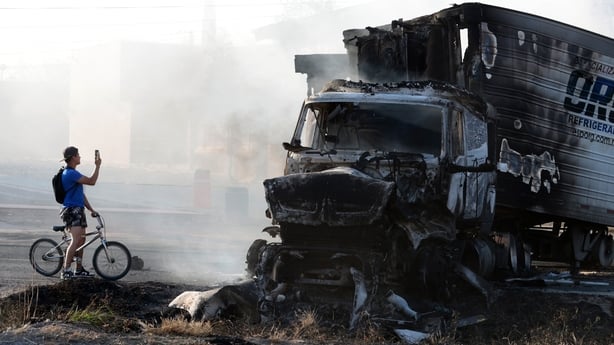
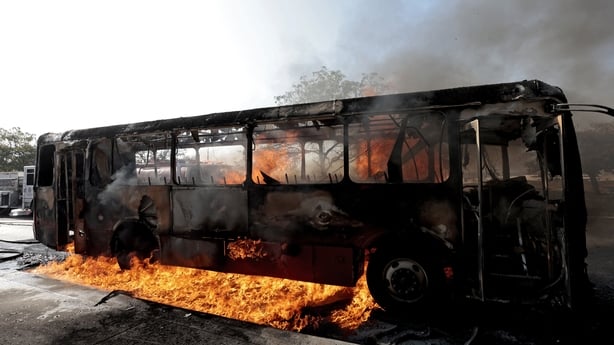
Supporters of the notorious narco boss took to the streets in towns and cities across 20 Mexican states on Sunday - a show of defiance and strength that included arson attacks, hits on government buildings, roadblocks and the orchestration of a prison break.
And there are concerns more unrest could be on the way, as would-be successors jostle for the top job in what is one of the world’s most powerful and violent criminal organisations.
Succession struggles
In Mexico, drug cartels are dynastic, with designated sons often taking over the top job.
An uncertain pathway to succession can trigger a bloody fight for dominance.
This is what analysts say is currently happening in the rival Sinaloa Cartel, which is also based in Mexico.
In recent years it has descended into factional fighting and power struggles after two successive leaders - Joaquin 'El Chapo' Guzman and Ismael 'El Mayo' Zambada - were captured by the United States.
The CJNG is similarly lacking a designated family successor.
El Mencho’s son, Rubén Oseguera González (known as ‘El Menchito’), was captured and extradited to the United States in 2020.
El Mencho’s wife was arrested in Mexico on money-laundering charges in November 2021. Two brothers are also in Mexican jails.
However, there is an organisational structure in place that may keep the ship steady "for now," according to Mexico-based security analyst, David Saucedo.
"El Mencho had been suffering from kidney disease and needed to rest regularly after the dialysis treatments - so he had created a council of commanders to delegate many of the cartel’s important leadership functions to," he told RTÉ News.
The four commanders of the Jalisco Cartel represent four regions of its vast narco-empire. They currently appear to stand united in the face of an "an external threat," said David Saucedo.
"The council of the Jalisco Cartel believes that the United States government and the Mexican government could launch a new offensive against them. Likewise, the cartel’s enemies are circling the borders of its empire and will try to seize territories that once belonged to them and that were taken by the Jalisco Cartel."
One of the four regional leaders - Juan Carlos Valencia, known as 'El 03' - has been tipped by some analysts as the most natural successor.
He is El Mencho’s stepson, but according to David Saucedo many see him as "too young" and without the necessary "knowledge or the experience".
Meanwhile, US President Donald Trump's administration continues to wage a pressure campaign on Mexico’s government to ramp up its crackdown on drug trafficking, including threats to intervene directly in the country.
Beheadings, public executions, ‘cannibalism’
With around 15,000-20,000 members spread across 100 countries (according to US Government figures), the task of leading - and indeed dismantling - the CJNG is exceedingly complex.
Formed in 2009/2010, the CJNG has grown into one of Mexico’s - and arguable the world’s - most powerful narco organisations, surpassing even the better-known Sinaloa cartel, according to analysts.
It has also become notorious for its extreme violence and brutality.
According to the US Office of the Director of National Intelligence, the cartel conducts public executions before displaying the bodies, sometimes publishing the images on social media. Beheadings and dismemberment are among the documented methods of killing.
The cartel has also been associated with cannibalism. It has been reported by the New York Times (via The Daily podcast) and other news organisations that new recruits have been tasked with hunting down targets and consuming their body parts as a show of loyalty during initiation ceremonies.
Among the chief targets for the extreme violence are rival drug gangs such as the Sinaloa Cartel, and previously the Los Zetas group.
Public officials have also drawn the wrath of the cartel. According to InSight Crime, a non-profit think tank focusing on organised crime in Latin America, the group was allegedly linked to one of the country’s most high-profile political assassinations, the murder of former Jalisco governor Aristóteles Sandoval in December 2020.
Indeed, the violence has had a particular impact in the cartel’s home state of Jalisco.
In the period following the CJNG’s emergence, "homicides, forced disappearances, and the discoveries of mass graves spiked in Jalisco," according to InSight Crime.
In one six-week period in 2015, the gang is reported to have killed two dozen police in western Mexico as a warning to authorities. Separately in 2015, the group shot down a Mexican military helicopter with a rocket-propelled grenade, killing nine soldiers.
But it’s not just rival drug cartels and public figures being targeted by the CJNG.
Drone shows smoke over Mexico's Puerto Vallarta after 'El Mencho' killing
An Associated Press report published last year found that the group had also used fake job advertisements in an attempt to lure new members - with some allegedly tortured as they attempted to escape.
In March, charred bones, shoes and clothing were found by a group of people looking for missing relatives found at what is believed to be a training ground for CJNG.
Yet each month new members continue to be recruited, as the enterprise expands. And while the production and trafficking of narcotics is the primary income stream, the business model is also diversifying.
According to the US Office of the Director of National Intelligence, the CJNG "profits from extortion, fuel theft, kidnapping, illegal logging and mining, migrant smuggling, and timeshare fraud."
The cartel is also reported to be heavily involved in the extortion of the Mexican avocado industry, particularly in Michoacán, a primary region for production.
World Cup concerns
Among those closely watching what happens next in Mexico are football fans, including supporters of the Republic of Ireland.
If Heimir Hallgrímsson’s side come through their remaining qualifying fixtures, they are scheduled to play in Guadalajara on 11 June.
Guadalajara, the capital of Jalisco, is considered a hub for the CJNG. The city witnessed some of the most intense violence following the killing of El Mencho last Sunday.
Vehicles were set ablaze on major highways, businesses were torched and residents in several districts were told to shelter in place as armed supporters erected roadblocks across parts of the city.
Mexico’s President Claudia Sheinbaum has since offered "full guarantees" for the safety of football fans at World Cup games in the city, claiming there was "no risk" to visiting fans.
FIFA president Gianni Infantino has also said in recent days that he has "full confidence" in Mexico as a host country.
Security analysts caution however that the violence that engulfed parts of the city of Guadalajara last weekend was not an isolated incident.
The CJNG is reported to have brought Guadalajara to a standstill on several other occasions in response to security operations targeting the group, including in 2011, 2012 and 2015.
A daytime gun battle is also alleged to have played out on the streets late last year.
According to the InSight Crime think tank, the city has "long served as the home base for the rank-and-file of the CJNG."
"The city offers ideal conditions: a dynamic formal economy that allows illicit profits to be laundered into legal markets, and a strategic location near a network of highways that connects drug production zones to the US border and major Pacific ports," it said.
The US Treasury Department has sanctioned dozens of businesses in Guadalajara over the last two decades for links to organised crime. Authorities have also documented cases of corruption, extortion and coercion associated with the group’s activities in the region.
'High degree of caution'
Ireland currently advises against non-essential travel to the wider state of Jalisco, although Guadalajara itself is exempt from the warning for those arriving by air and remaining within the city.
More broadly, Irish travellers to Mexico are urged to exercise a "high degree of caution", reflecting persistent levels of drug-related violence.
The advisory notes that while tourists are not typically targeted, bystanders can be caught up in criminal incidents.
"Since 2017, there has been an increase in reported shootings and violent episodes in tourist areas across Mexico, including some that have directly affected foreign visitors."
"Crime and violence are prevalent throughout Mexico, and the security situation poses a risk for foreigners.
"Visitors should therefore make sure to research their destination thoroughly, and take all the necessary precautions in all parts of Mexico," it said.