
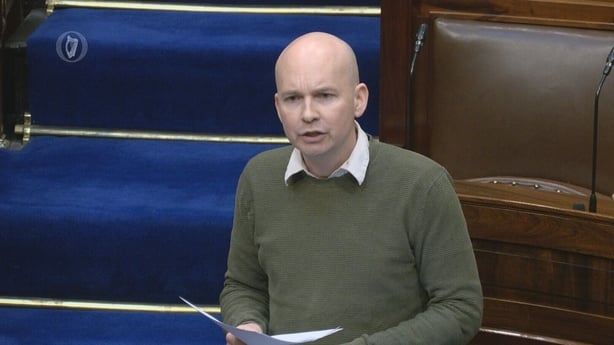
"Neither King nor Kaiser," exclaimed left wing People Before Profit TD Paul Murphy in the Dáil this week.
"The best defence that we have is a consistent position of neutrality … We have the position that Connolly put forward," he said.
A vexed Taoiseach shot back; "If anything happened subsea cables, if anything happened to the gas interconnector with Britain we wouldn't have an economy in ten days! Are you saying we shouldn’t cooperate with Britain to protect the gas interconnector...are you saying we should ignore all of our European partners in protecting critical infrastructure such as subsea cables…what planet are you on?"
The two were debating the Government's National Maritime Security Strategy which Deputy Murphy sees as a "shameful abandonment of any independent foreign policy".
The ill-tempered exchange in the Dáil on Wednesday afternoon was indicative of the pressure the Government is under as it awakes to Ireland's overall security vulnerability in a changed geopolitical world and the need to protect the now imminent EU Presidency in July while also guarding Ireland’s cherished policy of military neutrality.
Maritime strategy
The new National Maritime Security Strategy is a first for Ireland, and will run for the next five years.
For the most part it’s a roadmap for protecting strategic marine, with an eye also on giving the EU confidence that Ireland is not blind to activities in its vast Exclusive Economic Zone (EEZ).
The Government has had constant reminders from other countries around this, with sources saying that at the recent Munich Security Conference "people wanted to talk about maritime security to Irish ministers".
The strategy aims to defend the State's maritime domain, protect Irelands critical subsea cables, gas and electricity interconnectors and enhance regional and international co-operation around maritime security and defence.
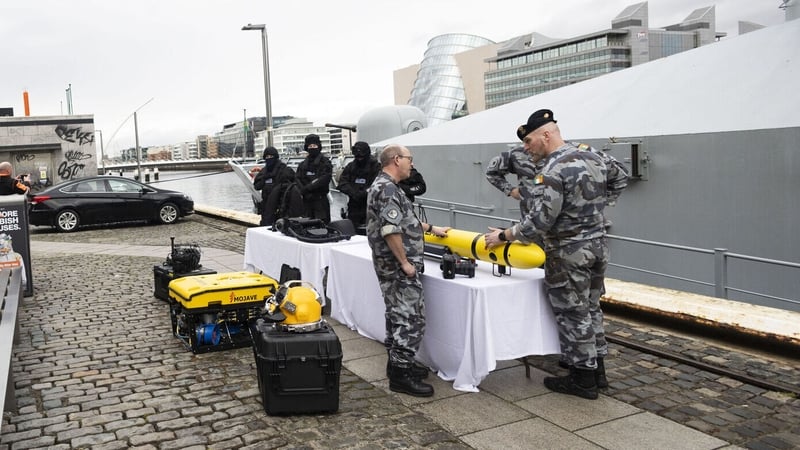
It contains an action plan with 41 objectives to be delivered between now and 2030. Some are already known such as beefing up personnel numbers in the Naval Service, delivery of new military radar and acquisition of towed sonar technology for ships.
It also proposes new naval "forward operating bases" on the east and west coasts of Ireland and looking at the concept of a National Maritime Centre.
More controversially, and where concerns about neutrality arise, is the broad spectrum of cooperation with neighbouring states, the EU and NATO countries that is proposed.
These include updating an existing defence memorandum of understanding with the UK, deepening existing cooperation with France both of whom are NATO members, fostering wider relations with NATO in the maritime security space and participating in activities under the Joint Expeditionary Force (a loose military alliance of the UK, Denmark, Finland, Iceland, Norway, Sweden, the Netherlands, Estonia, Latvia and Lithuania).
EU Presidency
Some of the objectives will require legislative changes to be introduced over the course of the five-year strategy.
Of more immediate concern for the Government is protecting events of the EU Presidency which Ireland holds for six months from 1 July.
In the course of the Presidency Ursula Von Der Leyen, President of the European Council, President of France Emmanuel Macron, the British Prime Minister Keir Starmer and leaders of all other European countries are expected here for meetings of the European Council and a European Political Community Summit.
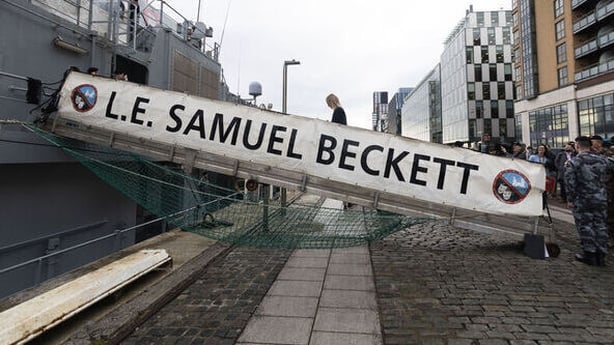
Dozens of meeting of European ministers will also take place, as well as hundreds of other lower-level meetings and events.
The Maritime Strategy comes too late for all of that, but we heard this week from Government sources that legislation that will give clear powers to the Naval Service "to safeguard and protect the sovereignty rights of the state" is being drafted and will be rushed through the Dáil ahead of the Presidency.
Most of the current legislation the Naval Service operates under concerns around the protection of fisheries, drug interdiction and assistance to civil powers.
The new act, specific to the Naval Service will clarify its powers to stop and board vessels in Irish territorial waters and the EEZ.
It is expected not to be prescriptive and will allow the Defence Forces themselves to draw up rules of engagement by which they will operate.
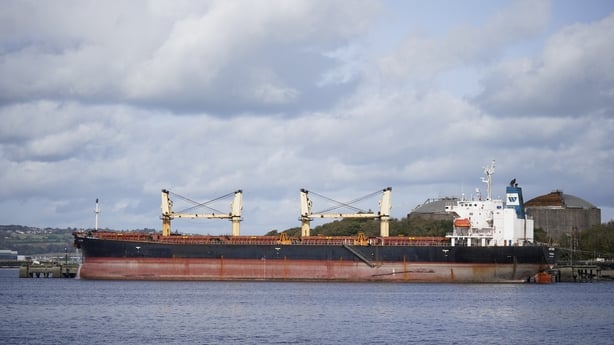
What it’s not expected to include is powers to arrest and detain vessels.
Sources say that is because there is no where to store them and arrested vessels immediately become a cost to the state.
That has been demonstrated with the drug ship the MV Mathew, which has already cost Ireland €14m for maintenance and berthage since it was detained in 2023.
Even when Naval Service gains new powers , its depleted ranks means its only able to put four of its eight vessels to sea at any one time.
As a result, its expected, although not confirmed that French and British navy ships will assist in patrolling Irish waters during the term of the presidency.
If confirmed that will significantly augment capabilities to deal with incidents such as the drone incident in the Irish Sea during the Zelensky visit last December.
It will also serve as a precursor to the ongoing cooperation envisioned in the Maritime Strategy and will likely lead to plenty more debate about protecting or undermining Irish neutrality.