
Minister for Defence Helen McEntee has launched Ireland's first National Maritime Security Strategy, aimed at safeguarding Irish sovereignty and to deepen naval co-operation with France and the UK.
The new plan comes amid increasing international pressure over the country's capabilities in defence and security.
The five-year strategy also comes at a crucial time with Ireland hosting the European Union presidency for six months from 1 July.
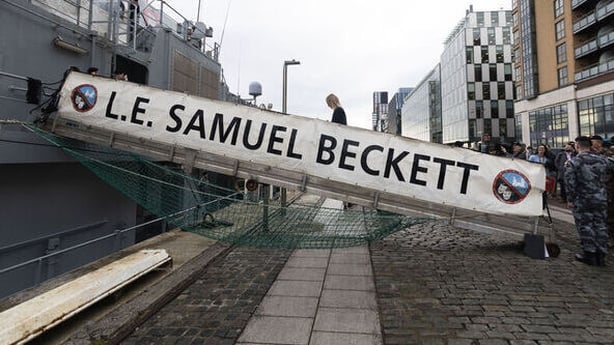
Aboard the naval vessel LÉ Samuel Beckett at Sir John Rogerson's Quay in Dublin, Ms McEntee said there was a huge need to increase focus on security and defence, given rising geopolitical tensions as well as the swathes vitally important undersea cables in Ireland's waters.
She said: "There is a backdrop of an ever-changing political and I think we all know that.
"We are for the first time, and for the past four years, witnessing a war taking place on the continent of Europe.
"We are seeing emerging and changing threats in terms of hybrid threats, hybrid warfare and shadow fleets. We're seeing an increasing volume of cyber attacks and security concerns.
"So the need to increase our focus on our security and defence is absolutely essential.
"This is not just a priority for Ireland. This is a priority for every European member state and for every country to increase and to highlight and to enhance our work when it comes to our security and defence."
A significant element of the new plan is the strengthening of regional partnerships, particularly with our nearest neighbours, the UK and France.
British and French vessels may patrol Irish-controlled waters
Ms McEntee also did not rule out allowing British and French vessels to patrol Irish-controlled waters and offer security during the six-month EU presidency.
Chief of Staff of the Defence Forces Rossa Mulcahy said there would be potential challenges in Ireland's cyber space, and potentially our air space and at sea for the duration of the EU presidency.
He said: "It's a significant opportunity for Ireland and the Defence Forces.
"An Garda Síochána have the lead for national security and we will provide all the resources they request of us.
"It will involve our army, our air force and our naval service capabilities and personel.
"There's been a lot of commentary in the media about the capacity of the Defence Forces to meet those tasks, I'm confident that the asks of An Garda Síochána's requests, that we will be able to meet those.
"We'll have challenges in our cyber space, potentially in our air space and at sea, but we'll have a plan in place.
"I'm confident we'll be able to provide the supports for An Garda Síochána."
We need your consent to load this rte-player contentWe use rte-player to manage extra content that can set cookies on your device and collect data about your activity. Please review their details and accept them to load the content.Manage Preferences
Under the strategy, Ireland will also pursue an opportunity to establish links with the Joint Expeditionary Force (JEF). This is a UK-led alliance which also consists of Denmark, Estonia, Finland, Iceland, Latvia, Lithuania, Norway, Netherlands and Sweden - all members of NATO.
Ireland would not join the group but would examine participating in a wider group known as JEF-Plus.
The new plan also includes the roll out of military radar and sonobuoy programmes.
It's also understood that legislation to broaden the Naval Services powers to allow them to board and inspect so-called Russian shadow vessels in Irish waters could be enacted by the Dáil's summer recess, and ahead of the Ireland's EU presidency commencing.
The bill would specifically empower the service to safeguard and protect Ireland's sovereignty rights in Irish territorial waters and the 420,000sq/km Exclusive Economic Zone that stretches far out into the Atlantic.
Six strategic objectives within document
The document has six strategic objectives:
- Defend the State's maritime domain
- Protect Ireland's critical maritime infrastructure, including undersea cables
- Enhance Ireland's maritime domain awareness
- Strengthen regional partnerships and international cooperation
- Ensure legal order in Ireland's maritime domain and support international law
- Educate, train, research and innovate to support increased maritime security
The new plan also includes the roll out of military radar and sonobuoy programmes.
It's also understood that legislation to broaden the Naval Services powers to allow them to board and inspect so-called Russian shadow vessels in Irish waters could be enacted by the Dáil's summer recess, and ahead of the Ireland's EU presidency commencing.
The bill would specifically empower the service to safeguard and protect Ireland's sovereignty rights in Irish territorial waters and the 420,000sq/km Exclusive Economic Zone that stretches far out into the Atlantic.
Opposition seek assurances for neutrality protection
Opposition TDs have welcomed the plan, but want assurances that Ireland's long-standing policy of military neutrality is protected.
Sinn Féin's Spokesperson on Defence Donnchadh Ó Laoghaire said: "We absolutely accept we share our seas with our neighbouring countries, there needs to be cooperation, but that should be on a bi-lateral basis - between Ireland and France, between Ireland and Britain - not with NATO.
"We shouldn't be meshing ourselves with international organisations like that."
People Before Profit TD Paul Murphy described the strategy as "a shameful abandonment of any independent foreign policy".
Deputy Murphy told the Dáil that the plan is committing Ireland to deep military cooperation with the UK and France, advocating integration with NATO, and using public money to protect infrastructure belonging to large technology companies.
He said the strategy sounds like a mutual defence pact and asked Taoiseach Micheál Martin - during Leaders' Questions - why a neutral country should support NATO-EU cooperation.
Mr Murphy also raised a French media report that Ireland will spend €1 billion of public money on armoured vehicles tanks and a howitzer artillery weapon.
Responding, Mr Martin said the deputy was engaged in hyperbole and exaggeration beyond belief, saying money was being spent on the arms industry when it is about basic necessities for protection of an island nation and vital economic infrastructure.
"If anything happened to the cables, if anything happened to the gas connectors with Britain, we wouldn't have an economy in ten days.
"Are you saying we shouldn’t cooperate with Britain to protect the gas interconnectors with the UK?
"Are you saying we should ignore all of our European partners in protecting undersea critical infrastructure - such as subsea cables, such as the interconnector with France that will be completed in a year or two?
"What planet are you on?" the Taoiseach asked.
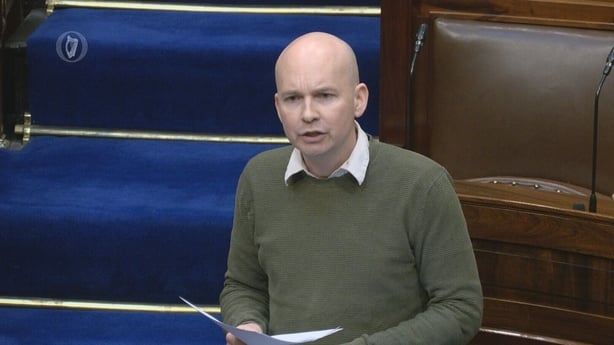
Deputy Murphy said the planet he is on is the one where the Government cut funding to people with disabilities and the incomes of the poorest people, but is spending €1bn on arms.
The best defence that Ireland has is a consistent position of neutrality, he added.
Additional reporting Joe Mag Raollaigh