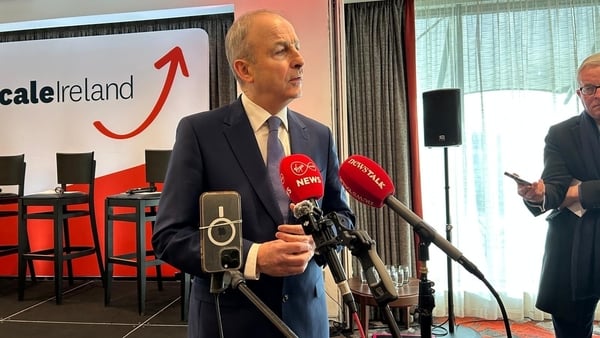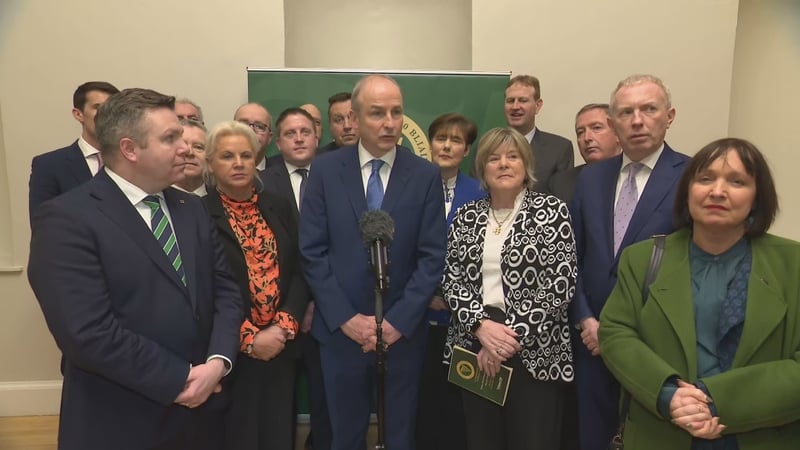
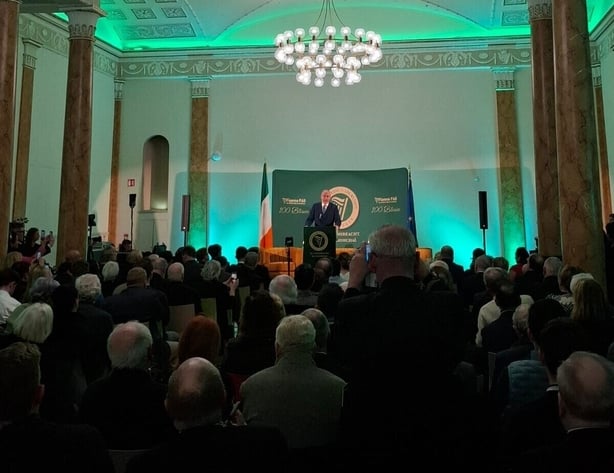
Taoiseach Micheál Martin has said he is confident in Fianna Fáil's future existence, as he launched a programme to commemorate the centenary of the foundation of the party.
Fianna Fáil was founded on 16 May 1926 by Eamon de Valera in The Le Scala Theatre, just off O’Connell Street in Dublin’s city centre.
At a launch event at the nearby Pillar Room on the grounds of the Rotunda Hospital this evening, Mr Martin paid tribute to de Valera and the party’s co-founders, Countess Markievicz and Seán Lemass.
He said: "Eamon de Valera’s speech at the party’s founding meeting was a combination of dealing with the politics of the moment and steering people towards a very different direction.
"Ultimately his objective, as shown in the programme, which was quickly developed by Seán Lemass and others, was to bring into power a radical government which would assert sovereignty, address pressing social concerns and develop employment through new industries.
"Chairing the meeting was of course Constance Markiewicz. She had been subject, like most republican women, to propaganda describing her as a hysterical radical. But her motivation throughout her life had always been both constitutional and social.
"For her, republicanism was about helping the people, and if that required taking a new route so be it."
Speaking ahead of the event, Mr Martin said he was confident Fianna Fáil would not go the way of the Whigs or the Irish Parliamentary Party and cease to exist in the future.
He said: "We’re the largest party in Government right now, largest local party, and I’m confident in Fianna Fáil will grow.
"In addition to the very fine representatives, we have a cohort of very good, high quality deputies who came into the party which gives me real hope for the future.
"But it is a much more fragmented legislature, and it’s a more fragmented system and multi-seat proportional representation...was always meant to give you fragmentation.
"That has its challenges as I think an overly fragmented parliament is problematic in terms of government decision making."
He added: "And what’s been interesting is in the last number of elections, Fianna Fáil has been more transfer friendly than it would have been historically and that’s helped us win seats in closely fought constituencies."