


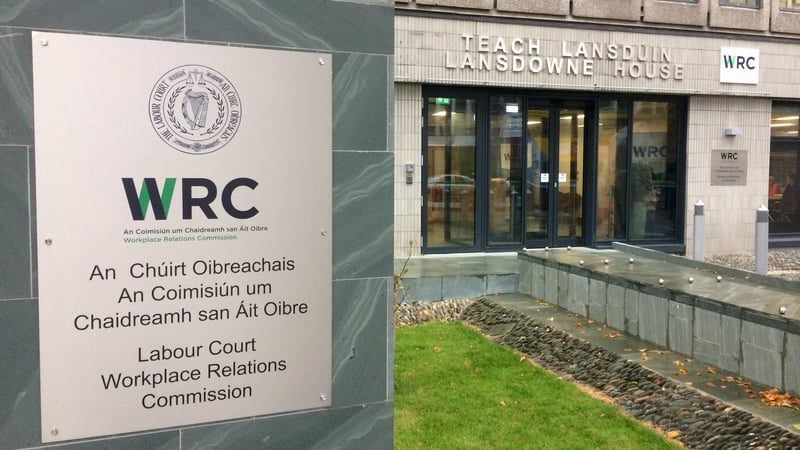
The State body overseeing special education for adults and children with disabilities has been ordered by the WRC to pay €40,000 in compensation to a Deaf man for denying him a job interview because he lacked an academic qualification in Irish Sign Language.
The National Council for Special Education (NSCE) was ruled to have indirectly discriminated against Noel O'Connell in breach of the Employment Equality Act 1998, when it turned down his application for a post as "advisor deaf/hard of hearing" in April 2022.
In a significant development, the tribunal decided to set aside the €13,000 cap on compensation in an employment access case set out in Irish equality law.
Michael Kinsley BL, appearing instructed by Sinead Lucey of the Free Legal Advice Centre (FLAC), said their client was "well-qualified" for the job in view of the fact that he was a fluent speaker of Irish Sign Language (ISL) and holds a PhD in Deaf Education.
Mr O'Connell’s first language is ISL, as he has been Deaf since childhood and does not communicate orally, the tribunal was told.
He was told his application for the job "had not been shortlisted". When he asked why, the NCSE told him the only reason was that he "did not have an academic qualification in ISL", Mr Kinsley submitted.
A human resources officer wrote back: "In your application it was noted that there was no qualification in ISL listed, albeit that you are a native ISL user."
'Would not be progressing'
"The [assessment] board determined that the criteria was specific in wanting a formal qualification in ISL and that you had failed to demonstrate in your application that you meet this requirement," the correspondence continued.
"The board did not shortlist you for interview, and we consequently sent you the notification confirming that your application would not be progressing," it added.
Mr O'Connell then sought a formal review of this decision under the code of practice for public service appointments. He argued that making a sign language qualification an essential requirement of the post was "wrong" because it "effectively excludes Deaf people".
The relevant clause in the job specification required "a qualification in ISL based on the common European language framework or equivalent," the tribunal heard.
When a more senior civil servant at the NCSE looked at Mr O'Connell’s complaint, she read the words "or equivalent" as "meaning an ISL qualification or equivalent" rather than an "equivalent qualification".
On that basis, the senior official decided Mr O'Connell did meet the requirements, acknowledging his status as a native user of ISL and additional experience met the requirement in the candidate handbook.
Overruling the assessment board, the senior official declared the rejection of his application "not upheld in this case," the Workplace Relations Commission heard.
By then, the recruitment competition was closed, the tribunal heard.
'Fundamentally flawed'
Mary-Paula Guinnness BL, instructed by Eversheds Sutherland for the NCSE, said in a legal submission that the senior civil servant's decision was "fundamentally flawed".
"A formal qualification in Irish Sign Language can be achieved by a Deaf or a hearing person and therefore it is simply incorrect to assert … that it 'effectively excludes Deaf people'," Ms Guinness submitted.
"There is clear, objective justification for the qualifications required for the role, and therefore there is no discrimination," Ms Guinness added.
Mr Kinsley said the requirement for a formal academic qualification in Irish Sign Language was a condition that disadvantaged Deaf applicants "disproportionately" and was indirect discrimination.
Adjudicator Jim Dolan noted in his decision that the NCSE followed the Public Service Appointments code on foot of Mr O'Connell’s complaint up to the point the senior official concluded the decision to reject his application was "not upheld".
"No remedy was offered by the designated decision-maker or the NSCE and the rejection of his application was not overturned," Mr Dolan wrote.
In the circumstances, the code of practice had required "a decision to be made" by the human resources team running the recruitment competition on the "appropriate next steps", Mr Dolan wrote.
"I believe in the instant case that the respondent has decided to ignore this," he wrote.
He ruled in favour of Mr O'Connell’s complaint and wrote: "I believe the respondent's actions amount to indirect discrimination against the complainant."
Mr Dolan noted submissions from the NCSE that there was a €13,000 cap on compensation for an employment access case under Ireland's domestic equality law.
The complainant side had cited the requirement for "effective, proportionate and dissuasive" compensation set out in European law.
Setting aside the domestic legislation, Mr Dolan awarded €40,000 for the breach.
Mr O'Connell thanked FLAC and welcomed the outcome of the case in a statement this morning.
"This unlawful conduct was carried out by a public service employer. I hope that this case will prompt all employers to reflect on their recruitment practices and policies and to ensure that they are compliant with the rights of people with disabilities," he remarked.
Sinéad Lucey, FLAC managing solicitor, said the tribunal’s decision in the case "confirms that compensation levels in Irish anti-discrimination law are not consistent with EU law".
"This is one of the reasons why FLAC campaigned for a comprehensive review of the equality legislation and for the removal of the compensation caps altogether," she said.
"The level of compensation provided for in Irish anti-discrimination law at present is so low that it does not act as a deterrent," she said.
"The evidence showed that our client had suffered losses far in excess of the €13,000 limit, she added.
Ms Lucey called for "expedited" progress through the Oireachtas of proposed changes to equality law which would increase compensation for victims of discrimination.
