
A decision by Ukraine's government last August to allow its young men, age 18-22, to leave the country for the first time during the war seemed unorthodox, even counterintuitive.
Though Ukraine currently drafts men from the age of 25, its armed forces have struggled to recruit young men since early in the war.
Soon after the exit rules were relaxed, Poland and Germany reported higher numbers of young Ukrainian men from the 18-22 age group arriving in their countries.
The Polish Border Guard security agency told RTÉ News that 184,000 Ukrainian men aged 18-22 crossed the border into Poland between September 2025 and the end of January this year.
That data also includes multiple journeys made by the one person and some of the journeys are short-term.
However, it is a six-fold increase compared to the same period 12 months previously and underscores that the cohort has grasped the opportunity to travel abroad for the first time during the war.
Ukraine’s government said it changed the exit rules to give young men an opportunity to study abroad and that the experience they gain abroad will be useful to rebuild Ukraine when they decide to return home.
Many experts in Ukraine viewed the easing of the exit rules as a political decision, an effort by Ukrainian President Volodymyr Zelensky and his government to appeal to younger voters ahead of eventual post-war elections.
Broadly popular among the public, especially among parents of young men, the policy is also a gamble.
I met and spoke to a number of young Ukrainian men who had moved to Poland since the law change, and all intended to stay abroad until the war is over.
Others plan to use the opportunity to stay abroad for longer.
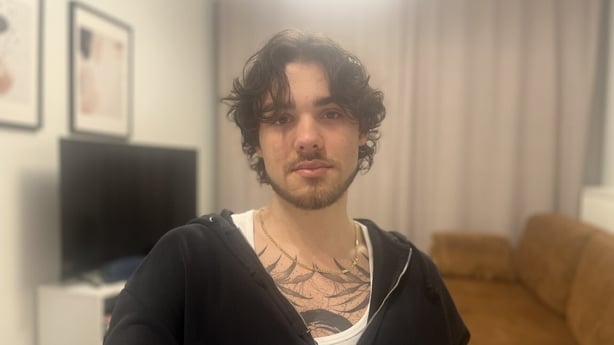
"If the government did not give me the chance to leave, I would probably not have considered it and I would keep living there," said Vadym, a 22-year-old from Chernihiv.
He arrived in Warsaw in early December and quickly found work with a Ukrainian logistics firm operating in Poland.
"As for returning to Ukraine, in my view, not now and not anytime soon after the war ends," said Vadym.
"Now I can only think about what lies beyond its borders".
"I'd like to build my future life here. Maybe I’ll return to Ukraine, but it’s hard to tell for now"
Asked if he feared being drafted, he said "of course, I don't want to be there," before adding that he knew people who were killed in the war.
"The war affected everyone in its own way. There’s not a single person that hasn’t been affected by it," he added.
In Poznan, 21-year-old Kyiv graphic student Maksym arrived into Poland in early January. His plan was to find work and continue his studies in Poland.
"I want to live in safety and Poland is economically convenient for me.
"I’d like to build my future life here. Maybe I’ll return to Ukraine, but it’s hard to tell for now," he said.
He was also worried about being drafted into the military if he stayed in Ukraine after the age of 25.
"I don’t really want to fight, unfortunately," he added.
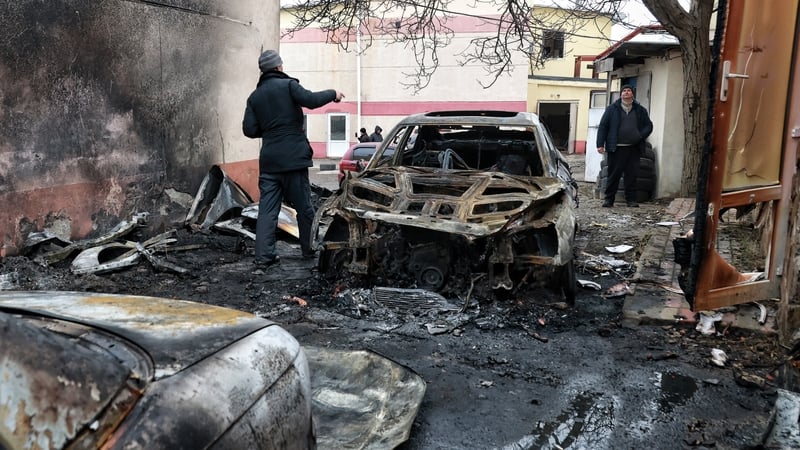
Four years of war and increasing missile attacks on their cities was cited by those I interviewed as one of the main reasons for leaving Ukraine.
"The missile attacks increase. It's not good [for] me, it’s not good for other people, they’re depressed," said Vania, a 22-year-old cyber security graduate, originally from occupied Lugansk in eastern Ukraine.
"When you’re reading the news, all the time you see how much people die, or something like that. [It’s] not good," he added.
Vania moved to Sweden in September and after three months living at a refugee camp in the north of the country, he is now living in a studio flat in a town near Stockholm. His immediate plan is to find a job.
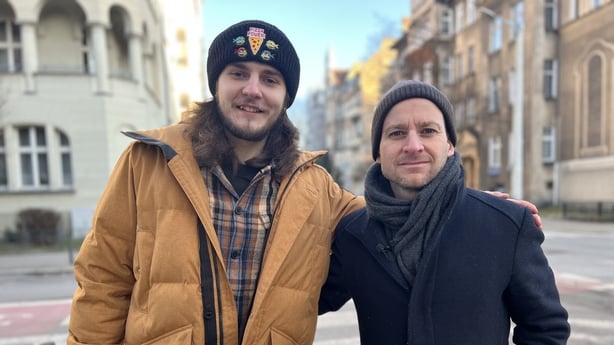
Last autumn, when it became clear that the number of young Ukrainian men arriving in Poland or Germany had increased substantially since the exit rules were eased, politicians on the right and far-right in both countries criticised Ukraine’s government for not keeping its young men at home during a time of war.
Bavarian Prime Minister Markus Söder called on Kyiv to restrict the number of young men leaving Ukraine.
"It helps no one if more and more young Ukrainian men come to Germany instead of defending their homeland," he said.
Yet it is hard to blame this cohort of young men for wanting to experience the norms of adolescence before they may one day have to return home and face an inevitable draft notice when they are 25.
Close to one million people currently serve in Ukraine’s armed forces with about 300,000 deployed on the frontlines.
As part of any peace settlement, Ukraine maintains that its armed forces must reach the level of 800,000 personnel.
Defence experts believe that attaining that figure is achievable but Ukraine’s armed forces, like the country more broadly, faces a demographic problem.
Many units are comprised of men in their 30s and 40s.
"Ukraine has been facing certain demographic problems for years now," says Marcin Jedrysiak, a Ukraine specialist at the Centre for Eastern Studies in Warsaw.
"This is especially problematic when it comes to young people and the generation of say, 20-year-olds," he added, pointing out that Ukraine’s birth rate dropped to a low point between 1996 and 2006.
"I can definitely see my future life in Ukraine. I really want to return there"
Ukraine’s population has fallen from about 51 million in the early 1990s to anywhere between 28m-35m today - a decline that was rapidly accelerated by Russia’s full-scale invasion four years ago.
Mr Jedrysiak believes that post-war Ukraine may face "serious social divisions" between those who stayed in Ukraine during the war and returnees who left during the war years.
Still, the draw of home remains strong for those who left Ukraine earlier in the war.
Vania, a 20-year-old from Dnipro, arrived in Poland with his mother almost four years ago following Russia’s full-scale invasion.
He has spent the past four years studying and working in Warsaw and now thinks daily about returning to his home city.
"I can definitely see my future life in Ukraine. I really want to return there," he tells me at a café in central Warsaw.
"As soon as the war ends, I’ll go back there instantly. I’m even considering returning there during the war. Because I really miss my city and everything we have there," he added.