
Nationwide explores the links between Ireland and the Choctaw Nation of Native Americans, which have flourished in recent years.
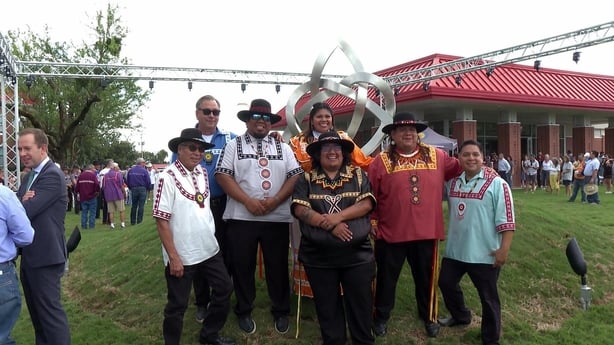
The monument of Indian feathers in Midleton, Co Cork, stands as a tribute to the generosity of the Choctaws, who sent financial aid to Ireland during the Great Famine. A similar monument featuring both Celtic and Choctaw designs was unveiled in the Choctaw homeland in Oklahoma.
RTÉ’s Washington Correspondent Sean Whelan attended the unveiling and has been finding out about the Choctaw people and their lives in the United States today, including one of their traditional sports, stickball, which has similarities to hurling.
There are lots of reasons to visit the Choctaw Nation of Oklahoma, but for me, the main reason was the stickball.
I wasn't disappointed.
"This game is our identity," said Ace Greenwood, coach and cultural custodian of stickball in Oklahoma.
"It's who we are."
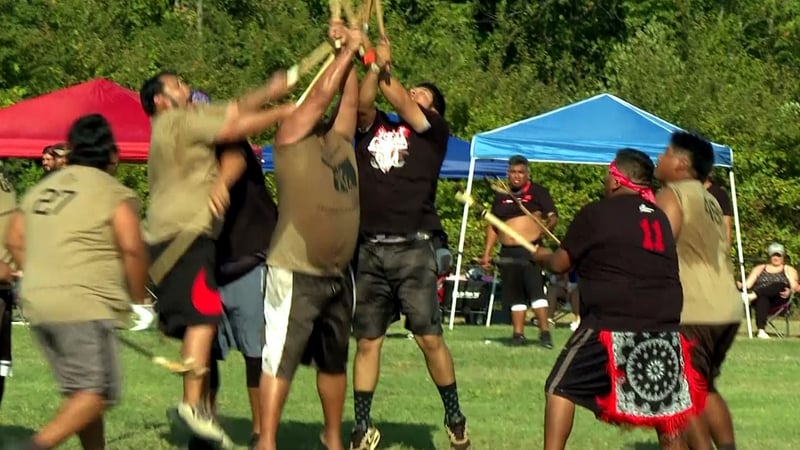
In front of us 60 men, carrying 120 sticks between them - one in each hand - propelled a small rubber ball between the two solitary poles at either end of the field.
Few prisoners were taken in the contest to score.
"You know it was actually illegal for us to play it at one point," said Ace.
I was hooked. Tell me more.
The big tournament of this ancient sport is played on the Labor Day festival the Choctaw nation organises each year, a large gathering at the tribal capital at Tuskahoma, a very small settlement in the middle of the Choctaw lands in south eastern Oklahoma.
Tribal members come from all over the state and further afield to be there.
Fly to Texas and it's an hour-and-a-half drive north from Dallas to Durant, the main town of the Choctaw territory, and home to its administration, cultural centre, university and biggest business - a casino and leisure resort.
But Tuskahoma, a good hour-and-a-half deeper into the rural heartland of the Choctaw territory, is the political centre, where the tribal council meets to make laws and policies. And hold the Labor Day festival – like a country fair, bringing together the 220,000 strong Choctaw Nation of Oklahoma, the third biggest Native American tribe in the US.
Its a population similar to Co Limerick.
They like their hurling in Limerick, just as the Choctaw like their Ishtaboli - stickball in English.
Like the name suggests, it's a stick and ball game - with a reputation for full-on intensity that would draw in any hurling fan.
Stick and ball games were common across Native American culture in what is now the US and Canada.
In the north east, the game was played with one stick with a net on the end.
Europeans codified it into lacrosse, adding in helmets and pads.
In the south east the game was played with two shorter sticks with smaller "cups" with leather lacing to catch the ball in.
This version of the game, played by Cherokee, Chickasaw, Creek, Seminole and Choctaw nations, was not taken up by the European settlers - which probably makes it the more authentic version of the ancient American sports.
No helmets, no pads.
Regional variations
Each of the nations in the south east has its own variant, so big tournaments involve some compromises in the rules, a bit like the Gaelic Football/Aussie Rules series.
Which, as we know, doesn't lessen the intensity.
In the Choctaw version of the game we saw, it was 30-a-side, overseen by a dozen referees, and played on a pitch similar to a GAA field.
At each end was a single, stout post about 4m tall.
Scoring was achieved by hitting the post with the small rubber ball - bigger than a squash ball, smaller than a tennis ball.
There is not much midfield action, most of the play involved a swarm of players, each holding two sticks, defending and attacking the posts.
In the good old days they used to attack each other as well.
Kapucha toli is a Choctaw term for the sport, translated to English as "little brother of war".
It recalls the early role of the game as a way of settling disputes within villages or within the larger tribal structure, a physical contest that was less than lethal.
The idea carried over into diplomatic concerns between different tribes, instead of waging war on each other, they played stickball to decide issues.
Games could last for days, there were few limits on player numbers, refereeing was apparently quite "flexible".
The young men of the tribe got to practice warfare, learn teamwork and keep fit, and live to tell the tale.
Missionary accounts
Europeans got their first written account of Choctaw stickball from a Jesuit missionary in 1729.
The Smithsonian museum in Washington DC has 19th century paintings of the game, in which US anthropologist James Moloney declared towards the end of that century "almost everything short of murder is allowable".
All was fine until the early 1900s when a particularly intense stickball game between the Choctaw and Chickasaw ended in a riot-like brawl involving some 300 spectators.
US Marshals and the Choctaw’s own police force, the Lighthorsemen, had to intervene.
The game was virtually suppressed after that, up until the mid-1970s, when the Choctaw Nation of Oklahoma began to revitalise it, part of a wider cultural and economic renaissance of the tribe.
As luck would have it, when we started filming for Nationwide, the Choctaw were playing the Chickasaw in the big match of the day.
It was indeed a full-on encounter, but like hurling's revival, the game has seen a lot more rules introduced.
In the modern day version, what's allowable stops a long way short of murder.
Which no doubt helps to account for the growing popularity of the sport.
There is now a women's division, and there are youth teams, adding a truly American sport to the usual US sports of baseball, basketball and American football in the local schools.
There is even a Choctaw World Series hosted by the Mississippi Band of Choctaw Indians at their annual fair.
While drummers pounded out a continuous beat, and the players battled each other and the sweltering heat, we asked around for an expert to talk us through the game.
They all pointed to Ace Greenwood, the coach of the Chickasaw team and a legend among stickball aficionados.
"We have always played this game: God gave us this game. So we still hold on to it, because it's who we are. It's something that we fought for, held on to all these years. So yes, we're going to continue playing," he said, explaining the cultural significance of the sport.
Once you know what you are looking at, the Kapucha pop up all around the Choctaw lands.
The two stickball sticks, made of hickory or other hardwoods, the ends thinned and shaped into a "cup", with leather netting strung between the sides to catch the ball, or Towa.
They have become a new icon for this nation, adorning tribal offices, artworks and signage, part of a cultural revival surfing on an economic and political revival of fortunes of the Choctaw in 21st century America.
"This is a prime example of us never giving up our ways, never giving up our culture," said Ace. "We're still standing, you know."
'Trail of tears'
Forced from their ancestral lands in what is now Louisiana, Mississippi and Alabama, by the federal government in the 1830s, the Choctaw, a tribe of farmers, endured the "trail of tears", pitching up with other displaced tribes in what was later to become the State of Oklahoma.
The traumatic event changed much in the tribal cultures, including the game.
"The game has changed. It's adjusted," said Ace. "Once we came here to Oklahoma, we made pacts that we're not going to fight against each other anymore, that we're not going to go to war with each other anymore.
"We would play this game to settle disputes. And so whenever they played that game, when the game was won and decided, the decision was decided as well. And so the losing team took their loss, you know - warriored up, took their loss, walked off the field. But the whole point of it was so that everybody could walk off the field."
In that context, what I was looking at was the domesticated, house-trained version of the game: played for bragging rights, not matters of state. Still, it was pretty feisty.
"What we've got out here are actually two different tribes. This is the Choctaw tribe and the Chickasaw tribe playing against each other. So there's a lot of pride in this game alone, you know?
"So it's going to be a good hard-fought game. But still, you know, we're neighbours. When the game is over, when it's all said and done, we're gonna pick each other up off this field, and walk off together," Ace said.
Which they did, their home side squeezing out a win, the teams lining up to fist-bump each other before clearing the field for two women's teams.
I asked Ace if the sport was an easy sell to Native American youth, who are as beset by the distractions of online life as any other teenagers.
"It's a pretty easy sell", he said. "They love the aggression, the skill that it takes to play this game. You know, fathers are playing it. So sons, they want to play it as well. Mothers are playing it.
"So, you know, the children want to play it as well. So we start them out maybe about seven years old. And then once they get into about 13, they go to like a teen division, and then once they turn 18, they go into adult division and play like this here. And so then, as old as they get, that's how far they'll play."
True enough, a few of the players had seen better days, but with age comes guile, and good field position and a keen eye still counts for a lot in this game.
Besides, big guys are harder to put on the deck. It doesn't stop the fast, fitter youngsters from trying.
But its hard to walk away from a sport with special cultural meaning. Hard to give up on a game with such deep historical roots.
Like Ace said, it's what they are. And hopefully always will be.
Tonight, on Nationwide at 7 pm, the historic links between Ireland and the Choctaw Nation of Oklahoma are explored, including the Choctaw-Ireland Scholarship at University College Cork, honouring the Choctaw Nation’s generosity during the Great Famine. The programme also looks at traditional Choctaw stickball, modern tribal enterprises such as drone technology and gaming, and everyday life in the Choctaw community today.