For every road death in Ireland last year, there were almost eight serious injuries, and those injured often face complex recoveries and disabilities that could last a lifetime.
A Co Meath man who lost an arm and leg in a crash in 2018 said he is an example of the life-long impact of drink-driving.
James Murtagh was injured in the single vehicle crash near Navan and is currently an inpatient at the National Rehabilitation Hospital (NRH) in Dún Laoghaire in Dublin.
Garda figures show that for every road death in Ireland last year, there were almost eight serious injuries. There were 190 deaths and 1,518 serious injuries as a result of road crashes in 2024.
"I nearly lost my life," said Mr Murtagh, speaking about drink-driving.
"I'd highly advise people not to be doing that. You see the damage that it can do to you, what it does to your family, it will make you realise how stupid you’d be."
"I shouldn't even be sitting here"
The injuries he sustained were not immediately noticeable to him as he could not sit up in hospital and could not remember the crash, he said.
"I shut everybody out for a couple of days, just to get my own head around it. I cried for two or three days straight," said Mr Murtagh.
He added: "It took a toll on me... Once I realised I was going to live, anything else that came after that was just a bonus. I'm on bonus time.
"I shouldn't even be sitting here."
Only the most serious injuries from road crashes are brought to the NRH, with road crashes making up 8% of all admissions.
Almost half of these admissions are in the 17-35 age group, and the vast majority are male.
Over half (56%) of all NRH admissions for road traffic injuries are for a brain injury. A quarter are for spinal cord injuries, and 9% are to rehabilitate after limb loss.
We need your consent to load this flourish contentWe use flourish to manage extra content that can set cookies on your device and collect data about your activity. Please review their details and accept them to load the content.Manage Preferences
Many of the cases are complex and require support from multiple hospital programmes, said Dr Cara McDonagh, consultant in rehabilitation medicine and medical director of the spinal cord system of care at the NRH.
"Only about 10% of the people who are admitted here will return to work following a road traffic accident.
"That just shows how devastating these injuries can be to people's livelihoods," she said.
Mr Murtagh was first admitted to the NRH in 2019, having first spent over half a year in Beaumont Hospital in Dublin.
His initial stay at the NRH was two months.
"I had a young child. It was too hard being away from her during the week. I already missed out on so much of her life being in hospital for that many months, so I left earlier than I should have," he said.
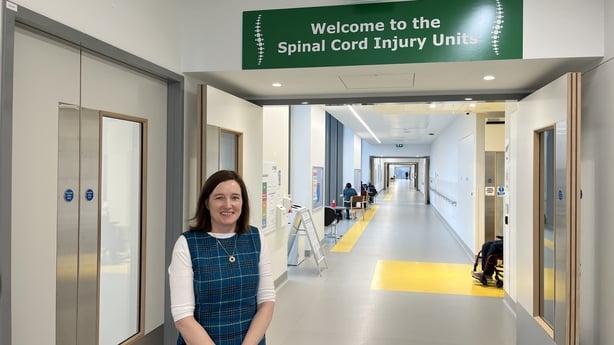
Most patients at the NRH have a life-long association with the hospital, and Mr Murtagh was re-admitted recently for prosthesis adjustment and pain management.
He now has two children and said that they are his motivation to continue his rehabilitation.
"They're able to get away from me when I'm in the wheelchair so now that I'm getting up on the legs, they won't be running away too far. Only for them I wouldn't be sitting here. They're the reason I have a reason to live."
'I realised immediately that I was paralysed'
Yanna Hartin was 18 years old when she was paralysed from the waist down in a crash.
She was a passenger in a single-vehicle crash while on her way to work in 2023. Her back was broken in the crash and her spinal cord was severely damaged.
"I realised immediately that I was paralysed," she said. "I was trying to move my toes and I couldn't. I was tapping on my leg and I couldn’t feel it."
She said that for her, the panic did not set in until she was tasked with learning wheelchair skills.
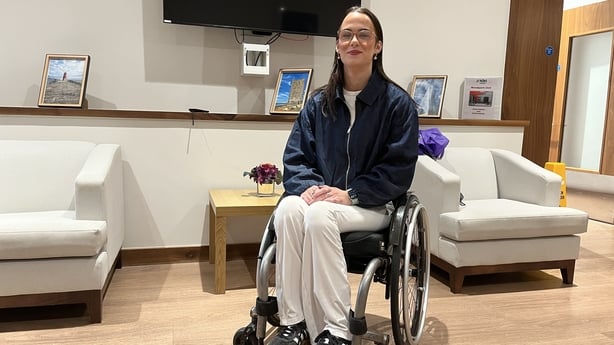
"I very quickly came to the realisation that it is going to be my life anyway. I'm going to have to get on with it. So yes you can be upset and panic, but you're going to have to get on with it eventually," said Ms Hartin.
On top of learning how to transfer and move in her wheelchair, she had to relearn tasks important to a teenage girl.
"I remember looking at my occupational therapist and saying, 'I need to be able to shave my legs and tan'.
"She laughed, but that was my reality. I was 18. I was a young girl. This is what was important to me," she said.
She spent nine months in the NRH and is now studying in Dublin City University, is back driving and has recently joined the Paralympic swimming team.
"I am very proud of myself. I have come a long way and put in so much effort to have the independence and freedom that I have. I'm a quadruplet, so they're at the same place in your life, so I'm not going to be left behind," she said.
There was no drink-driving or "foul play" involved in the crash, she said, adding that it is impossible to know what is coming next.
"You can't control other people on the road. You have to be so aware and so careful. If you go out and you're drinking or on your phone - doing things you shouldn't be doing - you have made that choice for your life.
"If you hit somebody, they have not made that choice," she said.
We need your consent to load this rte-player contentWe use rte-player to manage extra content that can set cookies on your device and collect data about your activity. Please review their details and accept them to load the content.Manage Preferences