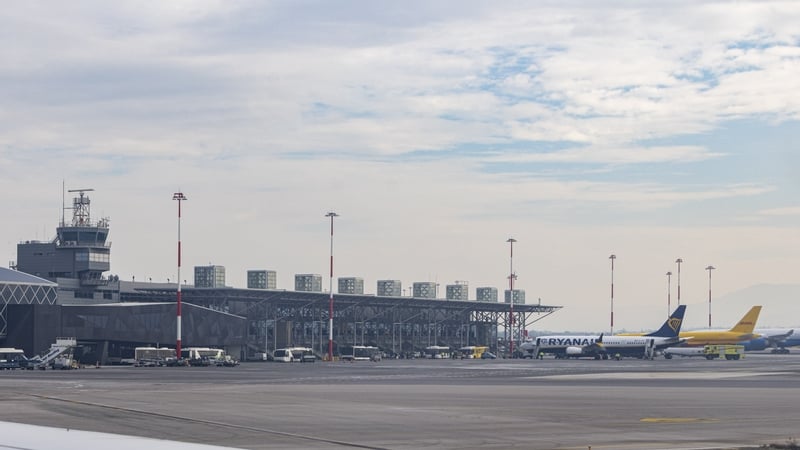

Minister for Transport Darragh O'Brien has said he is "paying close attention" to staffing issues with air traffic controllers that have led to Ireland's airspace being affected, with runways closed intermittently at Dublin and Cork airports.
AirNav Ireland, which is responsible for Irish air traffic control, said the restrictions at Cork Airport were in place between midnight and 7am on 11 February, which led to disruption to normal flight schedules.
Some flights had to be diverted or were delayed.
AirNav Ireland said it had "temporarily restricted the flow of arriving and departing flights at Cork Airport to ensure safety was fully maintained" due to "short-notice sick leave overnight".
Daa, the operator of Dublin and Cork airports, said departures and arrivals at Dublin Airport have been impacted "at times over a number of weeks" and that the most recent was Friday night when airspace was closed for two 30-minute periods at 2am and 4am.
In a statement to RTÉ News, Minister O'Brien said his department's "primary focus is on ensuring the smooth operation of our airports and minimising disruption to passengers".
He said the priority for AirNav is the safe operation of Irish airspace and that it is "currently engaging with Fórsa on issues such as staffing levels through the company's internal dispute resolution board mechanism".
The minister said it would be inappropriate to comment further while that engagement is under way.
Talks between the Fórsa union and AirNav Ireland will continue after an agreement was reached on proposals at a meeting yesterday.
In a statement, AirNav Ireland said it has been informed by the Internal Disputes Resolution Board that Fórsa agreed to proposals presented to both parties and that talks are expected to continue next week.
In a statement, Fórsa said "it continues to focus on a negotiated solution to the current challenges, and can confirm a positive engagement with AirNav on Friday."
It said it is aware there is a very high global demand for air traffic controllers which has created capacity challenges for Irish air traffic control.
Fórsa said the challenge of retaining personnel has led to an over-reliance on overtime to fill any gaps in service and that the union is continuing its engagement with AirNav under the auspices of the Internal Dispute Resolution Board.
Not enough air traffic controllers across Europe
Eoghan Corry, editor of Travel Extra, said there are not enough air traffic controllers across Europe and this will likely cause disruption this summer.
"It's going to be really difficult summer with about 20% shortage of air traffic controllers and if it continues until summer we are looking at trouble," he said.
Mr Corry said the recruitment of so-called ATCs did not phase up to the right level post-pandemic and has not accelerated as it should have across Europe.
"We need graduates to be arriving at air traffic control in much larger numbers," he said.
He said although there is an active recruitment campaign, and that it is a very well paid job, there does seem to be a difficulty in converting that onto the workspace with the speed of which they are required.
Mr Corry said it is very important to ensure Ireland has enough air traffic controllers because Irish ATCs spend most of their time handling the air traffic that passes over the airspace as "we are on the major gateway of the busiest transcontinental routes in the world between Europe and North America."
He believes the issue of low staffing in air traffic control across France and Germany is likely to cause problems throughout the holiday period this summer.
"We have shortages in two or three airspaces that are prone to them across the south of France and south of Germany," he said.
"We have pretty belligerent unions mainly in France, three of them competing in terms of militancy.
"It is likely they will pick the key dates in July and August to call strikes," Mr Corry added.
He advised people booking holidays that if a strike is called, it is not their fault and that the airline must help.