


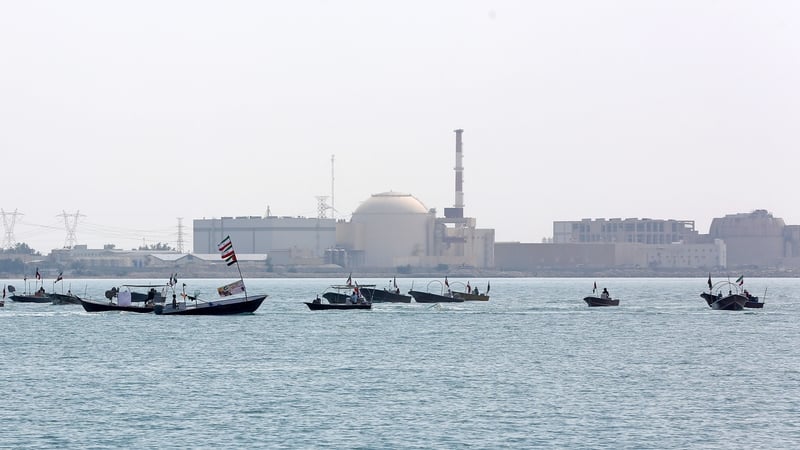
Israeli Prime Minister Benjamin Netanyahu said that any deal between the United States and Iran must involve the removal of all enriched uranium from Iran as well as Tehran's ability to enrich more.
His comments came as Iran's Foreign Minister Abbas Araghchi headed to Switzerland for the second round of renewed nuclear talks with the United States later this week.
At a speech in Jerusalem, Mr Netanyahu said any agreement must include several elements.
"The first is that all enriched material has to leave Iran," he said.
"The second is that there should be no enrichment capability... dismantle the equipment and the infrastructure that allows you to enrich in the first place".
The third, he said, was resolving the issue of ballistic missiles.
Considerable uncertainty surrounds the fate of Iran's stockpile of more than 400 kilogrammes of 60% enriched uranium that was last seen by nuclear watchdog inspectors in June, before Israeli and US strikes against Iranian nuclear sites.
Addressing a conference of presidents of major American Jewish organisations, Mr Netanyahu said he had insisted on these conditions even during his talk with US President Donald Trump earlier this month.
He also called for sustained inspections of Tehran's nuclear programme.
"There has to be real inspection, substantive inspections, no lead-time inspections, but effective inspections for all of the above," he said.
"These are the elements that we believe are important for the achievement of the deal."
Tehran and Washington restarted nuclear negotiations in Muscat on 6 February, months after previous talks collapsed when Israel launched an unprecedented bombing campaign against Iran last June that started a 12-day war.
The latest talks came with the US having threatened Iran with military action and deployed an aircraft carrier group to the region following Iran's deadly crackdown on anti-government protests last month.
Earlier, the exiled son of Iran's last shah said he is ready to lead the country to a "secular democratic future" at a rally in Munich.
Son of Iran's last shah urges US action at Munich rally
US-based Reza Pahlavi, who has not returned to Iran since before the 1979 Islamic revolution that ousted the monarchy, told the crowd of around 200,000 people of his supporters that he could lead a transition.
"I am here to guarantee a transition to a secular democratic future," he said.
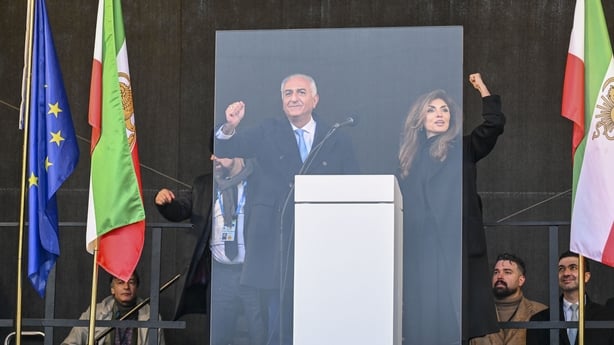
"I am committed to be the leader of transition for you so we can one day have the final opportunity to decide the fate of our country through a democratic, transparent process to the ballot box," Mr Pahlavi said.
"Javid shah (long live the shah)," the crowd chanted as they waved green-white-and-red flags with a lion and a sun, the emblem of the toppled monarchy.
"The Iranian regime is a dead regime," a 62-year-old protester originally from Iran who gave his name only as Said told AFP. "It must be game over."
Mr Pahlavi has urged Iranians at home and abroad to continue demonstrating, calling on them to chant slogans from their homes and rooftops this afternoon, to coincide with protests in Germany and elsewhere.
Thousands of protesters in various demonstrations from downtown Los Angeles to the National Mall in Washington marched in solidarity with anti-government protests in Iran.
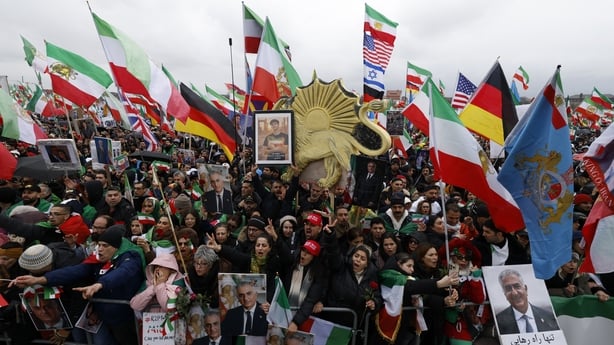
"Trump act now!" demonstrators chanted in Toronto.
When Iran began its crackdown, Mr Trump initially said the United States was "locked and loaded" to help demonstrators.
But he has more recently focused his military threats on Iran's nuclear programme, which US forces struck last June during Israel's unprecedented 12-day war with Iran.
Representatives of Iran and the United States, which have had no diplomatic relations since shortly after the 1979 revolution, held talks on the nuclear programme last week in Oman.
A Swiss foreign ministry spokesman said that Oman would host talks in Geneva next week, without providing further details.
Videos verified by AFP showed people in Iran this week chanting anti-government slogans despite the ongoing crackdown, as the clerical leadership celebrated the anniversary of the Islamic revolution.
According to US-based Human Rights Activists News Agency, at least 7,010 people, mostly protesters, were killed in the crackdown, though they and other rights groups warn the toll is likely far higher.
More than 53,845 people have been arrested, it added.
Mr Pahlavi had encouraged Iranians to join the wave of protests, which Iranian authorities have said were hijacked by "terrorists" fuelled by their sworn enemies, the United States and Israel.
Many protest chants had called for the monarchy's return, and Mr Pahlavi, 65, has said he is ready to lead a democratic transition.
The Iranian opposition remains divided and Mr Pahlavi has faced criticism for his support for Israel, making a highly publicised visit in 2023 that fractured an attempt to unify opposition camps. He has also never distanced himself from his father's autocratic rule.
